


Gunmen killed a leading Gulf Cartel commander who was sought by the US and believed to be behind a split with a rival crime organization that intensified Mexico’s drug violence, authorities said on Friday.
Samuel Flores Borrego, also know as “el Metro 3,” was shot dead near Reynosa, across the border from McAllen, Texas, in what appeared to be an attack by members of his own cartel, the Mexican Attorney General’s Office said in a statement. He was found on Friday inside a vehicle along with the body of a police officer.
Flores, 39, is believed to be responsible for the killing of a Zetas member in January last year that led to a rupture between the former allies, US anti-drug officials have said. The Zetas started as a gang of hit men for the Gulf Cartel, but after the split formed their own cartel, and fighting between the groups over territory and drug turf has caused violence to soar in parts of Mexico.
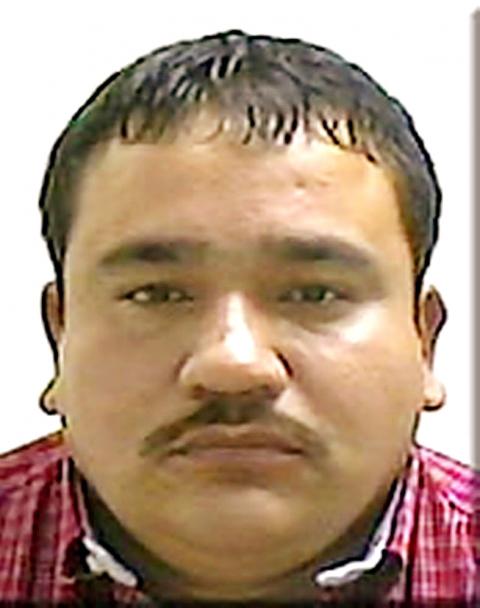
PHOTO: EPA
The US government had a reward of up to US$5 million for the capture of Flores, who faced drug-trafficking charges north of the border, according to an indictment in the District of Columbia last year.
Of the 20 people charged in the US indictment, eight remain fugitives, including Zetas leader Heriberto Lazcano and Gulf Cartel leader Jorge Eduardo Costilla.
The indictment says Flores was the Gulf Cartel’s chief in the border cities of Reynosa and Miguel Aleman and gathered information on police and security forces.
The Zetas used to operate as the military arm of the Gulf Cartel. The indictment chronicles how the two gangs worked together under the name “The Company,” with Flores calling and meeting with the Zetas leader to plan cocaine and marijuana smuggling operations from Colombia.
The alliance crumbled in January last year, when a member of the Zetas was slain in Reynosa apparently by Flores, leader of the border city’s “plaza” or shipping corridors, and a group of men. The killing led to fierce war between the two gangs, mostly in northern Mexico and Mexico’s Gulf coast.
The Mexican government has cracked down on the Zetas, arresting dozens of alleged members this year. Mexican marines killed leader Antonio Ezequiel Cardenas Guillen, also known as “Tony Tormenta” or “Tony the Storm,” in November last year.
Mexican President Felipe Calderon acknowledged on Friday in his state-of-the-nation speech that violence “worsened with the rupture between the Gulf Cartel and the Zetas.”
More than 35,000 people have been killed in Mexico since Calderon deployed federal police and troops to some regions in December 2006 to fight drug traffickers. Other groups put the death toll at 40,000.
The war between the Zetas and the Gulf Cartel is blamed for some of the country’s worst crimes, including the April discovery of 193 bodies in mass graves in the town of San Fernando near the US border. The government blamed the Zetas for last week’s casino arson in the industrial city of Monterrey that killed 52 people, mostly women who met with friends to gamble.
Meanwhile, in a central Mexican state, police arrested 31 suspected drug cartel members, including 16 police officers who allegedly were paid to protect the Zetas gang.
Hidalgo State police chief Damian Canales said the arrests began when police arrested three alleged robbers earlier this week carrying about 30 yellow envelopes stuffed with a total of 100,000 pesos (US$8,100). Canales said it was the cartel payroll and some of the envelopes were marked with the names of police officers.
Hidalgo is the home state of alleged Zetas leader Heriberto Lazcano Lazcano and a transit point for drugs. Hidalgo authorities in May arrested a police chief, commanding officers and agents suspected of helping the Zetas.
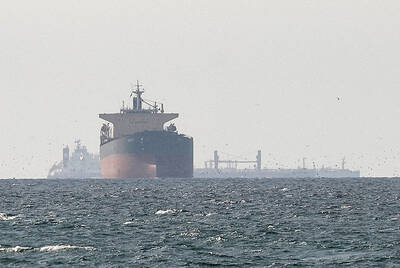
A ship that appears to be taking on the identity of a scrapped gas carrier exited the Strait of Hormuz on Friday, showing how strategies to get through the waterway are evolving as the Middle East war progresses. The vessel identifying as liquefied natural gas (LNG) carrier Jamal left the Strait on Friday morning, ship-tracking data show. However, the same tanker was also recorded as having beached at an Indian demolition yard in October last year, where it is being broken up, according to market participants and port agent’s reports. The ship claiming to be Jamal is likely a zombie vessel that

Japan is to downgrade its description of ties with China from “one of its most important” in an annual diplomatic report, according to a draft reviewed by Reuters, as relations with Beijing worsen. This year’s Diplomatic Bluebook, which Japanese Prime Minister Sanae Takaichi’s government is expected to approve next month, would instead describe China as an important neighbor and the relationship as “strategic” and “mutually beneficial.” The draft cites a series of confrontations with Beijing over the past year, including export controls on rare earths, radar lock-ons targeting Japanese military aircraft and increased pressure around Taiwan. The shift in tone underscores a deterioration

LAW CONSTRAINTS: The US has been pressing allies to send warships to open the Strait, but Tokyo’s military actions are limited under its postwar pacifist constitution Japan could consider deploying its military for minesweeping in the Strait of Hormuz if a ceasefire is reached in the war on Iran, Japanese Minister of Foreign Affairs Toshimitsu Motegi said yesterday. “If there were to be a complete ceasefire, hypothetically speaking, then things like minesweeping could come up,” Motegi said. “This is purely hypothetical, but if a ceasefire were established and naval mines were creating an obstacle, then I think that would be something to consider.” Japan’s military actions are limited under its postwar pacifist constitution, but 2015 security legislation allows Tokyo to use its Self-Defense Forces overseas if an attack,

German Chancellor Friedrich Merz’s conservative Christian Democratic Union (CDU) yesterday faced a regional election battle in Rhineland-Palatinate, now held by the center-left Social Democratic Party (SPD). Merz’s CDU has enjoyed a narrow poll lead over the SPD — their coalition partners at the national level — who have ruled the mid-sized state for 35 years. Polling third is the far-right Alternative for Germany (AfD), which spells a greater threat to the two centrist parties in several state elections in September in the country’s ex-communist east. The picturesque state of Rhineland-Palatinate, bordering France, Belgium and Luxembourg and with a population of about 4 million,


 RSS
RSS