


Lebanon yesterday braced for a possible backlash after a UN-backed tribunal issued an indictment in the 2005 murder of former prime minister Rafiq Hariri in which four Hezbollah members were named.
Lebanese Interior Minister Marwan Charbel confirmed the names of the men charged by the Netherlands-based Special Tribunal for Lebanon (STL) and said efforts would begin to arrest them.
He said Lebanese Prosecutor General Said Mirza had given him the arrest warrants early yesterday for Mustafa Badreddine, Salim Ayyash, Assad Sabra and Hussein Anaissi. Their whereabouts are unknown.
Badreddine is the brother-in-law of top Hezbollah operative Imad Mughniyeh, who died in a 2008 bombing in Damascus.
He is suspected of having masterminded the Feb. 14, 2005 seaside bombing that killed Hariri and 22 others.
Ayyash, another senior party official who holds US citizenship, allegedly carried out the attack.
Sabra and Anaissi allegedly coordinated with Ahmad Abu Adas, a Palestinian who contacted al-Jazeera television following the Hariri assassination to claim responsibility for the bombing.
Charbel said a meeting among all concerned security services was planned for today to coordinate search operations for the suspects.
“We have to address this issue calmly and wisely to preserve the civil peace,” he said. “If the situation explodes, everyone loses.”
He added that there were between 15,000 and 20,000 outstanding arrest warrants in Lebanon.
Hassan Nasrallah, leader of the Shiite militant party, is set to make a televised address today that will mark his first reaction to the indictment that has triggered fears of sectarian unrest in the volatile country.
Hezbollah, blacklisted as a terrorist organization by Washington, has repeatedly warned that it would not sit idle should any of its militants be accused of Hariri’s assassination.
All eyes are on how Lebanese Prime Minister Najib Mikati’s new government, dominated by Hezbollah and its allies, will respond to the indictment and whether it will continue cooperating with the tribunal.
Hariri’s son and political heir, former Lebanese prime minister Saad Hariri, has hailed the indictment as a “historic” moment for Lebanon, while his ally, the US, said the move was “an important step towards justice and ending impunity for political assassinations in Lebanon.”
The Iranian and Syrian-backed party Hezbollah, the most powerful political and military force in Lebanon, engineered the collapse of Saad Hariri’s Western-backed unity government in January after he refused to end cooperation with the tribunal. Mikati, his successor, was appointed with the blessing of Hezbollah.
In an ambiguously worded policy statement on Thursday, he said Lebanon would respect international resolutions as long as they did not threaten the civil peace.
The opposition “March 14” coalition headed by Saad Hariri said this was a clear sign Mikati’s government would not abide by its international obligations.
Lebanon has 30 days to serve out the STL arrest warrants. If the suspects are not arrested within that period, the tribunal can then publicly call on them to surrender.
The STL, set up in The Hague in 2009 by the UN, is the first international court with jurisdiction to try an act of terrorism.
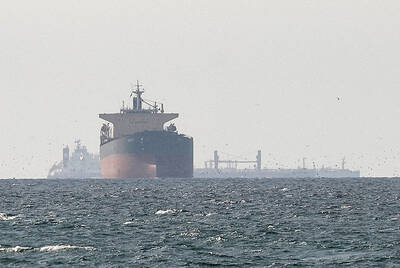
A ship that appears to be taking on the identity of a scrapped gas carrier exited the Strait of Hormuz on Friday, showing how strategies to get through the waterway are evolving as the Middle East war progresses. The vessel identifying as liquefied natural gas (LNG) carrier Jamal left the Strait on Friday morning, ship-tracking data show. However, the same tanker was also recorded as having beached at an Indian demolition yard in October last year, where it is being broken up, according to market participants and port agent’s reports. The ship claiming to be Jamal is likely a zombie vessel that
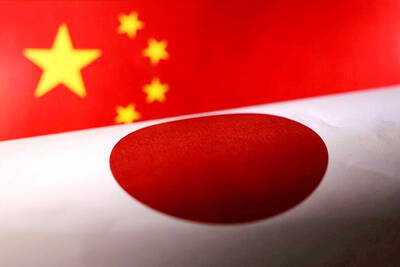
Japan is to downgrade its description of ties with China from “one of its most important” in an annual diplomatic report, according to a draft reviewed by Reuters, as relations with Beijing worsen. This year’s Diplomatic Bluebook, which Japanese Prime Minister Sanae Takaichi’s government is expected to approve next month, would instead describe China as an important neighbor and the relationship as “strategic” and “mutually beneficial.” The draft cites a series of confrontations with Beijing over the past year, including export controls on rare earths, radar lock-ons targeting Japanese military aircraft and increased pressure around Taiwan. The shift in tone underscores a deterioration
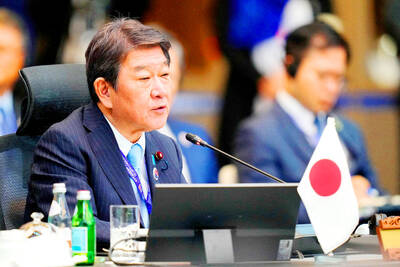
LAW CONSTRAINTS: The US has been pressing allies to send warships to open the Strait, but Tokyo’s military actions are limited under its postwar pacifist constitution Japan could consider deploying its military for minesweeping in the Strait of Hormuz if a ceasefire is reached in the war on Iran, Japanese Minister of Foreign Affairs Toshimitsu Motegi said yesterday. “If there were to be a complete ceasefire, hypothetically speaking, then things like minesweeping could come up,” Motegi said. “This is purely hypothetical, but if a ceasefire were established and naval mines were creating an obstacle, then I think that would be something to consider.” Japan’s military actions are limited under its postwar pacifist constitution, but 2015 security legislation allows Tokyo to use its Self-Defense Forces overseas if an attack,

German Chancellor Friedrich Merz’s conservative Christian Democratic Union (CDU) yesterday faced a regional election battle in Rhineland-Palatinate, now held by the center-left Social Democratic Party (SPD). Merz’s CDU has enjoyed a narrow poll lead over the SPD — their coalition partners at the national level — who have ruled the mid-sized state for 35 years. Polling third is the far-right Alternative for Germany (AfD), which spells a greater threat to the two centrist parties in several state elections in September in the country’s ex-communist east. The picturesque state of Rhineland-Palatinate, bordering France, Belgium and Luxembourg and with a population of about 4 million,


 RSS
RSS