


Scientists have found “significant abnormalities” in the brains of people addicted to cocaine, which could help explain some of the compulsive behavior associated with using the drug. It may also hint at why some people are more prone to addiction.
Brain scans revealed that cocaine users had a “dramatic decrease in gray matter” in their frontal lobes, researchers said, which affected key functions, including decisionmaking, memory and attention.
Karen Ersche of the Behavioural and Clinical Neuroscience Institute at the University of Cambridge, who led the latest work, found the longer a person had been using cocaine, the poorer their attention was and the more compulsively they used the drug.
“That is the hallmark of cocaine dependence — namely, that most of them are intelligent people who go to great extents to buy cocaine, to get more cocaine, to put their jobs at risk, their families at risk,” Ersche said.
The results were published in the journal Brain. Ersche and her team scanned the brains of 60 people who were dependent on cocaine and compared them to scans of 60 people without any history of drug-taking.
“We found significant abnormalities in the brains of the cocaine users,” she said.
Specifically, the amount of gray matter in the orbitofrontal cortex was reduced in people with cocaine addiction, an area involved in decisionmaking and goal-directed behavior.
Other affected areas included the insula, an area of the brain involved in feedback processing, learning and feelings of cravings. The gray matter in the anterior cingulate, involved in emotional processing and being attentive, was also reduced.
In contrast, a region deep in the brain associated with reward processing, attention and motor movements — the chordate nucleus — was enlarged in subjects who were addicted to the drug. This could explain why those subjects were more prone to addiction, but the scientists cannot be sure whether the enlargement is a result of cocaine use.
Ersche said her research was not conclusive on which came first.
“At the moment, correlation shows me a direct relationship — but I don’t know which direction the relationship is,” she said.
However, the work could be used to help in diagnosis and treatment of addiction.
“We basically show that cocaine is a disorder of the brain, which is a big step,” Ersche said.
Australians were downloading virtual private networks (VPNs) in droves, while one of the world’s largest porn distributors said it was blocking users from its platforms as the country yesterday rolled out sweeping online age restriction. Australia in December became the first country to impose a nationwide ban on teenagers using social media. A separate law now requires artificial intelligence (AI)-powered chatbot services to keep certain content — including pornography, extreme violence and self-harm and eating disorder material — from minors or face fines of up to A$49.5 million (US$34.6 million). The country also joined Britain, France and dozens of US states requiring

Hungarian authorities temporarily detained seven Ukrainian citizens and seized two armored cars carrying tens of millions of euros in cash across Hungary on suspicion of money laundering, officials said on Friday. The Ukrainians were released on Friday, following their detention on Thursday, but Hungarian officials held onto the cash, prompting Ukraine to accuse Hungary’s Russia-friendly government of illegally seizing the money. “We will not tolerate this state banditism,” Ukrainian Minister of Foreign Affairs Andrii Sybiha said. The seven detained Ukrainians were employees of the Ukrainian state-owned Oschadbank, who were traveling in the two armored cars that were carrying the money between Austria and
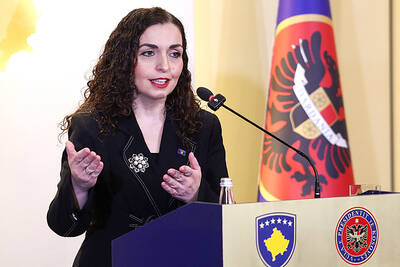
Kosovar President Vjosa Osmani on Friday after dissolving the Kosovar parliament said a snap election should be held as soon as possible to avoid another prolonged political crisis in the Balkan country at a time of global turmoil. Osmani said it is important for Kosovo to wrap up the upcoming election process and form functional institutions for political stability as the war rages in the Middle East. “Precisely because the geopolitical situation is that complex, it is important to finish this electoral process which is coming up,” she said. “It is very hard now to imagine what will happen next.” Kosovo, which declared

MORE BANS: Australia last year required sites to remove accounts held by under-16s, with a few countries pushing for similar action at an EU level and India considering its own ban Indonesia on Friday said it would ban social media access for children under 16, citing threats from online pornography, cyberbullying, online fraud and Internet addiction. “Accounts belonging to children under 16 on high-risk platforms will start to be deactivated, beginning with YouTube, TikTok, Facebook, Instagram, Threads, X, Bigo Live and Roblox,” Indonesian Minister of Communications and Digital Meutya Hafid said. “The government is stepping in so that parents no longer have to fight alone against the giants of the algorithm. Implementation will begin on March 28, 2026,” she said. The social media ban would be introduced in stages “until all platforms fulfill their


 RSS
RSS