


In a town all but destroyed when its salt lake overflowed over three decades ago, the desolation is surreal: from silvery-white empty houses and hotels to trees, stark and dead; and one lonely man who calls this home.
Once a lake country spa town south of Buenos Aires, Epecuen is a lagoon with a salinity level only topped by the Dead Sea. For decades, tourists visited to take its waters believing they were good for one’s health.
Everything came crashing down in 1985 when a long period of heavy rains sent the lagoon bursting over its banks, and it swept over a busy small town.
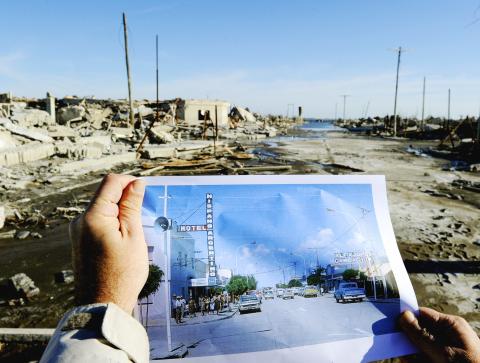
Photo: AFP
“I had a bunch of cats and dogs, and they ran away a couple days before the flood and I never saw them again,” Norma Berg, 48, said, recalling her childhood spent here, until the flood.
“I think my pets could feel that the water was coming,” Berg said, as she glanced at the rubble of the childhood home she fled.
A town of about 40 square blocks, Epecuen was submerged beneath 10m of water.
Even when the waters eventually receded, the country town, 550km south of the capital, was never rebuilt. Its welcoming little hotels seem frozen in time, rot and rust, glistening with the salt in which they were steeped.
Berg recalls that fateful date — Nov. 10, 1985 — when the flood barely left her family and the town’s 1,500 other residents enough time to grab some belongings and run.
“A lot of the locals never, ever came back; other people just died of the shock and stress of losing everything,” Berg said sadly.
However, someone did come back. One man.
“Until about four or five years after the flood, when the waters were still high, nobody came around here at all,” said Pablo Novak, 81.
“I was totally alone. All day, every day,” said Novak, now the town’s only inhabitant.
Every day, he climbs on his bicycle and rides around surveying the eerie shells of 185 hotels, restaurants and other businesses that existed before 1985.
“I am OK here. I am just alone. I read the newspaper. And I always think of the town’s golden days,” of the 1960s and 1970s, Novak says.
Back then, as many as 20,000 people would visit every year to take the waters here.
Visitors pick up on Epecuen’s spooky vibe eying abandoned beds from a former old folks home, dozens of stranded, toppled night tables from local hotels, and upended materials visitors and businessmen tried to pry out of the rubble to reuse as construction materials.
The town’s surreal silvery cast has inspired filmmakers including Roland Joffe, who in 2009 filmed the Spanish civil war-drama There Be Dragons here; and Argentina’s Pino Solana, who filmed scenes of his El viaje (The Journey) locally.

Crowds in Bangladesh are flocking to snap photographs with an unlikely social media star — an albino buffalo with flowing blond hair nicknamed “Donald Trump” that is due to be sacrificed within days. Owner Zia Uddin Mridha, 38, said his brother named the 700kg bull over its flowing helmet of hair resembling the signature look of the US president. “My younger brother picked this name because of the buffalo’s extraordinary hair,” he said at his farm in Narayanganj, just outside the capital, Dhaka. Mridha said that a constant stream of curious visitors — social media fans, onlookers and children — have come throughout

It began as a satirical online project. Now millions of young people in India are flocking to it as an outlet for their frustration. A parody political party called the Cockroach Janta Party, with the insect as its symbol, has exploded across India’s social media by turning absurdist humor into protest. Memes and short videos mocking corruption, joblessness and political dysfunction have flooded social media sites, where millions of users are embracing the cockroach — known for its ability to survive harsh conditions — as a tongue-in-cheek symbol of endurance. The online movement’s rise has been unusually rapid. The Cockroach Janta Party (CJP)

HOTTER: While Indians are accustomed to summer heat, climate change has caused northwestern India to warm faster than other parts of the country, an academic said Roads and markets have emptied during afternoons and some farmers have switched to nighttime work to avoid scorching temperatures as a heat wave grips large parts of India. The India Meteorological Department forecast maximum temperatures for yesterday of about 45°C in the capital, New Delhi, where authorities have opened temporary “cooling zones” to help people cope. The weather department warned that conditions would likely persist across several northern regions in the coming days, with temperatures staying well above seasonal averages. Authorities urged people to stay indoors during the hottest hours and take precautions against heat-related illnesses. India declares a heat wave whenever maximum temperatures

BIGGER ROLE: Beijing has said it maintains an impartial stance on the war in Ukraine, but by training Russian troops, China is far more involved than previously known China’s armed forces secretly trained about 200 Russian military personnel in China late last year, and some have since returned to fight in Ukraine, according to three European intelligence agencies and documents seen by Reuters. While China and Russia have held a number of joint military exercises since Moscow’s full-scale invasion of Ukraine in 2022, Beijing has repeatedly said that it is neutral in the conflict and presents itself as a peace mediator. The covert training sessions, which predominantly focused on the use of drones, were outlined in a dual-language Russian-Chinese agreement signed by senior Russian and Chinese officers in Beijing on


 RSS
RSS