


A group of underground Chinese Christian churches has issued a defiant petition to the country’s parliament demanding respect for their constitutional right to freedom of religion.
The petition — signed by the pastors of 17 top unregistered churches — was addressed to National People’s Congress Chairman Wu Bangguo (吳邦國) and urges the legislature to pass a law to protect religious freedom.
It complained of an ongoing nationwide crackdown aimed at shutting down “underground” or “home” churches.
In China, about 20 million Protestants and Catholics worship in official churches, while membership in “underground” churches that refuse to bow to government controls on religion has grown to an estimated 50 million.
The action was the first time so many unregistered churches had grouped together to publicly address freedom of worship in China, said the US-based rights group China Aid, which posted the petition on its Web site.
“For the last six decades, the rights to liberty of religious faith granted to our country’s Christians by the Constitution of the People’s Republic of China have not been put into practice,” said the petition, dated May 10.
It urged the parliament to investigate the constitutionality of the government’s “religious management” policy, which restricts and suppresses religious freedom through “politically charged” government-run churches.
It also accused the authorities of systematically violating a clause on religious freedom in the Universal Declaration of Human Rights, which the Beijing government has signed up to.
The petition urged a probe into efforts by authorities to shut down Beijing’s Shouwang Church, the capital’s leading unregistered church with a congregation of more than 1,000, largely businesspeople and academics.
Since 2009, Beijing authorities have repeatedly closed Shouwang’s places of worship, put church leaders under house arrest and detained hundreds of followers, who have had to resort to worshipping outdoors, the petition said.
In response to the petition, the government said it singled out Shouwang for engaging in “illegal gatherings” and harming “social order,” and denied that religious freedoms had been curtailed.
“The Chinese government safeguards the right of Chinese citizens to religious freedom and freedom of faith in accordance with the law,” Ministry of Foreign Affairs spokesman Jiang Yu (姜瑜) told reporters yesterday.
“At the same time, while enjoying their freedom, citizens must respect their legal rights and obligations and cannot harm the public interest,” Jiang said.

South Korea’s air force yesterday apologized for a 2021 midair collision involving two fighter jets, a day after auditors said the pilots were taking selfies and filming during the flight and held them responsible for the accident. “We sincerely apologize to the public for the concern caused by the accident that occurred in 2021,” an air force spokesman told a news conference, adding that one of the pilots involved had been suspended from flying duties, received severe disciplinary action and has since left the military. The apology followed a report released on Wednesday by the South Korean Board of Audit and Inspection,

About 240 Indians claiming descent from a Biblical tribe landed at Tel Aviv airport on Thursday as part of a government operation to relocate them to Israel. The newcomers passed under a balloon arch in blue and white, the colors of the Israeli flag, as dozens of well-wishers welcomed them with a traditional Jewish song. They were the first “bnei Menashe” (“sons of Manasseh”) to arrive in Israel since the government in November last year announced funding for the immigration of about 6,000 members of the community from the states of Manipur and Mizoram in northeast India. The community claims to descend from
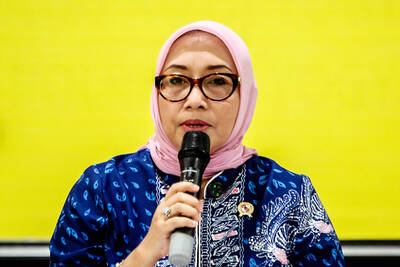
Indonesian police have arrested 13 people after shocking images of alleged abuse against small children at a daycare center went viral, sparking outrage across the nation, officials said on Monday. Police on Friday last week raided Little Aresha, a daycare center in Yogyakarta on Java island, following a report from a former employee. CCTV footage circulating on social media showed children, most younger than two, lying on the floor wearing only diapers, their hands and feet bound with rags. The police have confirmed that the footage is authentic. Police said they also found 20 children crammed into a room just 3m by 3m. “So

‘TROUBLING’: The firing of Phelan, who was an adviser to a nonprofit that supported the defense of Taiwan, was another example of ‘dysfunction’ under Trump, a US senator said US Secretary of the Navy John Phelan has been fired, a US official and a person familiar with the matter said on Wednesday, in another wartime shakeup at the Pentagon coming just weeks after US Secretary of Defense Pete Hegseth ousted the Army’s top general. The Pentagon announced his departure in a brief statement, saying he was leaving the administration “effective immediately,” but it did not provide a reason or say whether it was his decision to go. The sources, who spoke on condition of anonymity, said Phelan was dismissed in part because he was moving too slowly to implement reforms to


 RSS
RSS