


US Secretary of State Hillary Rodham Clinton on Friday urged China to free dozens of government critics rounded up this year, including a prominent artist and said Beijing’s rights record was worsening.
The US Department of State’s annual survey said China last year stepped up efforts to rein in activists, the media and free Internet access and pursued “severe repression” in the Tibet and Xinjiang regions.
Presenting the report, Clinton voiced alarm at developments this year as China — apparently alarmed over a pro-democracy wave of protests sweeping the Middle East — launches its most sweeping crackdown on dissent in years.
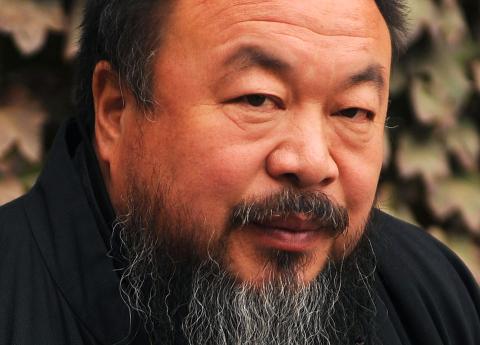
Photo: AFP
“In China, we’ve seen negative trends that are appearing to worsen in the first part of 2011,” Clinton told reporters.
“As we have said repeatedly, the United States welcomes the rise of a strong and prosperous China,” she said. “However, we remain deeply concerned about reports that since February, dozens of people including public-interest lawyers, writers, artists, intellectuals and activists have been arbitrarily detained and arrested.”
She mentioned the case of Ai Weiwei (艾未未), an outspoken artist who helped design the Bird’s Nest Olympic Stadium for the 2008 Beijing Games. He was detained last Sunday for unspecified “economic crimes.”
“Such detention is contrary to the rule of law, and we urge China to release all of those who have been detained for exercising their internationally recognized right to free expression and to respect the fundamental freedoms and human rights of all of the citizens of China,” Clinton said.
In an unusual public criticism, a UN human rights panel on Friday also voiced concern at China’s treatment of activists and lawyers, saying that so-called enforced disappearances were a crime under international law.
The UN Working Group on Enforced or Involuntary Disappearances expressed “serious concern” at the disappearances, saying that they represented “the continuation of a disturbing trend in the suppression of dissidents” in China.
China has warned foreign nations not to “interfere” over Ai’s case. China often bristles at the annual US State Department report on human rights, hitting back that the US also has concerns it needs to address.
Michael Posner, the assistant secretary of state for democracy, human rights and labor, said that the US State Department would welcome reading China’s account of the situation in the US.
“We are very open to the notion that people in this country have [the right] to be critical of what we do, and we engage them in that criticism,” he told reporters.
Posner said that US Assistant Secretary of State for East Asia Kurt Campbell was raising human rights among other issues on his current visit to China.
In the latest report, the US State Department said that many Chinese — possibly tens of thousands — were involuntarily committed to psychiatric hospitals including members of Falun Gong, the banned spiritual movement.
China imposed tight restrictions on citizens’ rights to assemble, travel and practice their religions and “continued its severe cultural and religious repression of ethnic minorities” in Xinjiang and Tibetan areas, it said.
The report quoted a Human Rights Watch report saying that hundreds of men from Xinjiang’s indigenous Uighur community went missing following 2009 clashes with China’s majority Han ethnicity.
China also denied passports or restricted travel to many ethnic Tibetans, part of a clampdown since mass protests in the predominantly Buddhist region in 2009, the study said.
The report comes one month before Clinton and US Treasury Secretary Timothy Geithner are due to meet in Washington with senior Chinese leaders for the annual Strategic and Economic Dialogue, a key forum between the world’s two largest economies.
Clinton’s comments come after criticism from activists at the beginning of her tenure, when she said that human rights concerns with China would not interfere with cooperation on other issues such as the global economy.

South Korea’s air force yesterday apologized for a 2021 midair collision involving two fighter jets, a day after auditors said the pilots were taking selfies and filming during the flight and held them responsible for the accident. “We sincerely apologize to the public for the concern caused by the accident that occurred in 2021,” an air force spokesman told a news conference, adding that one of the pilots involved had been suspended from flying duties, received severe disciplinary action and has since left the military. The apology followed a report released on Wednesday by the South Korean Board of Audit and Inspection,

About 240 Indians claiming descent from a Biblical tribe landed at Tel Aviv airport on Thursday as part of a government operation to relocate them to Israel. The newcomers passed under a balloon arch in blue and white, the colors of the Israeli flag, as dozens of well-wishers welcomed them with a traditional Jewish song. They were the first “bnei Menashe” (“sons of Manasseh”) to arrive in Israel since the government in November last year announced funding for the immigration of about 6,000 members of the community from the states of Manipur and Mizoram in northeast India. The community claims to descend from
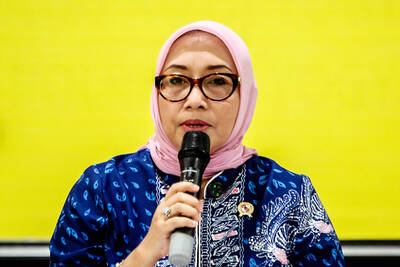
Indonesian police have arrested 13 people after shocking images of alleged abuse against small children at a daycare center went viral, sparking outrage across the nation, officials said on Monday. Police on Friday last week raided Little Aresha, a daycare center in Yogyakarta on Java island, following a report from a former employee. CCTV footage circulating on social media showed children, most younger than two, lying on the floor wearing only diapers, their hands and feet bound with rags. The police have confirmed that the footage is authentic. Police said they also found 20 children crammed into a room just 3m by 3m. “So

‘TROUBLING’: The firing of Phelan, who was an adviser to a nonprofit that supported the defense of Taiwan, was another example of ‘dysfunction’ under Trump, a US senator said US Secretary of the Navy John Phelan has been fired, a US official and a person familiar with the matter said on Wednesday, in another wartime shakeup at the Pentagon coming just weeks after US Secretary of Defense Pete Hegseth ousted the Army’s top general. The Pentagon announced his departure in a brief statement, saying he was leaving the administration “effective immediately,” but it did not provide a reason or say whether it was his decision to go. The sources, who spoke on condition of anonymity, said Phelan was dismissed in part because he was moving too slowly to implement reforms to


 RSS
RSS