


As popular revolts continue to rock autocratic regimes across the Arab world, women are defying both taboo and stereotype and emerging as a driving force that is keeping the momentum of the protests going.
“Women played and continue to play an integral part in the uprisings and revolutions in the region, and what is key is that they are there, physically present in the streets, showing their numbers,” Human Rights Watch senior researcher Nadim Houry said.
“That is a hopeful sign,” Houry said. “They should now play a key role the new governing structures that will emerge from these revolutions.”
In T-shirts and jeans or long black robes and veils, tens of thousands of women have made their voices heard in the streets, from Tunis to Cairo, from Manama to Sana’a, to demand reform in a region long ruled by autocracies.
Inspired by the uprising that toppled former Tunisian president Zine El Abidine Ben Ali, women turned out en masse in Egypt’s Tahrir Square for weeks to demand the ouster of then-Egyptian president Hosni Mubarak, who quit on Feb. 11 after 30 years in power.
Bahrain, where thousands of mainly Shiite protesters have been demanding the fall of the Sunni al-Khalifa dynasty, has also witnessed a massive turnout of women, who form a sea of black in their traditional robes and headscarves at the continuing gender-segregated rallies.
In the conservative countries of Yemen and Libya, women have overturned social norms and joined the insurrections against Yemeni President Ali Abdullah Saleh and Libyan leader Muammar Qaddafi, marching openly in the streets and talking to journalists on camera.
“Women play a decisive role in the region, from Tunisia to Egypt and Libya, and they have been a key factor in sparking the revolutions in every city,” said Tawakkul Karman, a Yemeni activist who is spearheading the participation of women in the Sana’a protests.
“The revolution aims primarily to topple regimes, but it has also succeeded in doing away with the archaic traditions that have long told us women should stay at home and out of public life,” Karman said. “This has also been a social revolution. The role of women is helping create a new society. The Yemen revolution has helped woman rise to a better place.”
While women from all walks of life have joined the protests, a young and educated segment of society is also turning to the new media to bring about change in their homelands.
Asma Mahfouz, a young Egyptian woman whose video blog calling for an uprising in Egypt became a viral hit, is widely credited with having inspired Egyptians to take to the streets in defiance of a long-running autocratic regime.
“I am making this video to send you one message: If we still have any honor, if we want to live in dignity in this country, we need to get out into the streets on Jan. 25,” the fresh-faced, veiled activist said.
“If you are a man, come down to the street,” she said in an -Arabic-language video posted on YouTube on Jan. 18. “Whoever says women shouldn’t protest ... should be man enough to come with me on Jan. 25.”
Voices of dissent allegedly from Saudi Arabia, which has not yet witnessed major protests, have also begun to surface on Facebook and Twitter, many under female usernames.
“I urge Saudi women to act now. Our Saudi brothers have betrayed us, for they are cowards. Act now, b4 it’s too late!” #SaudiWomenRevolution tweeted.
While the region’s future political landscape remains unclear, the uprisings have revealed discontent with both the existing political and social structure across the region. experts say.

Crowds in Bangladesh are flocking to snap photographs with an unlikely social media star — an albino buffalo with flowing blond hair nicknamed “Donald Trump” that is due to be sacrificed within days. Owner Zia Uddin Mridha, 38, said his brother named the 700kg bull over its flowing helmet of hair resembling the signature look of the US president. “My younger brother picked this name because of the buffalo’s extraordinary hair,” he said at his farm in Narayanganj, just outside the capital, Dhaka. Mridha said that a constant stream of curious visitors — social media fans, onlookers and children — have come throughout

The Bolivian government on Friday struck a deal with protesting miners, but was still grappling with blockades and demonstrations by other workers across La Paz. Other groups are still blocking access roads into the city, which is also the seat of the government. Police on Thursday prevented the miners from entering the main square by using tear gas, while the demonstrators hurled stones and explosives with slingshots. Protests against the policies of Bolivian President Rodrigo Paz have convulsed the Andean nation since early this month, and roadblocks were choking routes into La Paz throughout Friday, the national road authority said. Miners demanded that Paz
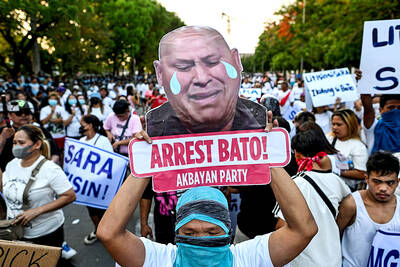
The Philippines said it has asked the country’s Supreme Court to allow it to arrest former Philippine president Rodrigo Duterte’s chief drug war enforcer to stand trial in an international tribunal. The International Criminal Court (ICC) last week unsealed an arrest warrant against Philippine Senator Ronald dela Rosa, accusing him along with Duterte and other “coperpetrators” of the “crime against humanity of murder.” Dela Rosa briefly sought refuge in the Philippine Senate last week while asking the Philippine Supreme Court to stop an ongoing attempt by government agents to arrest him. “By his own conduct, he has placed himself outside the protection of

The researchers in Ireland looked at their computer screen, marveling at a medieval book tracked down in a Roman library. They flipped through its digitized pages and found their sought-after treasure: the oldest surviving English poem. “We were extremely surprised. We were speechless. We couldn’t believe our eyes when we first saw that,” said Elisabetta Magnanti, a visiting research fellow at Trinity College Dublin’s school of English. The poem was also within the main body of Latin text, she said, calling it “extraordinary.” Composed in Old English by a Northumbrian agricultural worker in the 7th century, Caedmon’s Hymn appears within some copies of


 RSS
RSS