


Former Soviet president Mikhail Gorbachev, turning 80, accused Russia’s leaders of rolling back democracy and advised Russian Prime Minister Vladimir Putin to learn from the Arab experience and stay out of next year’s presidential vote.
In a show of respect for a statesman still reviled by millions of compatriots for his role in the collapse of the Soviet Union, Russian President Dmitry Medvedev met Gorbachev and granted him Russia’s highest state medal on Wednesday.
The Kremlin handling of Gorbachev’s 80th birthday underscored the Russian leadership’s delicate ties with a man who helped create the country they rule, but has become an increasingly vocal critic of their tight grip on power.
It came one year before the presidential election in March in which Putin has hinted he will return to the presidency or endorse his protege, Medvedev, for a second term.
“Vladimir Vladimirovich has already served two terms, and one more as prime minister. I would not run for president if I were in his place,” Gorbachev told the weekly Argumenty i Fakty in an interview published on Wednesday.
“People ... do not want to be a mass, a flock led for decades by the same shepherds,” Gorbachev said, pointing to Arab unrest as proof.
Toppled Egyptian president Hosni Mubarak “stayed too long, people were fed up with him,” he said.
Gorbachev said he likes both members of Russia’s ruling “tandem” as people.
“But both of them must understand: Their time is limited,” said Gorbachev, whose 1980s reforms eased decades of oppression in the Soviet Union, but hastened its breakup in 1991.
President from 2000-2008, Putin steered Medvedev into the Kremlin when term limits barred him from seeking re-election. If Putin returns to the presidency next year, he could then run for another six-year term in 2018.
Gorbachev listed several Putin-era electoral reforms he said had deprived Russians of their rights, including the scrapping of popular elections of regional governors and of voting for individual candidates in parliamentary elections.
Asked whether the events of Egypt or Libya could be repeated in Russia, he said: “In Russia nothing is ever repeated, everything happens in its own way. But it is no good to anger people by endlessly taking everything away from them.”
Political analyst Yevgeny Volk said granting Gorbachev the Order of Andrei Pervozvanny was a way for Medvedev and Putin to acknowledge his part in the paving the way for today’s Russia. That could be aimed at bolstering their own legitimacy by drawing a direct line to Gorbachev’s democratic achievements.
Medvedev, who has cast himself as a champion of civil rights and political pluralism but made few changes to Putin’s policies, told Gorbachev the award was “a fitting evaluation of the big work you did as head of state.” But in a careful nod to Gorbachev’s critics, he said that work “can be assessed in different ways” and called the award “a symbol of respect for the state you led ... the Soviet Union.”
Putin, adhering to a birthday tradition dating back to the Soviet era, offered Gorbachev his best wishes in a telegram.
He avoided praising Gorbachev’s role as Soviet leader, making no reference to the post, but saying he “had a noticeable influence on the course of world history and did much to strengthen Russia’s authority.”

When a hiker fell from a 55m waterfall in wild New Zealand bush, rescuers were forced to evacuate the badly hurt woman without her dog, which could not be found. After strangers raised thousands of dollars for a search, border collie Molly was flown to safety by a helicopter pilot who was determined to reunite the pet and the owner. A week earlier, an emergency rescue helicopter found the woman with bruises and lacerations after a fall at a rocky spot at the waterfall on the South Island’s West Coast. She was airlifted on March 24, but they were forced to
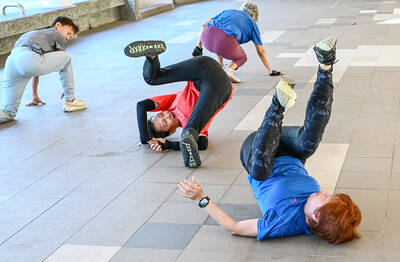
CONFIDENCE BOOSTER: ’After parkour ... you dare to do a lot of things that you think only young people can do,’ a 67-year-old parkour enthusiast said In a corner of suburban Singapore, Betty Boon vaults a guardrail, crawls underneath a slide, executes forward shoulder rolls and scales a steep slope, finishing the course to applause. “Good job,” the 69-year-old’s coach cheers. This is “geriatric parkour,” where about 20 retirees learned to tackle a series of relatively demanding exercises, building their agility and enjoying a sense of camaraderie. Boon, an upbeat grandmother, said learning parkour has aided her confidence and independence as she ages. “When you’re weak, you will be dependent on someone,” she said after sweating it out with her parkour classmates in suburban Toa Payoh,
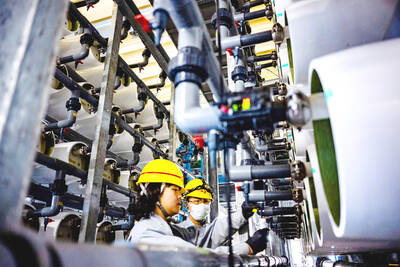
HIGH HOPES: The power source is expected to have a future, as it is not dependent on the weather or light, and could be useful for places with large desalination facilities A Japanese water plant is harnessing the natural process of osmosis to generate renewable energy that could one day become a common power source. The possibility of generating power from osmosis — when water molecules pass from a less salty solution to a more salty one — has long been known. However, actually generating energy from that has proved more complicated, in part due the difficulty of designing the membrane through which the molecules pass. Engineers in Fukuoka, Japan, and their private partners think they might have cracked it, and have opened what is only the world’s second osmotic power plant. It generates
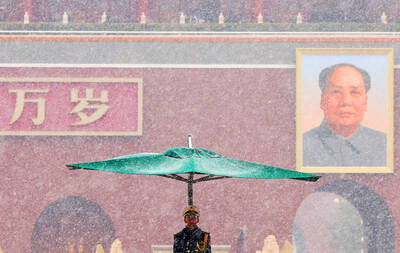
Chinese dissident artist Gao Zhen (高兟), famous for making provocative satirical sculptures of former Chinese leader Mao Zedong (毛澤東), was tried on Monday over accusations of “defaming national heroes and martyrs,” his wife and a rights group said. Gao, 69, who was detained in 2024 during a visit from the US, faces a maximum three-year prison sentence, said his wife, Zhao Yaliang (趙雅良), and Shane Yi, a researcher at the Chinese Human Rights Defenders group which operates outside the nation. The closed-door, one-day trial took place at Sanhe City People’s Court in Hebei Province neighboring the capital, Beijing, and ended without a


 RSS
RSS