


A Soyuz capsule carrying two Russian cosmonauts and a US astronaut from the International Space Station landed safely in Kazakhstan yesterday.
“The TMA module has landed,” an announcer at Mission Control outside Moscow said to applause from officials and relatives, relieved after an initial attempt to return from the orbital outpost was foiled by an equipment problem on Friday.
Space officials said the capsule landed upright, on time and on target near Arkalyk on the central Kazakh steppe. Swooping down beneath parachutes, it kicked up a cloud of dust as it hit after firing rockets to cushion the landing.
NASA TV showed technicians crouching over the hatch of the gumdrop-shaped capsule, its nose scorched by the heat of re-entry, and helping Soyuz commander Alexander Skvortsov out in his spacesuit.
“I feel fantastic. The landing was soft and smooth,” he said.
NASA astronaut Tracy Caldwell Dyson was next out, smiling as she was carried to an armchair at the landing site and covered with a blue blanket.
As cosmonaut Mikhail Korniyenko was extracted from the hatch in the top of the cramped capsule, Dyson chatted on a satellite phone.
Skvortsov, Dyson and Korniyenko spent nearly six months aboard the International Space Station, arriving on April 4 in the same Soyuz TMA-18 that brought them back to Earth.
They were to have returned on Friday, but the descent was aborted after latches on a docking port holding the spacecraft to the orbital station failed to open, sending puzzled engineers scrambling for answers.
NASA later said crew members rigged up a solution, attaching jumper cables to bypass a failed hatch sensor that was blocking commands, enabling the latches on the Russian-made Poisk module to open.
The Soyuz separated smoothly from the docking port this time and landed in Kazakhstan at 11:23am.
The three crewmates’ stay aboard the station was marred by mishaps including a cooling system failure last month and a faulty radio link that sent a supply craft coasting past after an aborted docking. It docked successfully two days later.
“This crew ... had to deal with some very serious problems in orbit and they met every challenge professionally and fixed all the problems,” NASA deputy director of manned space programs Mark Bauman said.
“I think we can see the benefit of having humans in space to keep the station healthy and yielding the science return that it will yield,” he said.
US space shuttle missions in November and next February are to complete the US$100 billion station, a project of 16 nations that has been under construction 355km above Earth since 1998.
Single-use Russian Soyuz craft will ferry all crews to the station after the NASA retires its shuttle fleet next year.
Earlier this year, Russia announced a halt to trips by millionaire space tourists to free capacity on Soyuz flights as the station has expanded to accommodate a permanent crew of six.
Russian Fyodor Yurchikhin and NASA astronauts Doug Wheelock and Shannon Walker remained aboard the station as planned after yesterday’s departure.
Three new crewmembers are to join them next month.

PARLIAMENT CHAOS: Police forcibly removed Brazilian Deputy Glauber Braga after he called the legislation part of a ‘coup offensive’ and occupied the speaker’s chair Brazil’s lower house of Congress early yesterday approved a bill that could slash former Brazilian president Jair Bolsonaro’s prison sentence for plotting a coup, after efforts by a lawmaker to disrupt the proceedings sparked chaos in parliament. Bolsonaro has been serving a 27-year term since last month after his conviction for a scheme to stop Brazilian President Luiz Inacio Lula da Silva from taking office after the 2022 election. Lawmakers had been discussing a bill that would significantly reduce sentences for several crimes, including attempting a coup d’etat — opening up the prospect that Bolsonaro, 70, could have his sentence cut to
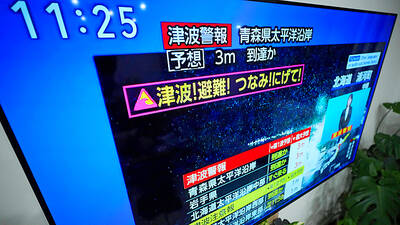
A powerful magnitude 7.6 earthquake shook Japan’s northeast region late on Monday, prompting tsunami warnings and orders for residents to evacuate. A tsunami as high as three metres (10 feet) could hit Japan’s northeastern coast after an earthquake with an estimated magnitude of 7.6 occurred offshore at 11:15 p.m. (1415 GMT), the Japan Meteorological Agency (JMA) said. Tsunami warnings were issued for the prefectures of Hokkaido, Aomori and Iwate, and a tsunami of 40cm had been observed at Aomori’s Mutsu Ogawara and Hokkaido’s Urakawa ports before midnight, JMA said. The epicentre of the quake was 80 km (50 miles) off the coast of
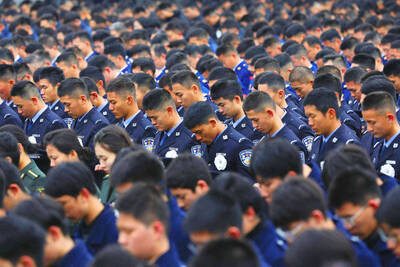
China yesterday held a low-key memorial ceremony for the 1937 Nanjing Massacre, with Chinese President Xi Jinping (習近平) not attending, despite a diplomatic crisis between Beijing and Tokyo over Taiwan. Beijing has raged at Tokyo since Japanese Prime Minister Sanae Takaichi last month said that a hypothetical Chinese attack on Taiwan could trigger a military response from Japan. China and Japan have long sparred over their painful history. China consistently reminds its people of the 1937 Nanjing Massacre, in which it says Japanese troops killed 300,000 people in what was then its capital. A post-World War II Allied tribunal put the death toll

A passerby could hear the cacophony from miles away in the Argentine capital, the unmistakable sound of 2,397 dogs barking — and breaking the unofficial world record for the largest-ever gathering of golden retrievers. Excitement pulsed through Bosques de Palermo, a sprawling park in Buenos Aires, as golden retriever-owners from all over Argentina transformed the park’s grassy expanse into a sea of bright yellow fur. Dog owners of all ages, their clothes covered in dog hair and stained with slobber, plopped down on picnic blankets with their beloved goldens to take in the surreal sight of so many other, exceptionally similar-looking ones.


 RSS
RSS