


The winner of the Karaoke World Championships may not achieve world fame, but at least he or she won’t have to worry where the next meal is coming from — the top prize is 1 million Russian dumplings.
With an unusual purse like that, it’s clear that karaokists retain a sense of humor about a pursuit as derided as it is popular.
However, they’re also serious enough about it to have traveled from as far away as Australia and Nigeria for a three-day battle-of-the-no-bands in a Moscow banquet hall.
The first night of the competition on Thursday seems to show that karaoke is at a tipping point. It’s gone far beyond caterwauling in front of a group of sozzled buddies and regretting it the next morning; most of those on stage here have serious pipes and carefully worked-out moves. Yet it retains the casual camaraderie of a barroom at midnight.
“It’s a contest, yes, but it’s more like a family,” said Atte Hujanen, managing director of the Finland-based KWC Organization that is the equivalent of a sports governing body.
One woman’s rendition of Vogue proved his point. Imagine Madonna if she’d never been to a gym, moved awkwardly and dressed like a diplomat. Still, the applause was warm, cameras flashed and no journalists seemed inclined to ask if the performance was intended as some kind of ironic statement.
Karaoke actually seems to be one of the world’s few genuine irony-free zones. The performers don’t go for modernist mumbling or cryptic lyrics — they love to belt it out and they go for songs with heart-on-the-sleeve words. The show began with a group rendition of that apogee of bathos We Are The World and a probably inevitable version of My Way occurred not long thereafter.
Hujanen posited that it’s this penchant for intensity that makes karaoke especially appealing in propriety-intensive countries such as Japan, where it originated, and his homeland, where six of the eight world championships have been held.
“People in Japan and Finland, it’s in our nature that we’re pretty shy,” he said. With karaoke, “we can sing a heartbreaking ballad and then shut up again.”
It’s also liberating for serious performers because it doesn’t require them to pursue a particular genre or artistic vision, as they would if they were part of an actual band, said US contestant Edward Pimentel, a technician for a cellular phone company in Albuquerque.
“The places I go to have 20,000 songs. I can change every single night,” he said. “I can do whatever.” They can also choose to look whatever. The show on Thursday had the sartorial variation of a good neighborhood bar — some men with snap-brim hats looking like dudes on the make, some in sneakers and untucked shirts looking like they’d stopped in for a cold one after a long shift at a gas station.
However, the emotions were higher for the singers than in a bar, said Tami Marie, also of Albuquerque, a standout with a searing version of Pink’s Misery.
“Here, you feel like a real star ... I feel so blessed,” she gushed.
However, the most gushing person to take the stage arguably wasn’t a performer at all, but the Russian organizer of the competition, Alexander Shamaev.
“The goal for us is the unification of the entire planet under the banner of karaoke,” he declared. “We hope it will become the most massive sport on the planet.”
The competition concludes today with the final round after two days of preliminaries. The judges will choose one winner from each gender, and the audience will vote on which of all the contenders deserves the dumplings provided by one of the championship’s sponsors.
Pimentel’s not in it for that kind of dough. Asked what he would do if he won that prize, it was the first time — on or offstage — that he was lost for words.

‘TERRORIST ATTACK’: The convoy of Brigadier General Hamdi Shukri resulted in the ‘martyrdom of five of our armed forces,’ the Presidential Leadership Council said A blast targeting the convoy of a Saudi Arabian-backed armed group killed five in Yemen’s southern city of Aden and injured the commander of the government-allied unit, officials said on Wednesday. “The treacherous terrorist attack targeting the convoy of Brigadier General Hamdi Shukri, commander of the Second Giants Brigade, resulted in the martyrdom of five of our armed forces heroes and the injury of three others,” Yemen’s Saudi Arabia-backed Presidential Leadership Council said in a statement published by Yemeni news agency Saba. A security source told reporters that a car bomb on the side of the road in the Ja’awla area in
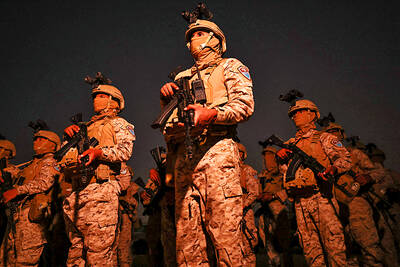
PRECARIOUS RELATIONS: Commentators in Saudi Arabia accuse the UAE of growing too bold, backing forces at odds with Saudi interests in various conflicts A Saudi Arabian media campaign targeting the United Arab Emirates (UAE) has deepened the Gulf’s worst row in years, stoking fears of a damaging fall-out in the financial heart of the Middle East. Fiery accusations of rights abuses and betrayal have circulated for weeks in state-run and social media after a brief conflict in Yemen, where Saudi airstrikes quelled an offensive by UAE-backed separatists. The United Arab Emirates is “investing in chaos and supporting secessionists” from Libya to Yemen and the Horn of Africa, Saudi Arabia’s al-Ekhbariya TV charged in a report this week. Such invective has been unheard of
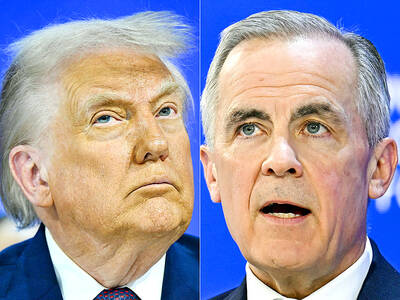
US President Donald Trump on Saturday warned Canada that if it concludes a trade deal with China, he would impose a 100 percent tariff on all goods coming over the border. Relations between the US and its northern neighbor have been rocky since Trump returned to the White House a year ago, with spats over trade and Canadian Prime Minister Mark Carney decrying a “rupture” in the US-led global order. During a visit to Beijing earlier this month, Carney hailed a “new strategic partnership” with China that resulted in a “preliminary, but landmark trade agreement” to reduce tariffs — but
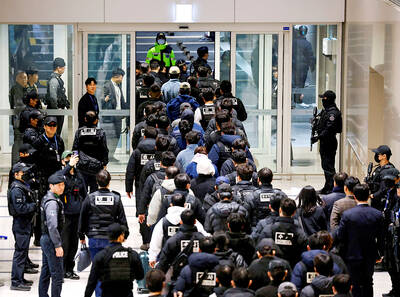
SCAM CLAMPDOWN: About 130 South Korean scam suspects have been sent home since October last year, and 60 more are still waiting for repatriation Dozens of South Koreans allegedly involved in online scams in Cambodia were yesterday returned to South Korea to face investigations in what was the largest group repatriation of Korean criminal suspects from abroad. The 73 South Korean suspects allegedly scammed fellow Koreans out of 48.6 billion won (US$33 million), South Korea said. Upon arrival in South Korea’s Incheon International Airport aboard a chartered plane, the suspects — 65 men and eight women — were sent to police stations. Local TV footage showed the suspects, in handcuffs and wearing masks, being escorted by police officers and boarding buses. They were among about 260 South


 RSS
RSS