


A South African girl who survived a violent criminal attack that shocked the nation was among those killed when a train hit a school bus this week, a family spokesman said.
Liesel Augis was only six years old when she was raped, beaten unconscious with a brick and thrown into a fire by a family friend in 2006. She survived and became known as “Little Rock”’ because of her strength and resilience.
On Wednesday, Liesel’s bus driver went around a closed railroad crossing gate and the vehicle was hit by a train. Nine children died at the scene in Cape Town, and a 10th died on Friday. Only the driver and four children survived.
Family spokesman Malvern de Bruyn said on Friday that Liesel had a zest for life, and the accident has left a deep scar in the family and the nation.
“We could see she was someone who wanted to defy anything that would cut her life,” de Bruyn said.
Liesel’s 2006 attacker, Abraham James, was sentenced to 28 years in jail without any hope of parole.
Her attack was one of many that took place between 2000 and 2006 by a number of assailants on a stretch of open land in a suburb of Cape Town now known locally as “Bushes of the Devil.”
The family’s plight did not end with her brutal attack. Days after James’ arrest, several unknown people tried to set fire to Liesel’s home.
De Bruyn said he had to find a refuge for them to move to in the same area.
After the attack Liesel started school at the Good Hope Primary School in Kuilsrivier, a suburb of Cape Town. She felt the need to conceal her name and the incident from her schoolmates, de Bruyn said.
“We could not divulge her real name, only the school principal knew the name,” de Bruyn said, but “the private school opened their arms to our child and gave all the support she needed.”
Liesel refused to talk about the incident and would only refer to herself as “Little Rock,” the name de Bruyn gave her, he said.
The pseudonym suppressed her pain and her anger, but also allowed her to build friendships without being taunted at school, he said.
De Bruyn took the name from the 1956 march in which some 20,000 women protested against the apartheid government’s introduction of passbooks which they were required to carry at all times and which restricted them to certain areas. The women then chanted, “you struck a rock, you struck a woman.”
“I named her ‘Little Rock’ because she was as tough as a rock like those women who fight against apartheid,” he said.
Liesel’s problems were compounded by a family that was destitute and lived in a shack, he said.
She was only able to go to school after a trust fund called The Little Rock Foundation was started for her and other child victims of rape.
Local academics, non-governmental organizations and the community of Greater Blue Downs in western South Africa contributed to the foundation.
The family that has had to handle so much already now has to deal with the the death of their little girl.
Police said they are currently investigating a case of homicide against the school bus driver, who may be charged later.
Liesel will be buried on Sept. 4 along with nine other victims from Wednesday’s crash.

Australians were downloading virtual private networks (VPNs) in droves, while one of the world’s largest porn distributors said it was blocking users from its platforms as the country yesterday rolled out sweeping online age restriction. Australia in December became the first country to impose a nationwide ban on teenagers using social media. A separate law now requires artificial intelligence (AI)-powered chatbot services to keep certain content — including pornography, extreme violence and self-harm and eating disorder material — from minors or face fines of up to A$49.5 million (US$34.6 million). The country also joined Britain, France and dozens of US states requiring
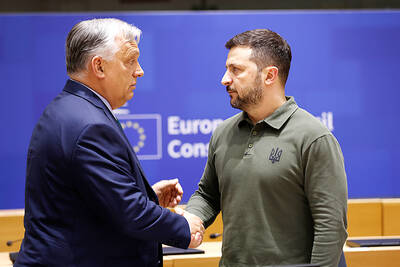
Hungarian authorities temporarily detained seven Ukrainian citizens and seized two armored cars carrying tens of millions of euros in cash across Hungary on suspicion of money laundering, officials said on Friday. The Ukrainians were released on Friday, following their detention on Thursday, but Hungarian officials held onto the cash, prompting Ukraine to accuse Hungary’s Russia-friendly government of illegally seizing the money. “We will not tolerate this state banditism,” Ukrainian Minister of Foreign Affairs Andrii Sybiha said. The seven detained Ukrainians were employees of the Ukrainian state-owned Oschadbank, who were traveling in the two armored cars that were carrying the money between Austria and
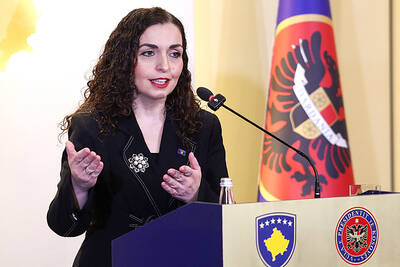
Kosovar President Vjosa Osmani on Friday after dissolving the Kosovar parliament said a snap election should be held as soon as possible to avoid another prolonged political crisis in the Balkan country at a time of global turmoil. Osmani said it is important for Kosovo to wrap up the upcoming election process and form functional institutions for political stability as the war rages in the Middle East. “Precisely because the geopolitical situation is that complex, it is important to finish this electoral process which is coming up,” she said. “It is very hard now to imagine what will happen next.” Kosovo, which declared

MORE BANS: Australia last year required sites to remove accounts held by under-16s, with a few countries pushing for similar action at an EU level and India considering its own ban Indonesia on Friday said it would ban social media access for children under 16, citing threats from online pornography, cyberbullying, online fraud and Internet addiction. “Accounts belonging to children under 16 on high-risk platforms will start to be deactivated, beginning with YouTube, TikTok, Facebook, Instagram, Threads, X, Bigo Live and Roblox,” Indonesian Minister of Communications and Digital Meutya Hafid said. “The government is stepping in so that parents no longer have to fight alone against the giants of the algorithm. Implementation will begin on March 28, 2026,” she said. The social media ban would be introduced in stages “until all platforms fulfill their


 RSS
RSS