


South Korea expressed reservations yesterday about China’s proposal for an informal meeting between North Korea and the US ahead of any resumption of six-party nuclear disarmament talks.
China’s visiting top nuclear envoy, Wu Dawei (武大偉), has held a series of discussions with South Korean officials, briefing them on his trip to Pyongyang last week, a foreign ministry spokesman said.
Wu, who arrived in Seoul on Thursday, said the North supported China’s three-step proposal for the resumption of the nuclear forum, which it quit in April last year.
China wants an informal dialogue between North Korea and the US and preliminary talks to take place before the full six-party session is resumed, the South Korean spokesman said.
“However, our side expressed reservations, saying North Korea should first show a strong willingness about denuclearization and a sincere attitude over the sinking of a South Korean warship,” he said.
North Korea expressed its willingness to resume the disarmament talks to former US president Jimmy Carter, who left the country yesterday after securing the release of a jailed man from the US, state media said.
Tensions have risen sharply on the peninsula since Seoul and Washington accused Pyongyang of torpedoing the ship in March with the loss of 46 lives, an accusation vehemently denied by the North.
South Korea believes the North’s overture for the talks are merely a ploy to dodge its responsibility for the sinking, Yonhap news agency said.
The six-way talks aimed at dismantling the North’s nuclear weapons program involve the two Koreas, the US, China, Russia and Japan.
South Korean Foreign Minister Yu Myung-hwan told Japanese reporters on Wednesday that the North should first disable its nuclear facilities and allow international monitors back to its nuclear complex.
Wu said on Thursday after talks with his South Korean counterpart Wi Sung-lac that six-party talks were still an “effective” tool to achieve peace in northeast Asia.
The Chinese envoy met South Korean Vice Foreign Minister Shin Kak-soo and senior presidential security secretary Kim Sung-hwan yesterday.

Crowds in Bangladesh are flocking to snap photographs with an unlikely social media star — an albino buffalo with flowing blond hair nicknamed “Donald Trump” that is due to be sacrificed within days. Owner Zia Uddin Mridha, 38, said his brother named the 700kg bull over its flowing helmet of hair resembling the signature look of the US president. “My younger brother picked this name because of the buffalo’s extraordinary hair,” he said at his farm in Narayanganj, just outside the capital, Dhaka. Mridha said that a constant stream of curious visitors — social media fans, onlookers and children — have come throughout
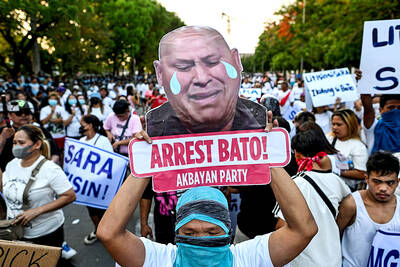
The Philippines said it has asked the country’s Supreme Court to allow it to arrest former Philippine president Rodrigo Duterte’s chief drug war enforcer to stand trial in an international tribunal. The International Criminal Court (ICC) last week unsealed an arrest warrant against Philippine Senator Ronald dela Rosa, accusing him along with Duterte and other “coperpetrators” of the “crime against humanity of murder.” Dela Rosa briefly sought refuge in the Philippine Senate last week while asking the Philippine Supreme Court to stop an ongoing attempt by government agents to arrest him. “By his own conduct, he has placed himself outside the protection of

It began as a satirical online project. Now millions of young people in India are flocking to it as an outlet for their frustration. A parody political party called the Cockroach Janta Party, with the insect as its symbol, has exploded across India’s social media by turning absurdist humor into protest. Memes and short videos mocking corruption, joblessness and political dysfunction have flooded social media sites, where millions of users are embracing the cockroach — known for its ability to survive harsh conditions — as a tongue-in-cheek symbol of endurance. The online movement’s rise has been unusually rapid. The Cockroach Janta Party (CJP)

BIGGER ROLE: Beijing has said it maintains an impartial stance on the war in Ukraine, but by training Russian troops, China is far more involved than previously known China’s armed forces secretly trained about 200 Russian military personnel in China late last year, and some have since returned to fight in Ukraine, according to three European intelligence agencies and documents seen by Reuters. While China and Russia have held a number of joint military exercises since Moscow’s full-scale invasion of Ukraine in 2022, Beijing has repeatedly said that it is neutral in the conflict and presents itself as a peace mediator. The covert training sessions, which predominantly focused on the use of drones, were outlined in a dual-language Russian-Chinese agreement signed by senior Russian and Chinese officers in Beijing on


 RSS
RSS