


Unable to reach a unanimous decision on several counts in the corruption trial of Rod Blagojevich, the ousted former governor of Illinois, jurors sent a note late on Wednesday to the presiding judge asking for advice.
It was the 11th day of deliberations and Judge James Zagel told lawyers for the defense and prosecutors that he would advise the jury to keep working to reach at least some consensus.
According to the note the judge read to the court, the jurors said: “We must now ask for guidance” because we are “in a situation where jurors cannot agree on a unanimous decision.”
“What should the next step be?” they asked.
Zagel said that he would ask the jurors for clarification on the points of contention, but that his advice would be for the jurors to decide whether they could reach a verdict on any or all charges.
Blagojevich, 53, is charged with 24 criminal counts, including racketeering and bribery. He listened to the judge on Wednesday with a somber face and pursed lips after bounding into the courtroom in his typically upbeat fashion, telling members of the media: “I missed you guys.”
Blagojevich has pleaded not guilty on all charges, including charges of trying to sell or barter US President Barack Obama’s vacated Senate seat.
The jury had not communicated with Zagel for more than a week and speculation about whether it was deadlocked had been swirling around the federal courthouse all afternoon.
The note, which provided only a tiny, unclear glimpse into the jurors’ deliberations, seemed to suggest that the discord was not heated.
“Without rancor” is how the jury described its discussions in the note.
“The jury room has always been quiet and the jury is, at least from my point of view, exceptionally disciplined,” Zagel said.
A lawyer for Blagojevich’s older brother and codefendant, Robert Blagojevich, who briefly served as a fund-raiser for the former governor and is charged with five criminal counts, said he did not understand the jury’s note.
“My guess is they’re hung,” attorney Michael Ettinger said.
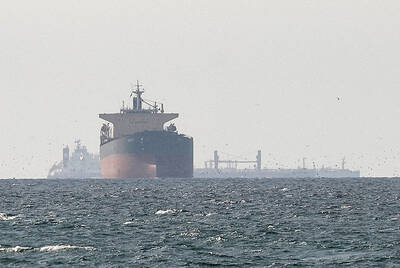
A ship that appears to be taking on the identity of a scrapped gas carrier exited the Strait of Hormuz on Friday, showing how strategies to get through the waterway are evolving as the Middle East war progresses. The vessel identifying as liquefied natural gas (LNG) carrier Jamal left the Strait on Friday morning, ship-tracking data show. However, the same tanker was also recorded as having beached at an Indian demolition yard in October last year, where it is being broken up, according to market participants and port agent’s reports. The ship claiming to be Jamal is likely a zombie vessel that

Japan is to downgrade its description of ties with China from “one of its most important” in an annual diplomatic report, according to a draft reviewed by Reuters, as relations with Beijing worsen. This year’s Diplomatic Bluebook, which Japanese Prime Minister Sanae Takaichi’s government is expected to approve next month, would instead describe China as an important neighbor and the relationship as “strategic” and “mutually beneficial.” The draft cites a series of confrontations with Beijing over the past year, including export controls on rare earths, radar lock-ons targeting Japanese military aircraft and increased pressure around Taiwan. The shift in tone underscores a deterioration

LAW CONSTRAINTS: The US has been pressing allies to send warships to open the Strait, but Tokyo’s military actions are limited under its postwar pacifist constitution Japan could consider deploying its military for minesweeping in the Strait of Hormuz if a ceasefire is reached in the war on Iran, Japanese Minister of Foreign Affairs Toshimitsu Motegi said yesterday. “If there were to be a complete ceasefire, hypothetically speaking, then things like minesweeping could come up,” Motegi said. “This is purely hypothetical, but if a ceasefire were established and naval mines were creating an obstacle, then I think that would be something to consider.” Japan’s military actions are limited under its postwar pacifist constitution, but 2015 security legislation allows Tokyo to use its Self-Defense Forces overseas if an attack,

German Chancellor Friedrich Merz’s conservative Christian Democratic Union (CDU) yesterday faced a regional election battle in Rhineland-Palatinate, now held by the center-left Social Democratic Party (SPD). Merz’s CDU has enjoyed a narrow poll lead over the SPD — their coalition partners at the national level — who have ruled the mid-sized state for 35 years. Polling third is the far-right Alternative for Germany (AfD), which spells a greater threat to the two centrist parties in several state elections in September in the country’s ex-communist east. The picturesque state of Rhineland-Palatinate, bordering France, Belgium and Luxembourg and with a population of about 4 million,


 RSS
RSS