

Sexual harassment is at dangerous levels in the workplace, with a joint Reuters/Ipsos global poll finding one in 10 workers have been pestered for sex by a senior employer.
The survey of about 12,000 people in 24 countries found workers in India were the mostly likely to report sexual harassment, with a report rate of 26 percent.
They were followed by workers in China, with 18 percent reporting sexual harassment, Saudi Arabia at 16 percent, Mexico at 13 percent and South Africa at 10 percent.
In Italy, 9 percent of workers reported being sexually harassed at work, while in Brazil, Russia, South Korea and the US a total of 8 percent of workers reported being pushed for sex by a senior.
The survey comes as experts warn that sexual harassment seems to be on the rise in the workplace, with several high profile cases recently.
Hewlett-Packard chief executive Mark Hurd resigned last week amid an investigation into claims of sexual harassment, and Mark McInnes, former chief executive of upmarket Australian retailer David Jones, quit in June after admitting to “unbecoming behavior” toward a female staff member.
“Where senior people have tried to have sex with employees because they work for them, and not because they wanted a true relationship, it’s not simply harassment, it’s exploitation,” said John Wright, a senior vice president at market research company Ipsos.
The workers who were least likely to have felt sexually harassed in the workplace were from Sweden and France, were only 3 percent of employees reported such incidents.
Only 4 percent of workers in Britain and Australia reported sexual harassment, 5 percent in Poland, Germany and Belgium, and 6 percent in Spain, Japan, Canada and Argentina. Seven percent of Hungarian workers reported sexual harassment.
The poll also found that 7 percent of employees have been intentionally physically assaulted out of anger by a co-worker or manager during their work day.
India again topped the table, with 25 percent of workers saying they had been assaulted at work. Sweden was once again at the bottom, with only 1 percent reporting such an incident.

A Chinese rocket carrying a communications satellite failed in its launch, state media said, attributing the failure to a “flight anomaly” as reports and videos suggested the spacecraft had exploded in mid-air. Beijing has plowed billions of dollars into its space program in the past few years to achieve what Chinese President Xi Jinping (習近平) calls the country’s “space dream.” Monday’s rare launch failure involved a Long March 7A carrier rocket, which lifted off from the Wenchang Space Launch Site in China’s southernmost province of Hainan at 8:02pm, state news agency Xinhua said. An “anomaly” occurred when the rocket, which was carrying the

UNITED STATES Russia frees US Marine Russia on Tuesday freed a former US Marine jailed there since 2022, President Donald Trump said, as the man returned to the US to be greeted with hamburgers and milkshakes. Russia agreed to release Robert Gilman, 32, to receive medical care in the US after discussions with Russian President Vladimir Putin, Trump wrote on social media. A Department of State plane carrying Gilman arrived at Washington Dulles International Airport late on Tuesday. Putin approved a pardon for him, US officials said. ZIMBABWE Ferry capsizing kills 15 At least 15 people were killed and 27 remain missing when

‘KOKUSHOBI’: Japan has recorded its first-ever ‘cruelly hot day,’ a new category introduced this year by the Japan Meteorological Agency for temperatures above 40°C In a potato field in Yanggu County, 130km northeast of Seoul, Lee Sang-hyuk dug into the soil and found nothing worth saving. A week earlier the crop, in Gangwon Province, had looked fine. Now the potatoes came up soft and collapsing, “like boiled potatoes,” spoiled by heat that had turned the ground into something closer to an oven. “It’s not just one or two fields like this. How can I even put it into words? It’s so upsetting,” he told local Seoul Broadcasting System. His ruined harvest is one thread in a punishing summer across east Asia, as record heat
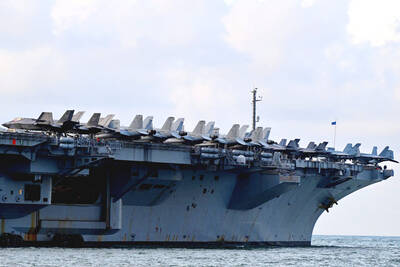
US President Donald Trump’s war against Iran is stretching the limits of US aircraft carriers and leaving the western Pacific without one of the key US warships as China shows more signs of aggression. The USS George Washington is departing the Pacific and expected to replace the USS Abraham Lincoln in the Middle East amid growing concerns about mental health and supply issues aboard the long-deployed carrier. The Lincoln has had its time at sea extended from its original May return date to support operations against Iran. The lack of a US carrier in the Pacific might be short-lived if


 RSS
RSS