


As Russia battles wildfires triggered by an unprecedented heatwave, flood waters surge across a drenched Pakistan leaving millions of people homeless, and questions are asked about global warming. Extreme weather has been a feature of this year’s northern summer, with floods in Pakistan, China and Eastern Europe seemingly matched by heatwaves in Western Europe and Russia.
However, experts interviewed on Monday were cautious over offering the events as proof of a changing climate, saying that while they fit with climatic projections in a warming planet, one extremely dry — or wet — summer isn’t sufficient evidence in isolation.
“One cannot conclude 100 percent that nothing like this has happened in the past 200 years, but the suspicion is there. Even if it’s only a suspicion,” said Jean-Pascal van Ypersele, vice president of the Intergovernmental Panel on Climate Change (IPCC), which has tracked the impact of human activity on climate for the past 20 years.
“These are events which reproduce and intensify in a climate disturbed by greenhouse gas pollution,” he said. “Extreme events are one of the ways in which climatic changes become dramatically visible.”
The planet has never been as hot as it has been in the first half of this year, the US National Oceanic and Atmospheric Administration said in a report last month.
According to the IPCC, droughts and heatwaves likes those affecting Russia and 18 US states become longer and more intense in a warming planet.
“Whether in frequency or intensity, virtually every year has broken records, and sometimes several times in a week,” said Omar Baddour, who tracks climate change for the World Meteorological Organization.
“In Russia, the record temperature in Moscow [38.2 ºC last month] — which had not been seen since records began 130 years ago — was broken again at the start of August. In Pakistan, the magnitude of the floods is unheard of,” he said.
“In both cases, it is an unprecedented situation. The succession of extremes and the acceleration of records conform with IPCC projections. But one must observe the extremes over many years to draw conclusions in terms of climate,” he said.
The floods in Pakistan could be caused by La Nina — the inverse of the El Nino phenomenon, which it generally follows — namely the cooling of surface temperatures in the Pacific ocean, Baddour said.
According to British climatologist Andrew Watson, the high temperatures this summer are linked to last year’s El Nino.
Nevertheless, Watson said the extreme events are “fairly consistent with the IPCC reports and what 99 percent of the scientists believe to be happening.”

Australians were downloading virtual private networks (VPNs) in droves, while one of the world’s largest porn distributors said it was blocking users from its platforms as the country yesterday rolled out sweeping online age restriction. Australia in December became the first country to impose a nationwide ban on teenagers using social media. A separate law now requires artificial intelligence (AI)-powered chatbot services to keep certain content — including pornography, extreme violence and self-harm and eating disorder material — from minors or face fines of up to A$49.5 million (US$34.6 million). The country also joined Britain, France and dozens of US states requiring

Hungarian authorities temporarily detained seven Ukrainian citizens and seized two armored cars carrying tens of millions of euros in cash across Hungary on suspicion of money laundering, officials said on Friday. The Ukrainians were released on Friday, following their detention on Thursday, but Hungarian officials held onto the cash, prompting Ukraine to accuse Hungary’s Russia-friendly government of illegally seizing the money. “We will not tolerate this state banditism,” Ukrainian Minister of Foreign Affairs Andrii Sybiha said. The seven detained Ukrainians were employees of the Ukrainian state-owned Oschadbank, who were traveling in the two armored cars that were carrying the money between Austria and
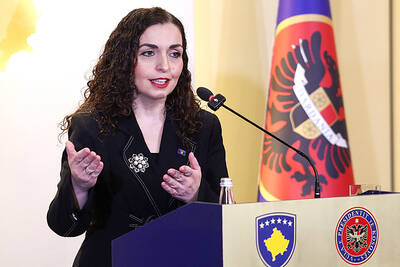
Kosovar President Vjosa Osmani on Friday after dissolving the Kosovar parliament said a snap election should be held as soon as possible to avoid another prolonged political crisis in the Balkan country at a time of global turmoil. Osmani said it is important for Kosovo to wrap up the upcoming election process and form functional institutions for political stability as the war rages in the Middle East. “Precisely because the geopolitical situation is that complex, it is important to finish this electoral process which is coming up,” she said. “It is very hard now to imagine what will happen next.” Kosovo, which declared

MORE BANS: Australia last year required sites to remove accounts held by under-16s, with a few countries pushing for similar action at an EU level and India considering its own ban Indonesia on Friday said it would ban social media access for children under 16, citing threats from online pornography, cyberbullying, online fraud and Internet addiction. “Accounts belonging to children under 16 on high-risk platforms will start to be deactivated, beginning with YouTube, TikTok, Facebook, Instagram, Threads, X, Bigo Live and Roblox,” Indonesian Minister of Communications and Digital Meutya Hafid said. “The government is stepping in so that parents no longer have to fight alone against the giants of the algorithm. Implementation will begin on March 28, 2026,” she said. The social media ban would be introduced in stages “until all platforms fulfill their


 RSS
RSS