


The US said yesterday it would resume ties with Indonesian special forces after a 12-year hiatus, as part of efforts by Washington to reach out to the world’s largest Muslim nation.
The announcement, made during a visit by US Secretary of Defense Robert Gates to Indonesia, comes as Washington seeks to resume training for the Kopassus unit as part of growing anti-insurgency and intelligence cooperation.
“We will begin a gradual, measured process of working with Kopassus,” a senior US defense official said, referring to the elite Indonesian military unit, with which Washington suspended ties in 1998.
The decision was made “in light of the progress that Indonesia and its military ... has made in terms of reform and professionalization since the fall of [former Indonesian president] Suharto as well as recent pledges of reform,” he said.
The move is controversial, as the Kopassus unit has been implicated in human rights abuses, including in East Timor and Aceh, and some figures in the US Congress have opposed embracing the force before it has accounted for its past.
The US broke off ties with the Kopassus under a law banning cooperation with foreign troops implicated in rights abuses.
The senior US defense official played down fears that senior figures in the special forces had been implicated in past rights violations.
“Individuals who had been convicted in the past for human rights violations have in the past several months been removed from Kopassus,” he said.
The administration of US President Barack Obama, who spent part of his childhood in Indonesia, sees the country as an increasingly important player in East Asia and key ally in the Muslim world.
Gates, who arrived from a visit to Seoul, was due to meet Indonesian President Susilo Bambang Yudhoyono and Defense Minister Purnomo Yusgiantoro later yesterday.
Ernie Bower, a Southeast Asia expert at the Center for Strategic and International Studies in Washington, said the Obama administration needed to handle its relationship with the Indonesian military carefully.
“I think it’s the view of the Indonesian military that without the ability to engage and train Kopassus, the American engagement and normalization of the military-to-military relationship would be incomplete,” he said.
“If you don’t have the relationship with the Indonesian military normalized, you can’t really participate and be the leading partner in this architecture,” he added. “Gates needs to get it right with Indonesia.”
However, the Pentagon needs to find an acceptable compromise to seal the deal without encountering too many objections in Washington.
“We’ve been working for some time both within the US government and with the government of Indonesia to try to figure out how and under what conditions we can pursue re-engagement with Kopassus,” one senior US defense official said.
However, leading voices in Washington such as Democratic Senator Patrick Leahy as well as human rights groups have opposed a normalization of military ties until Kopassus commanders have faced justice for past rights violations.
“Before resuming military cooperation with the Kopassus, Robert Gates must make sure that there’s no senior military officers implicated in the past abuse who hold a structural position in the military,” activist Usman Hamid said.

PARLIAMENT CHAOS: Police forcibly removed Brazilian Deputy Glauber Braga after he called the legislation part of a ‘coup offensive’ and occupied the speaker’s chair Brazil’s lower house of Congress early yesterday approved a bill that could slash former Brazilian president Jair Bolsonaro’s prison sentence for plotting a coup, after efforts by a lawmaker to disrupt the proceedings sparked chaos in parliament. Bolsonaro has been serving a 27-year term since last month after his conviction for a scheme to stop Brazilian President Luiz Inacio Lula da Silva from taking office after the 2022 election. Lawmakers had been discussing a bill that would significantly reduce sentences for several crimes, including attempting a coup d’etat — opening up the prospect that Bolsonaro, 70, could have his sentence cut to

A powerful magnitude 7.6 earthquake shook Japan’s northeast region late on Monday, prompting tsunami warnings and orders for residents to evacuate. A tsunami as high as three metres (10 feet) could hit Japan’s northeastern coast after an earthquake with an estimated magnitude of 7.6 occurred offshore at 11:15 p.m. (1415 GMT), the Japan Meteorological Agency (JMA) said. Tsunami warnings were issued for the prefectures of Hokkaido, Aomori and Iwate, and a tsunami of 40cm had been observed at Aomori’s Mutsu Ogawara and Hokkaido’s Urakawa ports before midnight, JMA said. The epicentre of the quake was 80 km (50 miles) off the coast of
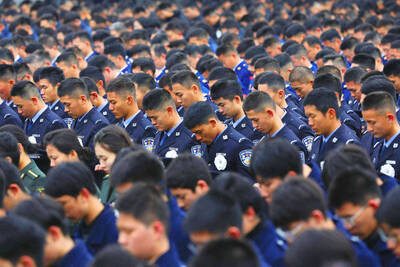
China yesterday held a low-key memorial ceremony for the 1937 Nanjing Massacre, with Chinese President Xi Jinping (習近平) not attending, despite a diplomatic crisis between Beijing and Tokyo over Taiwan. Beijing has raged at Tokyo since Japanese Prime Minister Sanae Takaichi last month said that a hypothetical Chinese attack on Taiwan could trigger a military response from Japan. China and Japan have long sparred over their painful history. China consistently reminds its people of the 1937 Nanjing Massacre, in which it says Japanese troops killed 300,000 people in what was then its capital. A post-World War II Allied tribunal put the death toll

A passerby could hear the cacophony from miles away in the Argentine capital, the unmistakable sound of 2,397 dogs barking — and breaking the unofficial world record for the largest-ever gathering of golden retrievers. Excitement pulsed through Bosques de Palermo, a sprawling park in Buenos Aires, as golden retriever-owners from all over Argentina transformed the park’s grassy expanse into a sea of bright yellow fur. Dog owners of all ages, their clothes covered in dog hair and stained with slobber, plopped down on picnic blankets with their beloved goldens to take in the surreal sight of so many other, exceptionally similar-looking ones.


 RSS
RSS