


Haiti’s president on Monday handed out medals to celebrities, aid group directors and politicians for post-earthquake work in a ceremony designed to beat back criticism of an uneven recovery that has left 1.6 million people homeless and destitute six months to the day since the disaster.
Just out of sight, baking in the oppressive noonday sun, were the fraying tarps of tens of thousands of homeless who live on the Champ de Mars, once a grassy promenade surrounding the government complex.
“That is just a way to put the people to sleep. But the people are suffering,” Edouard James, a 32-year-old vendor, said when he was told of the ceremony.
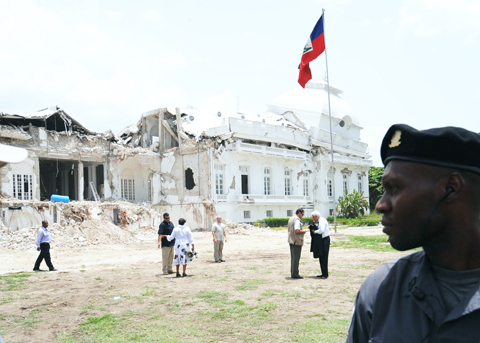
PHOTO: AFP
Unable to find a job with his degree in diplomacy, he sells pirated DVDs in a tarp-covered booth.
“We are tired of the NGOs ... saying we will have a better life and better conditions, and then nothing happens,” he said.
Twenty-three honorees — including actor Sean Penn, CNN anchor Anderson Cooper and the head of the UN peacekeeping mission — crossed a podium in front of the crushed, unrepaired national palace to steady applause. Some smiling, some solemn, each received medals and certificates deeming them Knights of the National Order of Honor and Merit.
Haitian President Rene Preval, whose successor is to be elected in November, defended the response to the quake. He said in two speeches during the ceremony that hard-to-see successes — like the avoidance of massive disease outbreaks and violence — obviates the perception that not enough has been done.
“There are people who did not see all the big efforts that were deployed during the emergency stage: Distributing tents, water, food, installing latrines, providing healthcare during the six months that have just gone by,” Preval said. “It is a major, major task.”
The ceremony was resolutely upbeat. The focus was on successes past and plans going forward, with little talk of the 230,000 to 300,000 people killed in the magnitude 7 temblor.
The president and Haitian Prime Minister Jean-Max Bellerive both used the occasion to announce that a six-month emergency phase has ended and that reconstruction has begun.
The distinction was lost on some Haitians.
“I don’t know if I’m mad or happy,” said Anne Bernard, a 24-year-old mother of two living in a metal shack a few hundred yards from the national palace. “All I know is they haven’t done anything.”
The most visible early emergency programs such as massive food distributions have stopped, and there still are few tangible effects of US$3.1 billion in humanitarian aid for all but a handful of those left homeless by the quake, who rely on plastic tarps for shelter.
Tarp-and-tent camps are growing instead of shrinking. Just 5,657 transitional shelters have been built of a promised 125,000, which even if completed would not be nearly enough for everyone.
When building materials finally get through customs, there is nowhere to put them. Fights over land rights, customs delays and systemically slow coordination between aid groups and the government have hampered nearly everything. It was reported on Sunday that the location of the largest of two relocation camps provided by the government was the result of an inside deal.
Shortly after the ceremony ended, that camp flooded in a sudden summer squall, with 94 deluxe tents collapsing in the wind and rain.
Compounding the problem in the city is that almost no rubble has been cleared. Preval said on Monday it would take US$1.5 billion to remove all of it.
Meanwhile donors have met 10 percent of a promised US$5.3 billion in reconstruction aid — separate from the humanitarian aid — mostly by forgiving debts, not providing cash.
CNN’s Cooper, who spent parts of January and February in Haiti following the quake and had not returned since, said he found out about the award while getting ready to board his plane to Haiti on Sunday.
“I thought a long time about not accepting it. We finally came to the opinion that it was recognition by the country for all journalists,” he told resident reporters after the ceremony. “I don’t think this in any way impacts the desire or willingness to be critical of the government.”

‘CROSSING THE LINE’: China’s embassy in Seoul criticized US Forces Korea Commander General Xavier Brunson, asking if his ‘hostile’ remarks were authorized by Washington South Korea and the US are in talks over recent public remarks by the commander of US Forces Korea, Seoul’s presidential office said yesterday, after the comments drew sharp criticism from China. In a recent podcast interview, US Forces Korea Commander General Xavier Brunson described South Korea as “the dagger in the heart of Asia” from China’s east coast, prompting the Chinese embassy in Seoul to say that he had “truly crossed the line.” The interview came amid growing speculation that Washington might seek to expand the role of US Forces Korea in countering the growing regional influence of China, a key

Through the noise of rushing papers and whirring belts at a print factory in Kyoto, two creators watch their photo essay come to life in broadsheet form — part of an effort to win new audiences in the age of artificial intelligence (AI). Despite the decline of the publishing industry, self-publication and handmade “zine” magazines are growing in popularity in Japan, reflecting the nation’s enduring love of paper in the digital era. While speaking to Agence France-Presse at the plant, his hands black with ink, one of the creators, Kazuma Obara, said: “I think [paper] is a medium that engages all five

Australian researchers have trained lab-grown brain cells on a silicon computer chip to play the 1990s shooter game Doom and said they are just scratching the surface of what the neurons could be capable of doing. It is the science-fiction work of biotech boffins at Cortical Labs, who researched and developed the technology that harnesses the workings of the brain’s networking system. Each so-called “biological computer” contains about 200,000 living human brain cells, grown from stem cells that were harvested from blood donations. Having mastered the simple computer game Pong, where a paddle is moved up and down to send a ball

France experienced its hottest spring on record, the French weather service said on Tuesday, after an exceptional early heat wave that also broke highs for the season in England and Wales. Meteo-France said the average nationwide temperature over March to May was 13.8°C — about 1.7°C above the norm, and surpassing records set in 2011 and 2020. “The warmest spring since records began in 1900,” it said in a bulletin. All three months were warmer than average, but the onset of an “unprecedented heatwave” late last month pushed the mercury to highs typically seen at the height of the summer. “Our country had never


 RSS
RSS