


Artifacts of a battle between a Native American tribe and English settlers, a confrontation that helped shape early US history, have sat for years below manicured lawns and children’s swing sets in a Connecticut neighborhood.
A project to map the battlefields of the Pequot War is bringing those musket balls, gunflints and arrowheads into the sunlight for the first time in centuries. It’s also giving researchers insight into the combatants and the land on which they fought, particularly the Mystic hilltop where at least 400 Pequot Indians died in a 1637 massacre by English settlers.
Historians say the attack was a turning point in English warfare with native tribes. It nearly wiped out the powerful Pequots and showed other tribes that the colonists wouldn’t hesitate to use methods that some consider genocide.
The battle site was farmland for years before being developed in the mid-20th century into a residential neighborhood of tidy homes.
A “Tree of Peace” is planted at a hilltop traffic circle that marks the center of an old Pequot fort.
“We never thought much about it when we moved here, though we’d get calls once in a while from researchers,” said Doris Oliver, who has lived on Pequot Avenue on the northern part of the battle zone with her husband since the 1940s.
This summer, teams of researchers are scouring the Olivers’ yard with metal detectors, notebooks, small shovels and other archeological tools.
In Mystic, the work is being done only where landowners agree to it. None of the land can be taken over by the government or the Pequots, or restricted in use.
The work, being done with grants from the National Park Service’s American Battlefield Protection Program, will also look at related Pequot War battle spots elsewhere in Connecticut, on Rhode’s Island’s Block Island and in Dover Plains, New York.
The Pequot War, waged from 1636 to 1638, broke out as tensions escalated between that powerful tribe and English settlers, who were bolstered by other tribes angry at the aggressive Pequots.
After the Pequots’ fort was burned, those who escaped were slaughtered as they fled or caught and enslaved, either by the English or their tribal allies.
Today, the Mashantucket Pequots — descendants of survivors given to the Mohegans as slaves — operate the Foxwoods Resort Casino.
Another group, the Eastern Pequots, descend from survivors enslaved by the Narragansetts and live in nearby North Stonington.
Members of both tribes are part of this summer’s battlefield mapping and archeology project, a joint venture between the Mashantucket Pequot Museum and Research Center at Foxwoods and the University of Connecticut.
“A lot of people think the Pequot War was just the one massacre, this single site, but it’s so much more than that,” said Joseph Peters Jr, 24, a Mashantucket Pequot. “There’s so much culture sitting under the ground, under the earth, for so long just waiting to be discovered.”
The researchers have already found remnants of English metal uniform buttons, bandoliers and other items that might help mark where settlers marched, camped before the attack and retreated afterward. The artifacts are being cataloged at the museum and will be kept and displayed there.
“I tell people all the time, history and archeology are right in your backyards, right under your feet, and this is a classic example of that,” Connecticut State Archeologist Nicholas Bellantoni said.
“The Pequot War is a short time ago, actually, by an archeologist’s reckoning, so absolutely the potential is there to recover some very significant artifacts,” Bellatoni said.

China’s military news agency yesterday warned that Japanese militarism is infiltrating society through series such as Pokemon and Detective Conan, after recent controversies involving events at sensitive sites. In recent days, anime conventions throughout China have reportedly banned participants from dressing as characters from Pokemon or Detective Conan and prohibited sales of related products. China Military Online yesterday posted an article titled “Their schemes — beware the infiltration of Japanese militarism in culture and sports.” The article referenced recent controversies around the popular anime series Pokemon, Detective Conan and My Hero Academia, saying that “the evil influence of Japanese militarism lives on in

DIPLOMATIC THAW: The Canadian prime minister’s China visit and improved Beijing-Ottawa ties raised lawyer Zhang Dongshuo’s hopes for a positive outcome in the retrial China has overturned the death sentence of Canadian Robert Schellenberg, a Canadian official said on Friday, in a possible sign of a diplomatic thaw as Canadian Prime Minister Mark Carney seeks to boost trade ties with Beijing. Schellenberg’s lawyer, Zhang Dongshuo (張東碩), yesterday confirmed China’s Supreme People’s Court struck down the sentence. Schellenberg was detained on drug charges in 2014 before China-Canada ties nosedived following the 2018 arrest in Vancouver of Huawei chief financial officer Meng Wanzhou (孟晚舟). That arrest infuriated Beijing, which detained two Canadians — Michael Spavor and Michael Kovrig — on espionage charges that Ottawa condemned as retaliatory. In January

A sign hanging from a rusty ice-green shipping container installed by Thai forces on what they say is the border with Cambodia reads: “Cambodian citizens are strictly prohibited from entering this area.” On opposite sides of the makeshift barricade, fronted by coils of barbed wire, Cambodians lamented their lost homes and livelihoods as Thailand’s military showed off its gains. Thai forces took control of several patches of disputed land along the border during fighting last year, which could amount to several square kilometers in total. Cambodian Kim Ren said her house in Chouk Chey used to stand on what is now the Thai
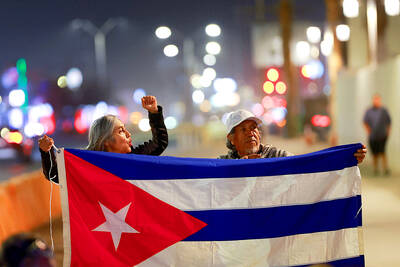
NEW RULES: There would be fewer school days, four-day workweeks, and a reduction in transportation services as the country battles a crisis exacerbated by US pressure The Cuban government on Friday announced emergency measures to address a crippling energy crisis worsened by US sanctions, including the adoption of a four-day work week for state-owned companies and fuel sale restrictions. Cuban Deputy Prime Minister Oscar Perez-Oliva Fraga blamed Washington for the crisis, telling Cuban television the government would “implement a series of decisions, first and foremost to guarantee the vitality of our country and essential services, without giving up on development.” “Fuel will be used to protect essential services for the population and indispensable economic activities,” he said. Among the new measures are the reduction of the working week in


 RSS
RSS