


Kyrgyz interim President Roza Otunbayeva was to meet with representatives of foreign observer missions yesterday after voters overwhelmingly backed a new constitution in a controversial referendum.
More than 90 percent of voters in Sunday’s poll backed the new charter that would set up ex-Soviet Central Asia’s first parliamentary democracy, according to preliminary results based on more than 99 percent of electoral districts.
But opposition leaders said the figures were impossibly high given the fallout from this month’s ethnic violence that killed hundreds.
Just 8 percent voted against, on the back of a mass turnout of 69.5 percent, the results indicate.
The vote was hailed as a “victory” by Otunbayeva, who came to power in April amid riots that ousted former president Kurmanbek Bakiyev. Not everyone agrees.
“I highly doubt that the central election commission’s data reflects the real picture,” said Adakhan Madumarov, leader of the Batun Kyrgyzstan party.
Liberal former interior minister and chief of the Ata-Zhurt opposition party Omurbek Suvanaliyev called the figures “fantastical” and accused the interim government of “massive falsification” in the registration of voters.
However, fear of further conflict and fatigue from the violence seemed to be major factors driving the unexpectedly high turnout.
“Almost everyone voted because without legitimacy there is no government and because they want peace and stability,” said Raikhan Samidinova, an ethnic Kyrgyz musician in Osh.
The Organisation for Security and Co-operation in Europe (OSCE) praised the interim government for its handling of the vote, despite evidence of “shortcomings.”
Meanwhile, Kazakh President Nursultan Nazarbayev said yesterday that violence in Kyrgyzstan could stir ethnic tension in Central Asia and encourage crime.
“Chaos and destabilization in the region play into the hands of criminals engaged in the illegal trade of drugs, arms and human trafficking,” he said.
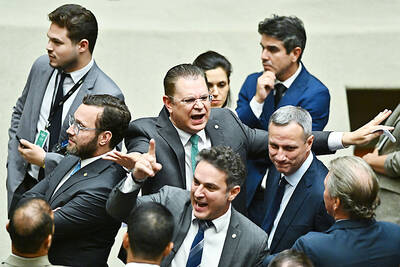
PARLIAMENT CHAOS: Police forcibly removed Brazilian Deputy Glauber Braga after he called the legislation part of a ‘coup offensive’ and occupied the speaker’s chair Brazil’s lower house of Congress early yesterday approved a bill that could slash former Brazilian president Jair Bolsonaro’s prison sentence for plotting a coup, after efforts by a lawmaker to disrupt the proceedings sparked chaos in parliament. Bolsonaro has been serving a 27-year term since last month after his conviction for a scheme to stop Brazilian President Luiz Inacio Lula da Silva from taking office after the 2022 election. Lawmakers had been discussing a bill that would significantly reduce sentences for several crimes, including attempting a coup d’etat — opening up the prospect that Bolsonaro, 70, could have his sentence cut to

A powerful magnitude 7.6 earthquake shook Japan’s northeast region late on Monday, prompting tsunami warnings and orders for residents to evacuate. A tsunami as high as three metres (10 feet) could hit Japan’s northeastern coast after an earthquake with an estimated magnitude of 7.6 occurred offshore at 11:15 p.m. (1415 GMT), the Japan Meteorological Agency (JMA) said. Tsunami warnings were issued for the prefectures of Hokkaido, Aomori and Iwate, and a tsunami of 40cm had been observed at Aomori’s Mutsu Ogawara and Hokkaido’s Urakawa ports before midnight, JMA said. The epicentre of the quake was 80 km (50 miles) off the coast of
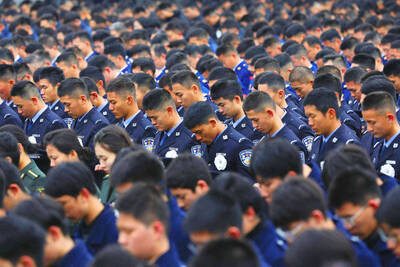
China yesterday held a low-key memorial ceremony for the 1937 Nanjing Massacre, with Chinese President Xi Jinping (習近平) not attending, despite a diplomatic crisis between Beijing and Tokyo over Taiwan. Beijing has raged at Tokyo since Japanese Prime Minister Sanae Takaichi last month said that a hypothetical Chinese attack on Taiwan could trigger a military response from Japan. China and Japan have long sparred over their painful history. China consistently reminds its people of the 1937 Nanjing Massacre, in which it says Japanese troops killed 300,000 people in what was then its capital. A post-World War II Allied tribunal put the death toll

A passerby could hear the cacophony from miles away in the Argentine capital, the unmistakable sound of 2,397 dogs barking — and breaking the unofficial world record for the largest-ever gathering of golden retrievers. Excitement pulsed through Bosques de Palermo, a sprawling park in Buenos Aires, as golden retriever-owners from all over Argentina transformed the park’s grassy expanse into a sea of bright yellow fur. Dog owners of all ages, their clothes covered in dog hair and stained with slobber, plopped down on picnic blankets with their beloved goldens to take in the surreal sight of so many other, exceptionally similar-looking ones.


 RSS
RSS