


Toronto police clashed with protesters for a second straight day on Sunday, with a final standoff played out in the downtown core near the just-finished G20 summit of world leaders.
Police said that 605 protesters had been arrested by late afternoon, while onlookers said many of those arrested came from peaceful protests. The running tally did not include the dozens seen detained by a Reuters witness just blocks away from where the G20 leaders wrapped up talks focused on fixing the ills of the global economy.
Trouble began on Saturday when the anarchists broke away from the main peaceful protest by trade unions and other groups around the summit conference center, and began smashing the windows of banks and chain stores and setting alight police patrol cars in the shopping and financial districts. Footage from the Canadian broadcaster CTV also showed them looting, and threatening photographers.
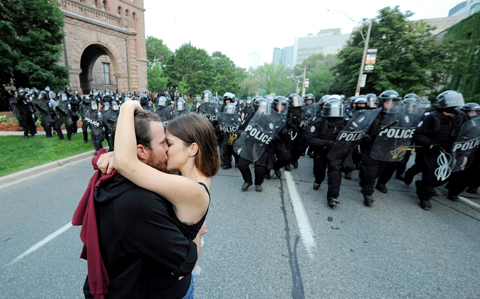
PHOTO: EPA
Police armed with batons, tear gas, pepper spray and plastic bullets were deployed with mounted officers to try to control the violence, news reports said.
The standoff on Sunday lasted more than five hours, from the late afternoon through to the late evening, as hundreds of police in full riot gear hemmed in protesters at a normally busy downtown intersection. A heavy downpour and a severe thunderstorm warning added to the drama as the standoff continued until 9:43pm.
“We had evidence of Black Bloc [anarchist] people, we had people donning masks in that very group, that’s exactly how everything started yesterday,” said Staff Sergeant Jeff McGuire in explaining why police opted to move against the protesters.
The operation ended abruptly after a heavy downpour, and police released most of the crowd unconditionally, McGuire told reporters. He could not confirm the number arrested.
Earlier, police confronted another group of protesters and fired tear gas for a second straight day. That clash occurred after hundreds of protesters marched on a temporary detention center for demonstrators arrested in Saturday’s riots.
Witnesses saw at least two muzzle blasts, and a police spokeswoman confirmed that “individual applications of tear gas” were fired on the crowd. The blasts are typically used against individuals at close range.
During Saturday’s violence police used tear gas against the public for the first time ever in Toronto.
Among those detained, on charges ranging from mischief to assaulting police, were four people who climbed through the sewer system and emerged near the lock-down area where world leaders were attending the summit.
About 70 people also were detained after police raided the University of Toronto’s downtown campus. Police said they seized weapons, including bricks, rocks and sticks.
A local TV station said that four of its reporters were also among those arrested at the Sunday evening standoff.
“Police are continuing to arrest people who engage in criminal activity,” police spokeswoman Jenn Geary said. “Media are treated just the way anyone else is. If they breach security they’re going to be arrested.”
There was anger at some of the police tactics. In scenes broadcast live in Toronto, an officer in riot gear could be seen striking an apparently unarmed protester several times during a standoff between lines of protesters and police. A Montreal journalist, Stefan Christoff, said he was hit many times by a riot policeman with plastic-coated metal baton after chanting slogans opposed to the G20.
Steve Paikin, who presents TV Ontario’s current affairs program Agenda, saw riot police with rubber bullet guns and smoke bombs break up a peaceful protest which was “like an old sit-in,” he said.
“No one was aggressive, and yet riot squad officers moved in,” he wrote on Twitter. “Police on one side screamed at the crowd to leave one way. Then police on the other side said leave the other way. There was no way out. So the police just started arresting people. This was a peaceful, middle-class crowd. No anarchists. Literally more than 100 officers with guns pointing at the crowd.”
“This is the criminalization of dissent,” said Chelsea Flook, with the Toronto Community Mobilization Network, just after police raided a protester convergence place run by the group in search of members of the Black Bloc.
The tight security has angered some in the city and L Ian MacDonald, a columnist for the Toronto Star, said the city “looked like West Berlin, 1961, not Toronto, 2010.”

‘CROSSING THE LINE’: China’s embassy in Seoul criticized US Forces Korea Commander General Xavier Brunson, asking if his ‘hostile’ remarks were authorized by Washington South Korea and the US are in talks over recent public remarks by the commander of US Forces Korea, Seoul’s presidential office said yesterday, after the comments drew sharp criticism from China. In a recent podcast interview, US Forces Korea Commander General Xavier Brunson described South Korea as “the dagger in the heart of Asia” from China’s east coast, prompting the Chinese embassy in Seoul to say that he had “truly crossed the line.” The interview came amid growing speculation that Washington might seek to expand the role of US Forces Korea in countering the growing regional influence of China, a key

Through the noise of rushing papers and whirring belts at a print factory in Kyoto, two creators watch their photo essay come to life in broadsheet form — part of an effort to win new audiences in the age of artificial intelligence (AI). Despite the decline of the publishing industry, self-publication and handmade “zine” magazines are growing in popularity in Japan, reflecting the nation’s enduring love of paper in the digital era. While speaking to Agence France-Presse at the plant, his hands black with ink, one of the creators, Kazuma Obara, said: “I think [paper] is a medium that engages all five

Australian researchers have trained lab-grown brain cells on a silicon computer chip to play the 1990s shooter game Doom and said they are just scratching the surface of what the neurons could be capable of doing. It is the science-fiction work of biotech boffins at Cortical Labs, who researched and developed the technology that harnesses the workings of the brain’s networking system. Each so-called “biological computer” contains about 200,000 living human brain cells, grown from stem cells that were harvested from blood donations. Having mastered the simple computer game Pong, where a paddle is moved up and down to send a ball

France experienced its hottest spring on record, the French weather service said on Tuesday, after an exceptional early heat wave that also broke highs for the season in England and Wales. Meteo-France said the average nationwide temperature over March to May was 13.8°C — about 1.7°C above the norm, and surpassing records set in 2011 and 2020. “The warmest spring since records began in 1900,” it said in a bulletin. All three months were warmer than average, but the onset of an “unprecedented heatwave” late last month pushed the mercury to highs typically seen at the height of the summer. “Our country had never


 RSS
RSS