


Chinese companies this month quietly signed a contract to cooperate in building two nuclear reactors at Pakistan’s Chashma atomic complex, advancing a controversial project that has worried Washington and India.
The China Nuclear Industry Fifth Construction Company and the CNNC China Zhongyuan Engineering Corp, which specializes in foreign nuclear projects, agreed to work together on the third and fourth plants at the Chashma complex, according to a Chinese-language announcement on the Web site of the construction company (www.cnfc.net.cn).
The deal, signed in Shanghai on June 8, confirmed that long-running plans about Chinese help in expanding Chashma are moving forward, despite misgivings in the region and beyond about security and proliferation risks in troubled Pakistan.
A Pakistani government official said there was nothing new in the agreement and that it was part of an ongoing cooperation with China in the peaceful use of nuclear energy.
COOPERATION
“China has long been cooperating with Pakistan for the use of nuclear technology for peaceful purposes and this cooperation is continuing,” the official said.
The pressurized water reactors are “a major cooperative project between China and Pakistan that both governments treat as highly important,” said the company announcement dated the same day as the signing, which received almost no domestic media attention at the time.
The project will “bring Chinese nuclear energy to the world and is significant for once again bearing firm fruit for Sino-Pakistani friendship,” the company statement said.
It did not give any details about the timing and cost of the project. The companies have worked on earlier reactors at Chashma.
Mounting signs that China will proceed with the reactor project in Punjab province have stirred international misgivings, especially in neighboring India and the US. The US said this month it wanted clarification from China on the proposed plants, which have been under planning and deepening negotiation for years.
WEAPONS
Pakistan and India are wary rivals, and both possess nuclear weapons and stay outside the nuclear Non-Proliferation Treaty.
Islamabad has looked to Beijing to counter to Indian influence.
Pakistan also faces severe power shortages. China says its nuclear cooperation with Pakistan is purely peaceful and follows international safeguards.
The proposed nuclear deal may be discussed this week by the Nuclear Suppliers Group (NSG), a body of 46 governments that seek to control access to their nuclear fuel and reactor technology to prevent the spread of atomic weapons.
China and the US are among the NSG members, who will meet in New Zealand.
MISGIVINGS
In 2008, China allowed a nuclear energy agreement between Washington and Delhi to win NSG approval, despite misgivings in Beijing, long a rival of India, and criticism from other capitals that the deal eroded nuclear non-proliferation rules.
China has said that the two proposed reactors “form part of an earlier agreement with Pakistan that predated its NSG membership, thereby denying that the sale would violate NSG guidelines,” said Lora Saalman, an associate in Beijing with the Carnegie Endowment for International Peace, who studies nuclear diplomacy between emerging Asian powers China and India.

PARLIAMENT CHAOS: Police forcibly removed Brazilian Deputy Glauber Braga after he called the legislation part of a ‘coup offensive’ and occupied the speaker’s chair Brazil’s lower house of Congress early yesterday approved a bill that could slash former Brazilian president Jair Bolsonaro’s prison sentence for plotting a coup, after efforts by a lawmaker to disrupt the proceedings sparked chaos in parliament. Bolsonaro has been serving a 27-year term since last month after his conviction for a scheme to stop Brazilian President Luiz Inacio Lula da Silva from taking office after the 2022 election. Lawmakers had been discussing a bill that would significantly reduce sentences for several crimes, including attempting a coup d’etat — opening up the prospect that Bolsonaro, 70, could have his sentence cut to

A powerful magnitude 7.6 earthquake shook Japan’s northeast region late on Monday, prompting tsunami warnings and orders for residents to evacuate. A tsunami as high as three metres (10 feet) could hit Japan’s northeastern coast after an earthquake with an estimated magnitude of 7.6 occurred offshore at 11:15 p.m. (1415 GMT), the Japan Meteorological Agency (JMA) said. Tsunami warnings were issued for the prefectures of Hokkaido, Aomori and Iwate, and a tsunami of 40cm had been observed at Aomori’s Mutsu Ogawara and Hokkaido’s Urakawa ports before midnight, JMA said. The epicentre of the quake was 80 km (50 miles) off the coast of
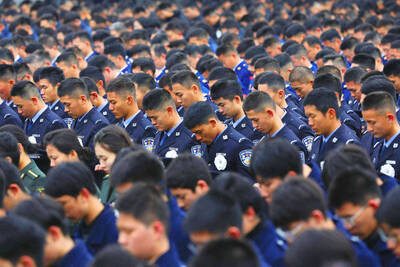
China yesterday held a low-key memorial ceremony for the 1937 Nanjing Massacre, with Chinese President Xi Jinping (習近平) not attending, despite a diplomatic crisis between Beijing and Tokyo over Taiwan. Beijing has raged at Tokyo since Japanese Prime Minister Sanae Takaichi last month said that a hypothetical Chinese attack on Taiwan could trigger a military response from Japan. China and Japan have long sparred over their painful history. China consistently reminds its people of the 1937 Nanjing Massacre, in which it says Japanese troops killed 300,000 people in what was then its capital. A post-World War II Allied tribunal put the death toll

A passerby could hear the cacophony from miles away in the Argentine capital, the unmistakable sound of 2,397 dogs barking — and breaking the unofficial world record for the largest-ever gathering of golden retrievers. Excitement pulsed through Bosques de Palermo, a sprawling park in Buenos Aires, as golden retriever-owners from all over Argentina transformed the park’s grassy expanse into a sea of bright yellow fur. Dog owners of all ages, their clothes covered in dog hair and stained with slobber, plopped down on picnic blankets with their beloved goldens to take in the surreal sight of so many other, exceptionally similar-looking ones.


 RSS
RSS