


Canadian Prime Minister Stephen Harper offered an apology on Wednesday to the families of those killed in the Air India terrorist attack, acknowledging that for 25 years they were treated with scant respect or consideration by the government and Canadians.
The bombing of Air India Flight 182 killed 329 people in one of the world’s deadliest terrorist strikes. It is the largest case of mass murder in Canadian history.
Harper said at a memorial marking the 25th anniversary of the tragedy that Canadians sadly did not accept that it was a Canadian tragedy.
Many white Canadians didn’t consider it an attack on Canadians because most of the victims were of Indian descent, as were the alleged attackers.
The prime minister said the families were treated with administrative disdain when they had a legitimate need for answers.
“I stand before you therefore, to offer on behalf of the government of Canada, and all Canadians, an apology for the institutional failings of 25 years ago and the treatment of the victims’ families thereafter,” Harper said.
The Air India flight from Montreal to London, originating in Vancouver, exploded and crashed off Ireland on June 23, 1985 — killing 278 Canadians.
An hour earlier, a bomb in baggage intended for another Air India flight exploded in the Tokyo airport, killing two baggage handlers.
The attacks were blamed on Sikh militants based in British Columbia who, prosecutors said, sought revenge for a deadly 1984 raid by Indian forces on the Golden Temple in Amritsar, the holiest site of their religion. About 800 Sikhs, including militants taking refuge in the temple, lost their lives.
A Canadian public inquiry concluded last week that authorities should have known an Air India flight in 1985 was a likely terrorist target. Former Canadian Supreme Court justice John Major said a cascading series of errors contributed to the failure of Canada’s police and security forces to prevent the atrocity.
Major’s report also recommended compensation for the families who, he said, were often treated as adversaries.
Before the bombings, Canadian intelligence officials had apparently learned of the plot by Sikh separatists in Canada and India to launch a terror attack.
All those aboard — chiefly Canadian citizens of Indian heritage bound for New Delhi and Mumbai — died as the Boeing 747 disintegrated and plunged 9,500m into the ocean about 190km off Ireland.
Only 131 bodies were recovered. Eighty-two of those aboard were children.
Inderit Singh Reyat, an electrician from Duncan, British Columbia, was convicted of manslaughter in the bombings. He remains the only suspect ever convicted of a role in the attacks.
Two other accused from British Columbia were brought to trial, but never convicted.
“This atrocity was conceived in Canada, executed in Canada, by Canadian citizens, and its victims were themselves mostly citizens of Canada,” Harper said. “We wish this realization had gained common acceptance earlier.”
Memorials were also planned for Vancouver and Ottawa.

Australians were downloading virtual private networks (VPNs) in droves, while one of the world’s largest porn distributors said it was blocking users from its platforms as the country yesterday rolled out sweeping online age restriction. Australia in December became the first country to impose a nationwide ban on teenagers using social media. A separate law now requires artificial intelligence (AI)-powered chatbot services to keep certain content — including pornography, extreme violence and self-harm and eating disorder material — from minors or face fines of up to A$49.5 million (US$34.6 million). The country also joined Britain, France and dozens of US states requiring
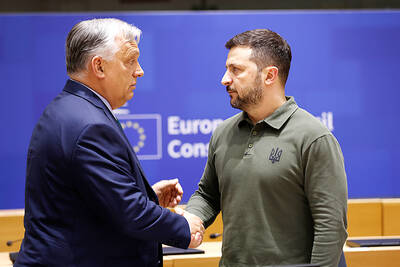
Hungarian authorities temporarily detained seven Ukrainian citizens and seized two armored cars carrying tens of millions of euros in cash across Hungary on suspicion of money laundering, officials said on Friday. The Ukrainians were released on Friday, following their detention on Thursday, but Hungarian officials held onto the cash, prompting Ukraine to accuse Hungary’s Russia-friendly government of illegally seizing the money. “We will not tolerate this state banditism,” Ukrainian Minister of Foreign Affairs Andrii Sybiha said. The seven detained Ukrainians were employees of the Ukrainian state-owned Oschadbank, who were traveling in the two armored cars that were carrying the money between Austria and
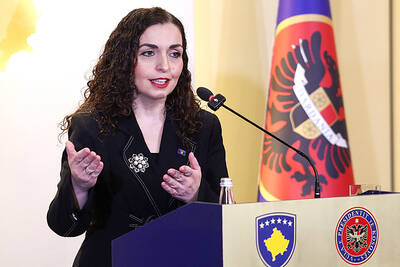
Kosovar President Vjosa Osmani on Friday after dissolving the Kosovar parliament said a snap election should be held as soon as possible to avoid another prolonged political crisis in the Balkan country at a time of global turmoil. Osmani said it is important for Kosovo to wrap up the upcoming election process and form functional institutions for political stability as the war rages in the Middle East. “Precisely because the geopolitical situation is that complex, it is important to finish this electoral process which is coming up,” she said. “It is very hard now to imagine what will happen next.” Kosovo, which declared

MORE BANS: Australia last year required sites to remove accounts held by under-16s, with a few countries pushing for similar action at an EU level and India considering its own ban Indonesia on Friday said it would ban social media access for children under 16, citing threats from online pornography, cyberbullying, online fraud and Internet addiction. “Accounts belonging to children under 16 on high-risk platforms will start to be deactivated, beginning with YouTube, TikTok, Facebook, Instagram, Threads, X, Bigo Live and Roblox,” Indonesian Minister of Communications and Digital Meutya Hafid said. “The government is stepping in so that parents no longer have to fight alone against the giants of the algorithm. Implementation will begin on March 28, 2026,” she said. The social media ban would be introduced in stages “until all platforms fulfill their


 RSS
RSS