


The CIA on Wednesday released a massive amount of documents dealing with the Korean War, some of which point to the young agency’s failure in the late 1940s to understand crucial events on the Korean Peninsula in the run-up to the conflict.
One CIA analysis said “American military and civilian leaders were caught by surprise” when North Korean troops moved across the 38th Parallel in June 1950.
“Only the intercession of poorly trained and equipped US garrison troops from Japan managed to halt the North Korean advance at a high price in American dead and wounded,” the report said.
That document, Two Strategic Intelligence Mistakes in Korea, 1950, also describes how US military and civilian leaders were caught off-guard four months later when the Chinese “intervened in massive numbers as American and UN forces pushed the North Koreans back.”
The release of the 1,300 CIA documents includes 900 papers that had either not been made public before or now contained new information. The CIA release coincides with the 60th anniversary this month of the Korean War’s start.
The CIA documents were released on a CD-ROM distributed at the Truman library to participants at a two-day conference on the Korean War. They were also to be made available on the CIA Web site.
The announcement of the papers also coincides with the release of hundreds of additional documents from the Woodrow Wilson International Center for Scholars in Washington and the Harry Truman Library and Museum.
The Truman library documents, which included audio clips of former US president Harry Truman and correspondence from then-secretary of state Dean Acheson, were being made available at the library, though some may eventually be released online, said museum director Michael Devine. The Wilson center’s documents are on its Web site.
The CIA documents include intelligence reports, correspondence and National Intelligence Estimates, and foreign media accounts of activity in the region.
CIA Deputy Director of Intelligence for Analytic Programs Peter Clement said the documents showed the CIA was “not very well-organized” at the time.
“They didn’t call the invasion,” he said. “It showed very clearly that we didn’t put the signs all together.”
Clement said the documents illustrate how the agency then relied on “a small crew of people who looked over the entire world,” as opposed to current iterations involving separate staffs each assigned to a specific region.
Some parallels remain, however, between the CIA in its early years and the agency today, which is still “doing some tea leaf reading.”
“Intelligence-wise, we have come far,” Clement said. “But at its core, the [job] of understanding leaders’ decisions ... is still a challenge.”
Program associate for the Woodrow Wilson center James Person said the documents his center had collected from 1955 to 1984 depict the “rocky relationship” between North Korea and China that continues today.
“We continue to get this wrong today, the North Koreans and the Chinese walking in lock step,” Person said. “The North Koreans can’t stand the Chinese ... It’s going to go on and on until we sit down and talk with them.”
Clayton Laurie, a CIA staff historian, said the “breadth” of the documents release indicates the Truman administration’s interest in the region.
“Even though this is not a primary area of interest for the Truman administration, they’re still reporting on this area,” he said.
Michael Pearlman, a former professor at the US Army Command and General Staff College in Leavenworth, Kansas, and a conference participant, said he had hoped the release would include information on the circumstances of General Douglas MacArthur’s firing in 1951. From what he could tell, the documents had no such detail.
“It’s more than disappointing,” he said. “It’s a tragedy.”
Paul Edwards, founder of the Center for the Study of the Korean War at Graceland University in Independence, Missouri, said before he had seen the documents that he hoped to find information about former US president Dwight Eisenhower’s efforts to end the war.
“I’ll be terribly surprised if there’s anything too surprising” in the papers, he said.
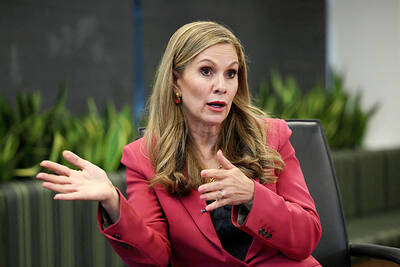
Australians were downloading virtual private networks (VPNs) in droves, while one of the world’s largest porn distributors said it was blocking users from its platforms as the country yesterday rolled out sweeping online age restriction. Australia in December became the first country to impose a nationwide ban on teenagers using social media. A separate law now requires artificial intelligence (AI)-powered chatbot services to keep certain content — including pornography, extreme violence and self-harm and eating disorder material — from minors or face fines of up to A$49.5 million (US$34.6 million). The country also joined Britain, France and dozens of US states requiring
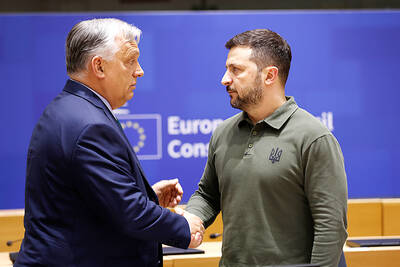
Hungarian authorities temporarily detained seven Ukrainian citizens and seized two armored cars carrying tens of millions of euros in cash across Hungary on suspicion of money laundering, officials said on Friday. The Ukrainians were released on Friday, following their detention on Thursday, but Hungarian officials held onto the cash, prompting Ukraine to accuse Hungary’s Russia-friendly government of illegally seizing the money. “We will not tolerate this state banditism,” Ukrainian Minister of Foreign Affairs Andrii Sybiha said. The seven detained Ukrainians were employees of the Ukrainian state-owned Oschadbank, who were traveling in the two armored cars that were carrying the money between Austria and
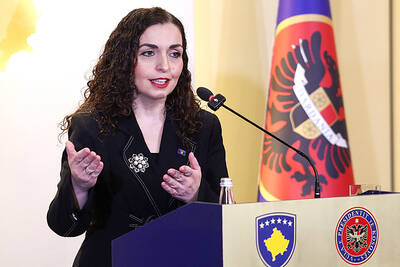
Kosovar President Vjosa Osmani on Friday after dissolving the Kosovar parliament said a snap election should be held as soon as possible to avoid another prolonged political crisis in the Balkan country at a time of global turmoil. Osmani said it is important for Kosovo to wrap up the upcoming election process and form functional institutions for political stability as the war rages in the Middle East. “Precisely because the geopolitical situation is that complex, it is important to finish this electoral process which is coming up,” she said. “It is very hard now to imagine what will happen next.” Kosovo, which declared

MORE BANS: Australia last year required sites to remove accounts held by under-16s, with a few countries pushing for similar action at an EU level and India considering its own ban Indonesia on Friday said it would ban social media access for children under 16, citing threats from online pornography, cyberbullying, online fraud and Internet addiction. “Accounts belonging to children under 16 on high-risk platforms will start to be deactivated, beginning with YouTube, TikTok, Facebook, Instagram, Threads, X, Bigo Live and Roblox,” Indonesian Minister of Communications and Digital Meutya Hafid said. “The government is stepping in so that parents no longer have to fight alone against the giants of the algorithm. Implementation will begin on March 28, 2026,” she said. The social media ban would be introduced in stages “until all platforms fulfill their


 RSS
RSS