


The inky skies over Australia’s Outback will, for a brief moment tonight, light up with a flash brighter than Venus as an asteroid-chasing Japanese space probe makes its delayed return to Earth.
The battered Hayabusa will complete a seven-year, 5-billion-kilometer journey in spectacular fashion shortly before midnight, breaking up and incinerating as it re-enters the atmosphere.
Down below, scientists will wait to see whether Hayabusa, three years behind schedule and hit by technical problems, has managed to gather the first-ever fragments from a moving asteroid, yielding vital clues about the universe.
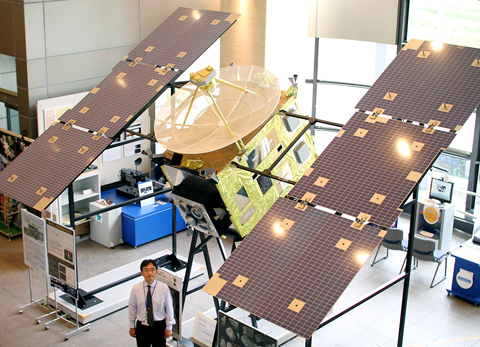
PHOTO: AFP
“Hayabusa will be the first space mission to have made physical contact with an asteroid and returned to Earth,” said Tommy Thompson, NASA’s Hayabusa project manager based in California.
“The mission and its team have faced and overcome several challenges over the past seven years. This round-trip journey is a significant space achievement,” he said.
FIREBALL
Hayabusa, or the peregrine falcon in Japanese, will dissolve into a fireball above Australia after releasing its sample canister, which is designed to withstand temperatures hotter than the sun’s surface before floating down on a parachute.
It blasted into space in May 2003 bound for Itokawa, a potato-shaped asteroid 300 million kilometers from Earth, to collect dust samples believed to yield unprecedented information about the evolution of the solar system.
“Hayabusa is hurtling toward Earth at an immense speed, comparable to that of an asteroid impact,” NASA’s Peter Jenniskens said this week. “The spacecraft will break into numerous pieces, essentially making it a manmade meteor.”
Jenniskens and a team of international astronomers will watch from a NASA jet at 12,000m as the 18kg canister re-enters at a blistering 1.93km per second.
Hayabusa became the world’s first spacecraft to land on and lift off a celestial body other than the moon after touching down on Itokawa, a “rubble-pile” asteroid, in September 2005.
However, the Japan Aerospace Exploration Agency (JAXA) is uncertain what, if anything, the 40cm by 20cm sample pod will contain, after systems designed to fire a pellet to stir up dust on the asteroid’s surface malfunctioned.
NASA’s Michael Zolensky said there was good reason to believe that the landing process alone would have kicked up enough dust for a sample, though he admitted the capsule was likely to return “less than a gram.”
‘NOT EMPTY’
“When we open it up, I think it is not going to be empty,” he said.
JAXA’s early observations, using Hayabusa’s on-board devices, show Itokawa’s fragments smashed away from a larger body during a crash, and its parent body was formed in the solar system’s embryonic stages.
“It’s a primitive celestial body that contains elements of an ancient era,” JAXA said. “It was born between several tens of millions and hundreds of millions of years ago.”
Once the dust pod is 10km above the ground, it will shed its heat shield and deploy a parachute and homing beacon to signal its exact landing location in the Woomera rocket-testing range, in the central Australian desert.
Australian authorities will escort JAXA scientists to the touchdown site, and the capsule will be retrieved by helicopter, for air-freighting by jet to ground control at Sagamihara, west of Tokyo.
There, it will be X-rayed, analyzed and finally opened by scientists from Japan, Australia and the US.
JAXA will then have a one-year exclusivity period to study the sample under microscope and infrared spectrometer, as well as to analyze its chemical and mineralogical composition.
INSIGHTS
Zolensky said space dust from Itokawa could provide valuable insights into the development of the solar system and information that could help minimize potential asteroid impacts with Earth.
Hayabusa’s mission was hit by serious technical troubles. It spun out of control and lost communication with JAXA for seven weeks, delaying its return for three years until the asteroid and Earth again aligned.
It is limping home on broken engines with wonky positional adjusters and faulty batteries, but Japan will welcome its return with thousands of devout fans lauding Hayabusa a national hero.

PARLIAMENT CHAOS: Police forcibly removed Brazilian Deputy Glauber Braga after he called the legislation part of a ‘coup offensive’ and occupied the speaker’s chair Brazil’s lower house of Congress early yesterday approved a bill that could slash former Brazilian president Jair Bolsonaro’s prison sentence for plotting a coup, after efforts by a lawmaker to disrupt the proceedings sparked chaos in parliament. Bolsonaro has been serving a 27-year term since last month after his conviction for a scheme to stop Brazilian President Luiz Inacio Lula da Silva from taking office after the 2022 election. Lawmakers had been discussing a bill that would significantly reduce sentences for several crimes, including attempting a coup d’etat — opening up the prospect that Bolsonaro, 70, could have his sentence cut to
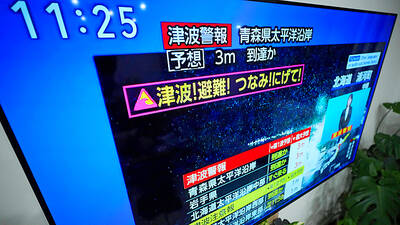
A powerful magnitude 7.6 earthquake shook Japan’s northeast region late on Monday, prompting tsunami warnings and orders for residents to evacuate. A tsunami as high as three metres (10 feet) could hit Japan’s northeastern coast after an earthquake with an estimated magnitude of 7.6 occurred offshore at 11:15 p.m. (1415 GMT), the Japan Meteorological Agency (JMA) said. Tsunami warnings were issued for the prefectures of Hokkaido, Aomori and Iwate, and a tsunami of 40cm had been observed at Aomori’s Mutsu Ogawara and Hokkaido’s Urakawa ports before midnight, JMA said. The epicentre of the quake was 80 km (50 miles) off the coast of
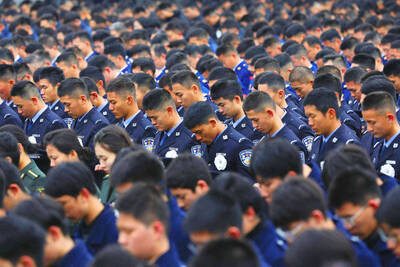
China yesterday held a low-key memorial ceremony for the 1937 Nanjing Massacre, with Chinese President Xi Jinping (習近平) not attending, despite a diplomatic crisis between Beijing and Tokyo over Taiwan. Beijing has raged at Tokyo since Japanese Prime Minister Sanae Takaichi last month said that a hypothetical Chinese attack on Taiwan could trigger a military response from Japan. China and Japan have long sparred over their painful history. China consistently reminds its people of the 1937 Nanjing Massacre, in which it says Japanese troops killed 300,000 people in what was then its capital. A post-World War II Allied tribunal put the death toll

A passerby could hear the cacophony from miles away in the Argentine capital, the unmistakable sound of 2,397 dogs barking — and breaking the unofficial world record for the largest-ever gathering of golden retrievers. Excitement pulsed through Bosques de Palermo, a sprawling park in Buenos Aires, as golden retriever-owners from all over Argentina transformed the park’s grassy expanse into a sea of bright yellow fur. Dog owners of all ages, their clothes covered in dog hair and stained with slobber, plopped down on picnic blankets with their beloved goldens to take in the surreal sight of so many other, exceptionally similar-looking ones.


 RSS
RSS