


Six months pregnant and with two toddlers to feed, saving the rainforest isn’t top of Marita Worjiloh’s list of priorities right now.
A log lies smoking amid burned, jagged tree stumps as Marita tosses seeds into the fertile soil gouged out of Liberia’s jungle.
She knows this traditional method of slash-and-burn farming is decimating woodlands, but “if I had something to do to make money I wouldn’t cut the forest down, because I know it is important. Without a forest we would not live a good life.”
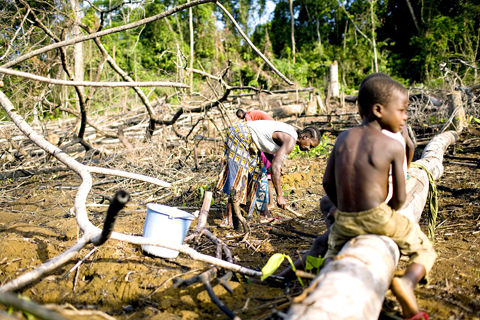
PHOTO: AFP
So while conservationists worry about preserving rainforests — a powerful aid against climate change — and the biodiversity they offer, it is poverty that drives this 23-year-old.
Liberia’s forest makes up 42 percent of what is left of the Upper Guinean Rainforest — just part of a fragmented system that once covered most of West Africa but has been reduced to 12 percent of its original reach.
The people of this west African nation have relied on the forest for food, medicine and even as a refuge during two successive civil conflicts from 1989 to 2003.
Villagers also have been razing large patches for farmland and hunting the wildlife for meat.
The threat of deforestation is real, with about 70 percent of the population involved in slash-and-burn farming, said Johansen Voker, the acting executive director of Liberia’s Environmental Protection Agency (EPA).
A traditional method used worldwide, slash-and-burn involves felling trees, burning their remains for nutrient-rich ash, and planting fast-growing crops such as rice and cassava.
The land should then be allowed to regenerate, but pressure from burgeoning populations often decreases this fallow period and can lead to permanent loss of forest cover.
Despite efforts to introduce more sustainable ways to live off the forest, poverty is the biggest threat to biodiversity, said Voker, leading to illegal logging, mining and burning charcoal as fuel.
“The population depends on the forest,” he said. “It is poverty that drives people into burning charcoal as a source of fuel and it is poverty that drives people into the kind of unsustainable farming we are talking about. What they think about is how they can cut down a tree to produce charcoal and that charcoal will put a bowl of rice on their table.”
According to a report t on deforestation by the UN Food and Agriculture Organization, Africa lost 3.4 million hectares of forest over the last decade, the second largest net loss after South America, which includes the Amazon.
Africa’s forest cover is concentrated in its western and central parts, but often in countries ravaged by war that has damaged their fragile environment through abuse of natural resources and massive population displacement.
In West Africa, wars in Liberia and Sierra Leone sent more than a million refugees fleeing across their borders into forested regions of Guinea and the Ivory Coast, one of the planet’s most diverse biological regions.
For Richard Sambolah, technical adviser for the British-based organization Fauna and Flora International, Liberia’s conflict led to further exploitation of the forest.
“It just intensified poverty in the country,” he added, “there are no jobs and so almost 80 to 90 percent of the population depends on the forest.”
According to Voker, Liberia’s agriculture ministry is trying to aid farmers to adapt to sustainable methods such as lowland or swamp farming which can be more profitable and increase yield.
“But the farmers have to make drastic changes ... to adapt to this so-called new technology,” he cautioned, and might be reluctant to ditch the familiarity of traditional upland farming.
Voker said Liberia was losing up to two percent of its forest cover every year.
“If it is not checked you can imagine what happens 20 years from now ... the forest will be gone,” he said.

‘CROSSING THE LINE’: China’s embassy in Seoul criticized US Forces Korea Commander General Xavier Brunson, asking if his ‘hostile’ remarks were authorized by Washington South Korea and the US are in talks over recent public remarks by the commander of US Forces Korea, Seoul’s presidential office said yesterday, after the comments drew sharp criticism from China. In a recent podcast interview, US Forces Korea Commander General Xavier Brunson described South Korea as “the dagger in the heart of Asia” from China’s east coast, prompting the Chinese embassy in Seoul to say that he had “truly crossed the line.” The interview came amid growing speculation that Washington might seek to expand the role of US Forces Korea in countering the growing regional influence of China, a key

Through the noise of rushing papers and whirring belts at a print factory in Kyoto, two creators watch their photo essay come to life in broadsheet form — part of an effort to win new audiences in the age of artificial intelligence (AI). Despite the decline of the publishing industry, self-publication and handmade “zine” magazines are growing in popularity in Japan, reflecting the nation’s enduring love of paper in the digital era. While speaking to Agence France-Presse at the plant, his hands black with ink, one of the creators, Kazuma Obara, said: “I think [paper] is a medium that engages all five

Australian researchers have trained lab-grown brain cells on a silicon computer chip to play the 1990s shooter game Doom and said they are just scratching the surface of what the neurons could be capable of doing. It is the science-fiction work of biotech boffins at Cortical Labs, who researched and developed the technology that harnesses the workings of the brain’s networking system. Each so-called “biological computer” contains about 200,000 living human brain cells, grown from stem cells that were harvested from blood donations. Having mastered the simple computer game Pong, where a paddle is moved up and down to send a ball

France experienced its hottest spring on record, the French weather service said on Tuesday, after an exceptional early heat wave that also broke highs for the season in England and Wales. Meteo-France said the average nationwide temperature over March to May was 13.8°C — about 1.7°C above the norm, and surpassing records set in 2011 and 2020. “The warmest spring since records began in 1900,” it said in a bulletin. All three months were warmer than average, but the onset of an “unprecedented heatwave” late last month pushed the mercury to highs typically seen at the height of the summer. “Our country had never


 RSS
RSS