


Militants who attacked a minority sect, killing 93 people in the country’s east, belonged to the Pakistani Taliban and were trained in a lawless border region where the US wants Islamabad to mount an army operation, police said.
Saturday’s revelation could help the US persuade Pakistan that rooting out the various extremist groups in North Waziristan is in Islamabad’s own interest. Up to now, Pakistan has resisted, in part because it says its army is stretched thin in operations elsewhere.
Suspicion that the man accused of a failed bombing attempt in New York’s Times Square earlier this month may have received aid from the Pakistani Taliban has added to US urgency about clearing North Waziristan.
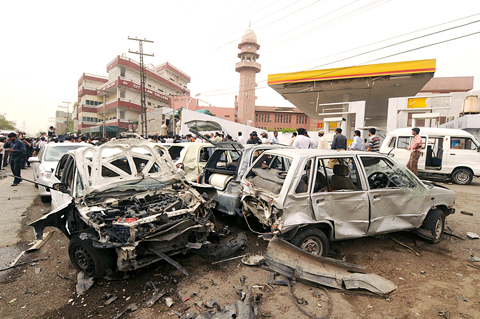
PHOTO: EPA
Local TV channels have reported the Pakistani Taliban, or an affiliate, had claimed responsibility for Friday’s attacks in Pakistan’s second-largest city.
Senior police officer Akram Naeem in Lahore said the interrogation of one of the arrested suspects revealed that the gunmen were involved with the Pakistani Taliban. The 17-year-old suspect told police the attackers had trained in the North Waziristan tribal region.
“Our initial investigation has found that they all belong to Tehrik-e-Taliban Pakistan,” or Pakistani Taliban movement, Naeem said. He said the suspect, “Abdullah alias Mohammad, was given terrorism training in Miran Shah” — the main city in North Waziristan.
North Waziristan has long been filled with militants focused on battling US and NATO forces across the border in Afghanistan. The Pakistani Taliban began arriving after army operations against them in other regions.
Before the Pakistani Taliban began operating in North Waziristan, Islamabad was believed to want to avoid taking on the area because the militant networks there were not threatening targets inside the country. Critics also suspect Pakistan wants to maintain good relations with some of those Afghan-focused militant networks so that it will have allies in Afghanistan once the US leaves the region.
Naeem would not rule out that Punjab Province-based militant groups played a role in the Lahore attacks, but would not mention any specific groups. The Pakistani Taliban have local affiliates and function as a coalition or network of militant organizations.
Pakistani Army chief spokesman Major General Athar Abbas, declined to comment on Saturday.
Friday’s attacks targeted the Ahmadi sect, a minority reviled by mainstream Muslims.
Two teams of gunmen, including some in suicide vests, stormed two mosques and sprayed bullets at worshippers while holding off police.
At least two of the seven attackers were captured, while some died in the standoff or by detonating their explosives.
Militants have used such tactics in attacking Pakistan’s US-allied government and foreign and security targets often in the past, but violence against religious minorities had previously not been waged in such a large-scale, sophisticated fashion.
Ahmadi leaders on Saturday demanded better government protection as they buried many of the victims. Waseem Sayed, a US-based Ahmadi spokesman, said it was the worst attack in the sect’s 121-year history.
The request could test the government’s willingness to take on hard-line Islamists whose influence is behind decades of state-sanctioned discrimination against the Ahmadis in the Sunni Muslim-majority country.

‘CROSSING THE LINE’: China’s embassy in Seoul criticized US Forces Korea Commander General Xavier Brunson, asking if his ‘hostile’ remarks were authorized by Washington South Korea and the US are in talks over recent public remarks by the commander of US Forces Korea, Seoul’s presidential office said yesterday, after the comments drew sharp criticism from China. In a recent podcast interview, US Forces Korea Commander General Xavier Brunson described South Korea as “the dagger in the heart of Asia” from China’s east coast, prompting the Chinese embassy in Seoul to say that he had “truly crossed the line.” The interview came amid growing speculation that Washington might seek to expand the role of US Forces Korea in countering the growing regional influence of China, a key

Through the noise of rushing papers and whirring belts at a print factory in Kyoto, two creators watch their photo essay come to life in broadsheet form — part of an effort to win new audiences in the age of artificial intelligence (AI). Despite the decline of the publishing industry, self-publication and handmade “zine” magazines are growing in popularity in Japan, reflecting the nation’s enduring love of paper in the digital era. While speaking to Agence France-Presse at the plant, his hands black with ink, one of the creators, Kazuma Obara, said: “I think [paper] is a medium that engages all five

Australian researchers have trained lab-grown brain cells on a silicon computer chip to play the 1990s shooter game Doom and said they are just scratching the surface of what the neurons could be capable of doing. It is the science-fiction work of biotech boffins at Cortical Labs, who researched and developed the technology that harnesses the workings of the brain’s networking system. Each so-called “biological computer” contains about 200,000 living human brain cells, grown from stem cells that were harvested from blood donations. Having mastered the simple computer game Pong, where a paddle is moved up and down to send a ball

France experienced its hottest spring on record, the French weather service said on Tuesday, after an exceptional early heat wave that also broke highs for the season in England and Wales. Meteo-France said the average nationwide temperature over March to May was 13.8°C — about 1.7°C above the norm, and surpassing records set in 2011 and 2020. “The warmest spring since records began in 1900,” it said in a bulletin. All three months were warmer than average, but the onset of an “unprecedented heatwave” late last month pushed the mercury to highs typically seen at the height of the summer. “Our country had never


 RSS
RSS