

Britain offered its first public accounting of its nuclear arsenal on Wednesday, disclosing that it has a stockpile of 225 warheads in a move that offers transparency to non-nuclear states in hopes of winning stricter global controls on the spread of atomic weapons.
The announcement, made without fanfare in the House of Commons, follows US President Barack Obama administration’s disclosure that the US has stockpiled 5,113 nuclear warheads and “several thousand” more retired warheads awaiting the junk pile — the first public description of the secretive arsenal born in the Cold War and now shrinking rapidly.
The US made the announcement at the May 3 opening of a five-year review of the Nuclear Nonproliferation Treaty, considered the cornerstone of global disarmament efforts, where Washington and its allies are seeking stronger measures to prevent the spread of nuclear arms. Britain made its announcement before the end of the monthlong conference at the UN today, with intense debate under way on a final document.
“We believe that the time is now right to be more open about the weapons we hold,” British Foreign Secretary William Hague told the House of Commons. “We judge that this will assist in building a climate of trust between nuclear and non-nuclear weapons states and contribute, therefore, to future efforts to reduce the number of nuclear weapons worldwide.”
Britain had earlier disclosed that it possessed 160 operational warheads, but Hague’s comments that the country’s “overall stockpile of nuclear warheads will not exceed 225 warheads” was the first time the maximum size of the total stockpile was revealed. The Foreign Office said the 225 figure was the number of warheads at present.
Countries that don’t possess nuclear weapons have long demanded more openness from the nuclear-weapon states — the US, Britain, France, Russia and China — about the size and nature of their arsenals as an essential step toward nuclear disarmament, which is a key plank in the Nuclear Nonproliferation Treaty.
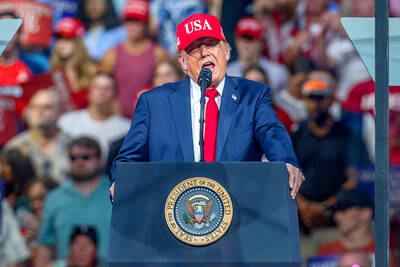
US President Donald Trump on Wednesday threatened to take action against the EU if it moves forward with European Commission President Ursula von der Leyen’s proposal to make Canada the bloc’s first associate member. “If they do that, if I think it’s at all a hostile act; I will put very serious tariffs or stop trading with Europe on many things,” Trump told reporters en route to an event in North Carolina, calling the proposal “laughable.” “If it’s a good intention, that’s fine. If it’s a bad intention, we’ll put very heavy tariffs on Europe,” he said. Von der Leyen made the proposal

SECRET FOOTAGE: A 17-year-old girl told British broadcaster Channel 4 that she had been approached by a man who covertly recorded her and their interaction Calls are growing louder in Europe for action against “pervert” smart glasses after secretly filmed footage of girls and women appeared online — with a petition in Britain demanding a ban on their sale. Anyone wearing smart glasses can take photos, film videos, listen to music, make phone calls, translate text or interact with an artificial intelligence (AI) assistant, with sales now hitting millions. The devices grabbed attention this summer after a marketing tie-up between Kylie Jenner, beauty mogul and member of the Kardashian dynasty, and tech giant Meta. Since smartphones are now embedded in daily life, “big tech” is
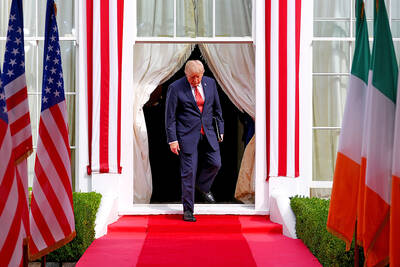
FROSTY RECEPTION: ‘I conveyed the strong view of the Irish people that the normalization of war and genocide can never be accepted,’ the Irish president said US President Donald Trump on Saturday said that he would “love to see” a united Ireland, wading into a politically sensitive subject as he embarked on a two-day Irish visit that blurs the lines between his presidency and personal business interests. After meeting Irish Prime Minister Micheal Martin in Dublin, Trump said reunification of the Republic of Ireland and Northern Ireland — split for more than a century — would be “a fantastic thing.” “It’s going to happen eventually. It may as well happen now,” he told reporters, adding that “the UK will have something to say about it, obviously.”
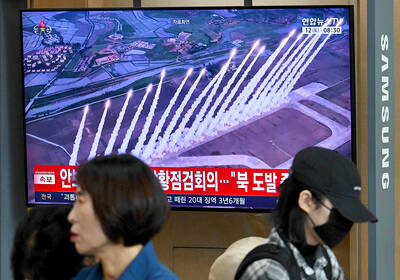
North Korea yesterday fired multiple ballistic missiles, Seoul said, a day after South Korea concluded five days of joint maritime drills with the US and Japan that were focused on the North. Pyongyang last month slammed plans for the so-called Freedom Edge joint exercises in international waters off South Korea as a “threat” to North Korea and other countries of the region. Yesterday, Seoul’s military detected “multiple short-range ballistic missiles launched from the Wonsan area toward the East Sea [the Sea of Japan],” the South Korean Joint Chiefs of Staff said in a statement. The missiles were detected at about


 RSS
RSS