


The head of Iran’s atomic energy organization said yesterday that the major powers would “discredit” themselves if they went ahead with a push for new UN sanctions despite a surprise deal inked with Brazil and Turkey, the Fars news agency reported.
“[Talk of] imposing sanctions has faded and this [UN Security Council draft] resolution is the last effort by the West,” the news agency quoted Iranian Vice President Ali Akbar Salehi, who also heads Iran’s atomic energy organization, as saying.
“They feel that for the first time in the world developing countries are able to defend their rights in the world arena without resorting to the major powers and that is very hard for them,” he said after a meeting of government ministers.
The comments came after the US and its Western allies won crucial support from Russia and China for new sanctions against Iran over its suspect nuclear program.
The draft resolution, obtained Tuesday by reporters, would ban Iran from pursuing “any activity related to ballistic missiles capable of delivering nuclear weapons,” freeze assets of nuclear-related companies linked to the Revolutionary Guard, bar Iranian investment in activities such as uranium mining, and prohibit Iran from buying several categories of heavy weapons including attack helicopters and missiles.
It would also call on all countries to cooperate in cargo inspections — which must receive the consent of the ship’s flag state — if there are “reasonable grounds” to believe these activities could contribute to Iranian nuclear activities.
On the financial side, the draft calls on — but does not require — countries to block financial transactions, including insurance and reinsurance, and ban the licensing of Iranian banks if they have information that provides “reasonable grounds” to believe these activities could contribute to Iranian nuclear activities.
The agreement appeared to be a significant victory for US President Barack Obama’s administration, which has doggedly pursued sanctions since Iran rebuffed US overtures last year. Iran has insisted its nuclear program is for peaceful purposes.
Russia and China, which have close ties to Iran and could veto any resolution, joined fellow permanent council members Britain, France and the US as well as non-member Germany in supporting the sanctions proposal.
Both Russia and China resisted sanctions before they were persuaded to support the stepped up pressure on Iran in recent weeks. Proposed sanctions relating to Iran’s oil and gas industry were removed due to opposition from the two countries, which have vast investments and interests in Iran’s energy sector.
Russia’s UN Ambassador Vitaly Churkin said the final draft is acceptable because it is “focused adequately on nonproliferation matters” and doesn’t cause “humanitarian damage” or create problems for normal economic activities in Iran and the country’s economic relations with other countries.
US Secretary of State Hillary Clinton told a Senate committee that she spent Tuesday on the phone with Russian foreign minister Sergey Lavrov “finalizing the resolution.” The Russian foreign ministry said Lavrov “expressed anxiety” in his talk with Clinton about reports that the US and EU might undertake unilateral sanctions against Iran beyond measures agreed to by the Security Council.
At least three of the 10 non-permanent Security Council members — Brazil, Turkey and Lebanon — have expressed opposition to new sanctions.
The US introduced the draft sanctions resolution at a closed council meeting Tuesday but Brazil announced afterwards that that it won’t even discuss it “at this point” because it wants to focus on the nuclear swap agreement that Iran signed Monday with Brazil and Turkey.
The deal would take 1,200kg of low-enriched uranium out of Iran for a year and return higher-enriched uranium for a medical research reactor in Tehran.
That’s the same amount as under a tentative October agreement negotiated by the US, Russia, France and Iran and endorsed by the International Atomic Energy Agency last year.
Also See: Three US hikers are spies: Iranian intelligence chief

A humanoid robot that won a half-marathon race for robots in Beijing on Sunday ran faster than the human world record in a show of China’s technological leaps. The winner from Honor, a Chinese smartphone maker, completed the 21km race in 50 minutes and 26 seconds, said a WeChat post by the Beijing Economic-Technological Development Area, also known as Beijing E-Town, where the race began. That was faster than the human world record holder, Ugandan Jacob Kiplimo, who finished the same distance in about 57 minutes in March at the Lisbon road race. The performance by the robot marked a significant step forward

Four contenders are squaring up to succeed Antonio Guterres as secretary-general of the UN, which faces unprecedented global instability, wars and its own crushing budget crisis. Chile’s Michelle Bachelet, Argentina’s Rafael Grossi, Costa Rica’s Rebeca Grynspan and Senegal’s Macky Sall are each to face grillings by 193 member states and non-governmental organizations for three hours today and tomorrow. It is only the second time the UN has held a public question-and-answer, a format created in 2016 to boost transparency. Ultimately the five permanent members of the UN’s top body, the Security Council, hold the power, wielding vetoes over who leads the
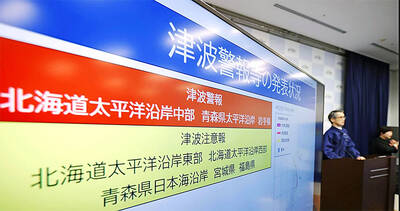
An earthquake registering a preliminary magnitude of 7.7 off northern Japan on Monday prompted a short-lived tsunami alert and the advisory of a higher risk of a possible mega-quake for coastal areas there. The Cabinet Office and the Japan Meteorological Agency said there was a 1% chance for a mega-quake, compared to a 0.1% chance during normal times, in the next week or so following the powerful quake near the Chishima and Japan trenches. Officials said the advisory was not a quake prediction but urged residents in 182 towns along the northeastern coasts to raise their preparedness while continuing their daily lives. Prime
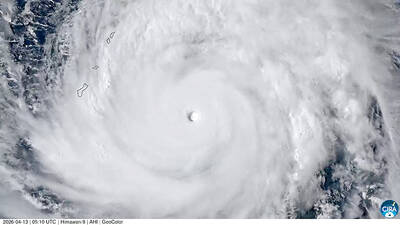
HAZARDOUS CONDITION: The typhoon’s sheer size, with winds extending 443km from its center, slowed down the ability of responders to help communities, an official said The US Coast Guard was searching for six people after losing contact with their disabled boat off the coast of Guam following Typhoon Sinlaku. The crew of the 44m dry cargo vessel, the US-registered Mariana, on Wednesday notified the coast guard that the boat had lost its starboard engine and needed assistance, Petty Officer 3rd Class Avery Tibbets said yesterday. The coast guard set up a one-hour communication schedule with the vessel, but lost contact on Thursday. A Coast Guard HC-130 Hercules aircraft was launched to search for the six people on board, but it had to return to Guam because of


 RSS
RSS