


Suspected militants have released 50 people kidnapped on Saturday in Pakistan’s restive northwest, a government official said yesterday.
Gunmen dressed as policemen kidnapped at least 60 people in two incidents in the ethnic Pashtun tribal region of Kurram, where government forces have recently stepped up an anti-militant operation.
Negotiations involving tribal elders were underway for the release of the remaining 10 hostages, believed to be employees of the state power company, regional government official Mumtaz Khan said.
“Militants seem reluctant to free them because they are government employees, but we are making all our efforts and we have engaged tribal elders in the process,” Khan said.
Pakistani government officials have accused Pakistani Taliban militants of carrying out kidnappings after coming under pressure from security crackdowns in Kurrum and other areas.
Taliban officials were not immediately available for comment.
Some kidnappings in the region were believed to have been carried out by tribes. Hameedullah Khan, a tribal elder, had a different account of what happened with the hostages, saying militants released 40, while 10 escaped. He was optimistic those still being held would be freed.
“The 10 men do not have identity cards so the Taliban are just holding them to verify their identity. It’s not a big deal,” Khan said.
In a video message last week, Pakistan’s Taliban warned the US it will soon “burn” while calling for Pakistan’s rulers to be overthrown for following “America’s agenda.”
Washington is convinced Pakistani Taliban militants allied with al-Qaeda and operating out of northwestern Pakistani border regions were behind an attempted car-bomb attack in New York’s Times Square on May 1.
The Pakistani Taliban claimed responsibility for the attempted bombing. If confirmed, it would be the first time their members were involved in an attempted attack in the West.
Pakistan has mounted military offensives against militants in their strongholds in the northwest over the past year, largely clearing several areas, killing hundreds of militants and destroying their bases, government officials said.
Militants have shown resilience and carried out a wave of suicide and bomb attacks, mainly in the northwest, killing hundreds of people.
Pakistani fighter jets bombed two Taliban hideouts yesterday in Orakzai region, near Kurram, killing 15 militants, a government official said.
There was no independent confirmation of those figures. Taliban militants often dismiss official casualty figures.
Meanwhile, a suspected US missile strike killed at least five people in the Khyber tribal region of northwest Pakistan on Saturday, in what would be one of the first such attacks in the area, intelligence and government officials said.
Officials gave differing death tolls in the strike, which one said involved two missiles hitting a house and two trucks loaded with militants. The death toll ranged from five to 15. Such discrepancies are common and are rarely reconciled.
The officials spoke on condition of anonymity because they were not authorized to speak to the media.
Much of the supplies for US and NATO troops in Afghanistan are transported through the region and the convoys have often been attacked. The US does not officially acknowledge firing the missiles.
Associated Press reports on past strikes do not show any in the Khyber region. Almost all of the more than 30 missile attacks this year have hit targets in the Waziristan tribal region. Khyber is also a militant hotspot that has seen several Pakistani military operations over the last year.
Pakistan officially protests the missile strikes on its territory, but it is believed to aid at least some of them.
Critics say the attacks, which are from unmanned drones, may violate international law and amount to extrajudicial killings.

An American scientist convicted of lying to US authorities about payments from China while he was at Harvard University has rebuilt his research lab in Shenzhen, China, to pursue technology the Chinese government has identified as a national priority: embedding electronics into the human brain. Charles Lieber, 67, is among the world’s leading researchers in brain-computer interfaces. The technology has shown promise in treating conditions such as amyotrophic lateral sclerosis and restoring movement in paralyzed people. It also has potential military applications: Scientists at the Chinese People’s Liberation Army have investigated brain interfaces as a way to engineer super soldiers by boosting

Indonesian police have arrested 13 people after shocking images of alleged abuse against small children at a daycare center went viral, sparking outrage across the nation, officials said on Monday. Police on Friday last week raided Little Aresha, a daycare center in Yogyakarta on Java island, following a report from a former employee. CCTV footage circulating on social media showed children, most younger than two, lying on the floor wearing only diapers, their hands and feet bound with rags. The police have confirmed that the footage is authentic. Police said they also found 20 children crammed into a room just 3m by 3m. “So
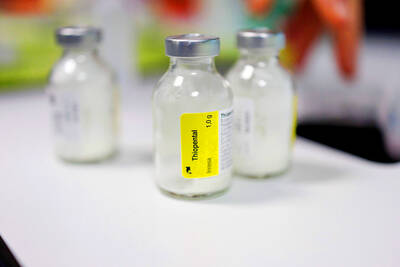
A grieving mother has ended her life at a clinic in Switzerland four years after the death of her only child. Wendy Duffy, 56, a physically healthy woman, died at the Pegasos clinic in Basel after struggling to cope with the death of her 23-year-old son, Marcus. The former care worker, from the West Midlands, England, had previously attempted to take her own life. The case comes as assisted dying would not become law in England and Wales after proposed legislation, branded “hopelessly flawed” by opponents, ran out of time. Ruedi Habegger, the founder of Pegasos, described Duffy’s death as
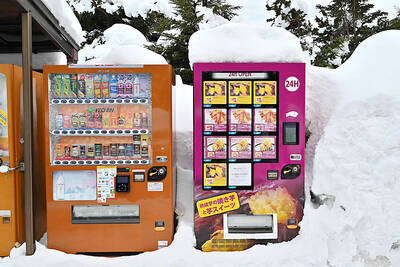
From post offices and parks to stations and even the summit of Mount Fuji, Japan’s vending machines are ubiquitous, but with the rapid pace of inflation cooling demand for their drinks, operators are being forced to rethink the business. Last month beverage giant DyDo Group Holdings announced it would remove about 20,000 vending machines — about 7 percent of their stock nationwide — by January next year, to “reconstruct a profitable network.” Pokka Sapporo Food & Beverage, based in Nagoya, also said last month it would sell its 40,000-machine operation to Osaka-based Lifedrink Co. “The strength of the vending machine


 RSS
RSS