


Canadian women’s groups say they feel threatened by abortion policies advocated at home and abroad by the Conservative government.
“It’s a threat we’ve been feeling for months …We feel that sexual and reproductive health is not really a priority [for the government],” Canadians for Choice executive director Patricia LaRue said.
At issue are several private members bills dealing with abortion. One introduced last month would make it a criminal offence to “coerce” a woman into having an abortion.
The Abortion Rights Coalition of Canada said the problem of coercion does not occur on a grand scale, and that bill C-510 “should be scuttled in favor of a bill prohibiting the much more common practice of coercing a women into childbirth.”
Another bill, C-484, approved last month in a second reading, makes it a criminal offense for someone to attack a woman with the intent of killing her unborn child. Proponents say the bill is designed to close a gap in the criminal code, but opponents say it is another attempt to give legal status to the fetus, recriminalize abortion and open the door to restricting access to the procedure.
“There have been five bills since the Conservatives have come to power, which call into question, either directly or indirectly, the right to abortion in Canada …Abortion is more threatened than ever before in Canada,” said Alexa Conradi, president of the Quebec Women’s Federation.
The debate was reignited when Canadian Prime Minister Stephen Harper introduced his G8 maternal health initiative, which aims to strengthen nutrition and health care systems in the developing world but does not include funding for abortions in those countries.
Women’s groups, opposition lawmakers and aid organizations have slammed Harper for the initiative, accusing him of hypocrisy and pandering to conservatives..
Last week, Conservative Senator Nancy Ruth told a group of aid advocates and women’s rights groups in Ottawa that they should “shut the f..k up on this issue.”
“We’ve got five weeks or whatever left until the G8 starts. Shut the f—k up on this issue,” said Ruth, who touched off a firestorm.
“If you push it, there’ll be more backlash. This is now a political football. This is not about women’s health in this country,” she said.
She went on to say that Canada was “still a country with free and accessible abortion. Leave it there. Don’t make this an election issue.”
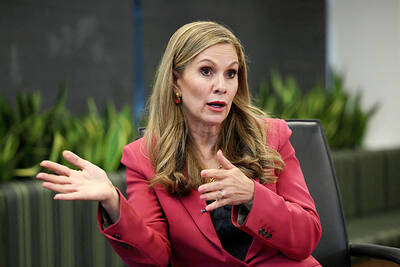
Australians were downloading virtual private networks (VPNs) in droves, while one of the world’s largest porn distributors said it was blocking users from its platforms as the country yesterday rolled out sweeping online age restriction. Australia in December became the first country to impose a nationwide ban on teenagers using social media. A separate law now requires artificial intelligence (AI)-powered chatbot services to keep certain content — including pornography, extreme violence and self-harm and eating disorder material — from minors or face fines of up to A$49.5 million (US$34.6 million). The country also joined Britain, France and dozens of US states requiring
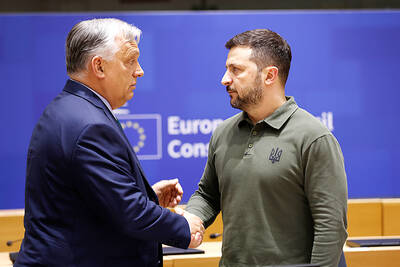
Hungarian authorities temporarily detained seven Ukrainian citizens and seized two armored cars carrying tens of millions of euros in cash across Hungary on suspicion of money laundering, officials said on Friday. The Ukrainians were released on Friday, following their detention on Thursday, but Hungarian officials held onto the cash, prompting Ukraine to accuse Hungary’s Russia-friendly government of illegally seizing the money. “We will not tolerate this state banditism,” Ukrainian Minister of Foreign Affairs Andrii Sybiha said. The seven detained Ukrainians were employees of the Ukrainian state-owned Oschadbank, who were traveling in the two armored cars that were carrying the money between Austria and
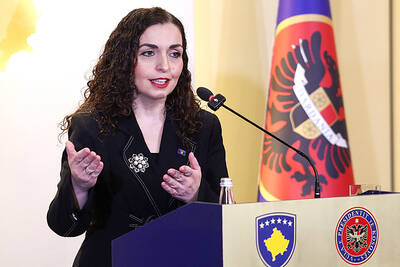
Kosovar President Vjosa Osmani on Friday after dissolving the Kosovar parliament said a snap election should be held as soon as possible to avoid another prolonged political crisis in the Balkan country at a time of global turmoil. Osmani said it is important for Kosovo to wrap up the upcoming election process and form functional institutions for political stability as the war rages in the Middle East. “Precisely because the geopolitical situation is that complex, it is important to finish this electoral process which is coming up,” she said. “It is very hard now to imagine what will happen next.” Kosovo, which declared

MORE BANS: Australia last year required sites to remove accounts held by under-16s, with a few countries pushing for similar action at an EU level and India considering its own ban Indonesia on Friday said it would ban social media access for children under 16, citing threats from online pornography, cyberbullying, online fraud and Internet addiction. “Accounts belonging to children under 16 on high-risk platforms will start to be deactivated, beginning with YouTube, TikTok, Facebook, Instagram, Threads, X, Bigo Live and Roblox,” Indonesian Minister of Communications and Digital Meutya Hafid said. “The government is stepping in so that parents no longer have to fight alone against the giants of the algorithm. Implementation will begin on March 28, 2026,” she said. The social media ban would be introduced in stages “until all platforms fulfill their


 RSS
RSS