

The US Senate on Wednesday unanimously agreed to take up the most sweeping finance industry overhaul since the Great Depression of the 1930s, US President Barack Obama’s top legislative goal.
After months of closed-door talks and three days of bitter partisan gridlock, lawmakers scheduled the start of what were expected to be two weeks of debate on the popular bill for 12:15pm yesterday.
“The American people have waited long enough for their leaders to get to work cleaning up Wall Street,” Democratic Senate Majority Leader Harry Reid said.
“It is time to move this debate from the sidelines to the playing field,” he said.
The move came after Republicans abandoned their lockstep opposition to starting debate on the bill, amid signs US public anger at big banks blamed for the 2008 global economic meltdown will shape November mid-term elections.
The measure enjoys the support of nearly two-thirds of the US public, struggling with an economy that has yet to heal from the collapse, with stubbornly high US unemployment, a struggling housing sector and other woes.
The bill aims to ban big firms from tapping billions of dollars in government aid when their failure threatens the broader economy and create, for the first time, an agency to protect consumers from shady financial dealings.
It also looks to regulate trade in derivatives, complex financial instruments often used by firms to smooth out volatile commodity prices but blamed for warping the market and fanning speculative flames.
Obama cheered news of the breakthrough as he headed home from a two-day campaign-style trip to mid-western states badly hit by the economic crisis.
“I am very pleased that the United States Senate has decided to proceed to the financial regulatory bill by unanimous consent,” Obama told reporters aboard Air Force One. “It is the right thing to do.
Obama declined to comment on the grilling faced by Goldman Sachs executives on Capitol Hill on Tuesday, citing the current investigation into the firm by the Securities and Exchange Commission.
But he spoke about some of the more exotic instruments pieced together by the finance industry, after bundles of bad loans traded on the markets were partly blamed for triggering the financial crisis.
“I will say that I think most Americans would say that some of the behavior generally on Wall Street, even if it’s legal, doesn’t seem to serve much of an economic purpose and puts, as we’ve discovered, the entire economy at risk.”
The logjam broke after Senate Banking Committee Chairman Chris Dodd, a Democrat, and the panel’s top Republican, Senator Richard Shelby, agreed on a compromise regarding how to handle failing firms whose collapse threatens the US economy, lawmakers said.
They were unable, however, to reach an agreement on derivatives trading or on the new consumer protection agency.
“I cannot agree to his desire to weaken consumer protections given the enormous abuses we have seen,” Dodd said. “It is time for this debate to begin. And it must be a serious, vigorous debate.”
“This massive new bureaucracy would have unchecked authority to regulate whatever it wants, whenever it wants, however it wants,” Shelby said.
The breakthrough, however, was merely one step in a long and uncertain legislative journey.
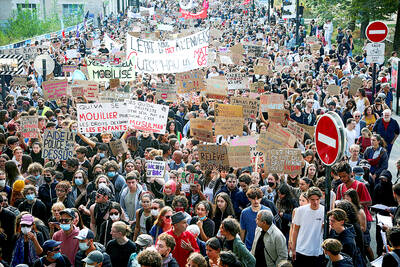
VIOLENT STANDOFFS: The government said 215 students have been injured since the start of the movement last month, including a teenager who lost a hand on Monday Thousands of demonstrators yesterday massed under heavy police surveillance in Paris and cities across France, as unions and teachers joined high-school students who for days have been demanding better conditions in protests punctuated by violent clashes. Students have blocked the entrances to hundreds of high schools for 15-to-17-year-olds since late last month, complaining of missing teachers, overloaded schedules, dilapidated classrooms and buildings that cannot cope with rising temperatures. In the Paris suburb of Creteil, where the protests started last month, students piled barriers outside the Saint-Exupery high school. “We are here to make our voice heard, all too often forgotten,” student Abderrahmane Abdelkader
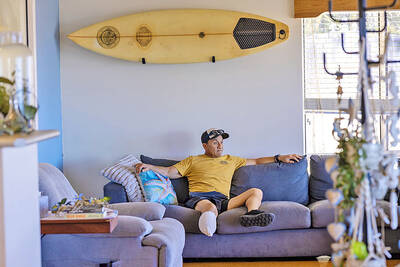
As shark attack survivor Mel Ismail fought the predator that severed his leg, he noticed something odd. “I saw its eye ... a big black eye,” Ismail said. “But it was winking back at me — I was trying to get my fingers in its eye and just pushing its eye as I was being dragged.” When the shark swam off, he managed to struggle back to shore, the surfer and professional firefighter said in an Australian Broadcasting Corp interview broadcast on Thursday. He was surfing at Glenfield Beach near Geraldton on Australia’s west coast when he was attacked on Sept. 14. He
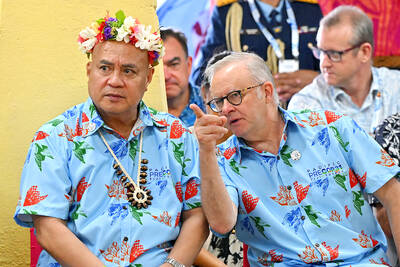
A Tuvalu government adviser yesterday said it felt like Australia had “taken over” the tiny country’s sovereignty during a visit by leaders to the Pacific island. The official — a senior government adviser who asked to remain anonymous because they were not authorized to speak to the media — said they were disappointed in Australia’s handling of the visit. The comments came during a visit by Australian Prime Minister Anthony Albanese and other leaders to Tuvalu, which has become a symbol of the existential threat posed by rising seas and is a key partner in Canberra’s Pacific strategy. “Just because we signed the

Halfway around the world from Russia, in a Caribbean tourism hot spot, men young and old are being lured by Moscow with tantalizing job offers, only to find themselves en route to the front lines in Ukraine. Moscow and Kyiv have recruited thousands of foreign nationals into their armies since Russia launched its invasion of Ukraine in 2022. Moscow is accused, in some cases, of using fake job ads to hoodwink men from deprived backgrounds in Africa, Asia and Latin America into traveling to Russia and then forcing them to fight on arrival. From countries such as India, Kenya, Equatorial Guinea, Colombia and


 RSS
RSS