


North Korea executed two senior economic officials last month — not one as previously reported — over a botched currency revamp that forced markets to close temporarily and fueled social tensions, a media outlet that specializes in the North reported.
The North redenominated the won in December as part of efforts to fight inflation and reassert control over its burgeoning market economy. That reportedly sparked unrest after many North Koreans were stuck with piles of worthless bills. A government economist said last week markets were forced to close for several days because of problems setting prices.
The two officials were executed by firing squad on March 12 at a stadium in Pyongyang before an audience of members of the ruling Workers Party and finance officials, the Seoul-based Daily NK reported on Sunday, citing a source in Pyongyang it did not identify.
South Korea’s Ministry of Unification, which handles relations with the North, and the National Intelligence Service said they could not immediately confirm the report.
The officials were the ruling party’s finance and planning department chief who spearheaded the reform, Pak Nam-gi, and a deputy chief of the State Planning Commission, Daily NK said.
Pak’s execution was reported last month by other South Korean media, but there has been no official confirmation.
The agency did not have the name of the second official. It was the first to give a date and location of Pak’s execution.
The Daily NK said it could not provide other details, including whether its source saw the execution firsthand, citing concerns about the source’s safety. The outlet was one of the few North Korea monitoring agencies that broke the news of the currency reform.
It is not unprecedented for Pyongyang to execute officials for policy failures. In the 1990s, North Korea publicly executed a top agricultural official following widespread starvation.
Pak was arrested in late January at the end of a three-day meeting in Pyongyang on the currency revamp, the report said.
It said a judge called Pak a “traitor that plunged the people’s life into distress” just before the execution.
North Korea is one of the world’s most isolated nations and its radios and TV sets receive only broadcasts by state media. One way monitoring agencies in Seoul get information from sources in North Korea is via illicit mobile phones that connect to networks in neighboring China.
Senior North Korean economist Ri Ki-song told APTN last week that markets closed temporarily after the redomination but later reopened as the economy stabilized.
Speaking in a rare interview, Ri denied reports of social upheaval following the change.
The North faces chronic food shortages and has relied on aid to feed much of its population since a famine that is believed to have killed as many as 2 million people in the 1990s.

ACTIONABLE ADVICE: The majority of chatbots tested provided guidance on weapons, tactics and target selections, with Perplexity and Meta AI deemed to be the least safe From school shootings to synagogue bombings, leading artificial intelligence (AI) chatbots helped researchers plot violent attacks, according to a study published on Wednesday that highlighted the technology’s potential for real-world harm. Researchers from the nonprofit watchdog Center for Countering Digital Hate and CNN posed as 13-year-old boys in the US and Ireland to test 10 chatbots, including ChatGPT, Google Gemini, Perplexity, Deepseek and Meta AI. Eight of the chatbots assisted the make-believe attackers in more than half the responses, providing advice on “locations to target” and “weapons to use” in an attack, the study said. The chatbots had become a “powerful accelerant for

Australians were downloading virtual private networks (VPNs) in droves, while one of the world’s largest porn distributors said it was blocking users from its platforms as the country yesterday rolled out sweeping online age restriction. Australia in December became the first country to impose a nationwide ban on teenagers using social media. A separate law now requires artificial intelligence (AI)-powered chatbot services to keep certain content — including pornography, extreme violence and self-harm and eating disorder material — from minors or face fines of up to A$49.5 million (US$34.6 million). The country also joined Britain, France and dozens of US states requiring
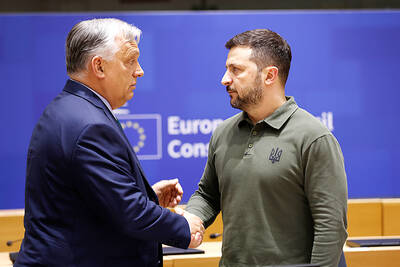
Hungarian authorities temporarily detained seven Ukrainian citizens and seized two armored cars carrying tens of millions of euros in cash across Hungary on suspicion of money laundering, officials said on Friday. The Ukrainians were released on Friday, following their detention on Thursday, but Hungarian officials held onto the cash, prompting Ukraine to accuse Hungary’s Russia-friendly government of illegally seizing the money. “We will not tolerate this state banditism,” Ukrainian Minister of Foreign Affairs Andrii Sybiha said. The seven detained Ukrainians were employees of the Ukrainian state-owned Oschadbank, who were traveling in the two armored cars that were carrying the money between Austria and
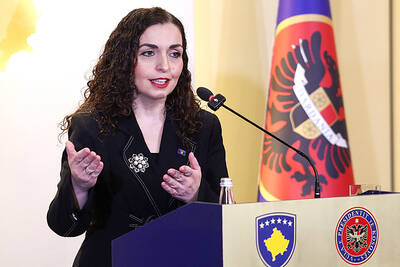
Kosovar President Vjosa Osmani on Friday after dissolving the Kosovar parliament said a snap election should be held as soon as possible to avoid another prolonged political crisis in the Balkan country at a time of global turmoil. Osmani said it is important for Kosovo to wrap up the upcoming election process and form functional institutions for political stability as the war rages in the Middle East. “Precisely because the geopolitical situation is that complex, it is important to finish this electoral process which is coming up,” she said. “It is very hard now to imagine what will happen next.” Kosovo, which declared


 RSS
RSS