


Forensic tests on the skeletal remains of a teenager discovered in the eaves of a 15th-century Italian church may hold clues to the identity of a killer with a hair fetish who murdered a British woman.
For several years, police in Dorset, southwestern England, have linked the 2002 killing of Heather Barnett, 48, to the disappearance and suspected murder of 16-year-old Elisa Claps in Italy.
Claps disappeared 17 years ago in Potenza, where her body was found this week in the roof of the church of the Santissima Trinita. She was last seen at the same church having made an appointment to meet an Italian man, Danilo Restivo.
SUSPECT
Restivo, now 37, became the only suspect in the Claps inquiry, and moved to Britain after serving a jail term for lying to investigators about an injury he sustained on the day of the teenager’s disappearance.
UK detectives have visited Italy several times in their hunt for Barnett’s killer. The mother of two was found in the bathroom of her apartment in the seaside resort of Bournemouth, Dorset, in November 2002.
She had been hit over the head with a heavy object and stabbed several times. Her breasts had been cut from her body and in her hands were strands of hair cut from an unidentified woman.
LINK
The cases were linked when it was discovered that Restivo had moved into a home across the road from Barnett after serving his perjury sentence.
British police said on Friday they were liaising with the Italian authorities after the discovery in Potenza.
At Bari University’s institute of forensic medicine, where the autopsy on Claps’s body is to be carried out, a source said there were “no evident signs” of violence on the body but there could still be vital clues in matter below the fingernails.
Restivo has been arrested twice by Dorset police and questioned on suspicion of Barnett’s murder, but was released without charge.
He has always denied involvement in Barnett’s death or Claps’s disappearance. He still lives opposite the murder scene in Bournemouth with his wife.
DENIAL
In an interview with the Italian news agency Ansa, Restivo said this week: “I do not believe my legal position has been impaired in the slightest. On the contrary, I hope that the urgent checks being carried out now will show that I had nothing whatever to do with Elisa Claps’ death.”
Restivo has complained in the past of being harassed by the missing girl’s family.
He said last year he received an envelope containing bullets — a traditional mafia warning. Claps’s family members have denied any involvement.
British detectives are also pursuing a separate link to the Potenza case.
While investigating Barnett’s killing they found a spate of complaints from women in the area who said strands of their hair had been cut as they traveled by bus in the town. Similar reports were received in Potenza before Claps disappeared in 1993.
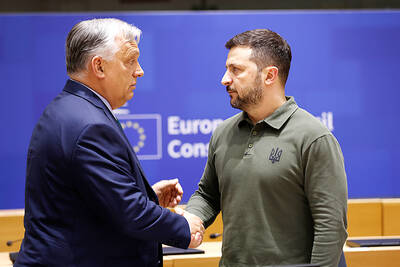
Hungarian authorities temporarily detained seven Ukrainian citizens and seized two armored cars carrying tens of millions of euros in cash across Hungary on suspicion of money laundering, officials said on Friday. The Ukrainians were released on Friday, following their detention on Thursday, but Hungarian officials held onto the cash, prompting Ukraine to accuse Hungary’s Russia-friendly government of illegally seizing the money. “We will not tolerate this state banditism,” Ukrainian Minister of Foreign Affairs Andrii Sybiha said. The seven detained Ukrainians were employees of the Ukrainian state-owned Oschadbank, who were traveling in the two armored cars that were carrying the money between Austria and
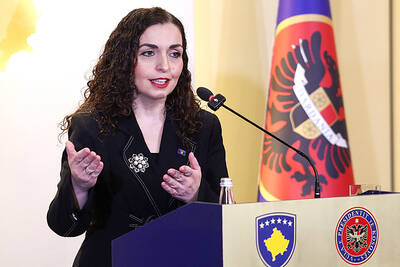
Kosovar President Vjosa Osmani on Friday after dissolving the Kosovar parliament said a snap election should be held as soon as possible to avoid another prolonged political crisis in the Balkan country at a time of global turmoil. Osmani said it is important for Kosovo to wrap up the upcoming election process and form functional institutions for political stability as the war rages in the Middle East. “Precisely because the geopolitical situation is that complex, it is important to finish this electoral process which is coming up,” she said. “It is very hard now to imagine what will happen next.” Kosovo, which declared

MORE BANS: Australia last year required sites to remove accounts held by under-16s, with a few countries pushing for similar action at an EU level and India considering its own ban Indonesia on Friday said it would ban social media access for children under 16, citing threats from online pornography, cyberbullying, online fraud and Internet addiction. “Accounts belonging to children under 16 on high-risk platforms will start to be deactivated, beginning with YouTube, TikTok, Facebook, Instagram, Threads, X, Bigo Live and Roblox,” Indonesian Minister of Communications and Digital Meutya Hafid said. “The government is stepping in so that parents no longer have to fight alone against the giants of the algorithm. Implementation will begin on March 28, 2026,” she said. The social media ban would be introduced in stages “until all platforms fulfill their
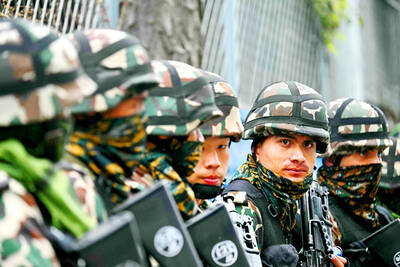
Counting was under way in Nepal yesterday, after a high-stakes parliamentary election to reshape the country’s leadership following protests last year that toppled the government. Key figures vying for power include former Nepalese prime minister K. P. Sharma Oli, rapper-turned-mayor Balendra Shah, who is bidding for the youth vote, and newly elected Nepali Congress party leader Gagan Thapa. In Kathmandu’s tea shops and city squares, people were glued to their phones, checking results as early trends flashed up — suggesting Shah’s centrist Rastriya Swatantra Party (RSP) was ahead. Nepalese Election Commission spokesman Prakash Nyupane said the counting was ongoing “in a peaceful manner”


 RSS
RSS