


Chinese Premier Wen Jiabao (溫家寶) warned his people to keep a “sober mind” about the challenges ahead in the new year as the country yesterday readied to welcome the arrival of the Year of the Tiger with noisy celebrations.
“In 2010, China will face a more complicated situation, both at home and abroad,” state news agency Xinhua paraphrased Wen as saying, in remarks carried in major newspapers.
People must “keep a sober mind and an enhanced sense of anxiety about lagging behind,” the premier added.
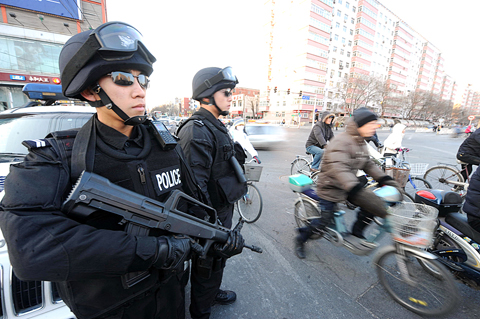
PHOTO: AFP
Priority should be given to “persistence in taking economic development as the central task, forcefully promoting reform and opening up ... and doing a better job responding to the global financial crisis, in order to keep steady and relatively fast economic development,” he said.
The government is trying to maintain a balance between the economic growth needed to create jobs for the country’s 1.3 billion people, and not letting the economy overheat and drive up the cost of basic goods and housing for residents.
“All the things we do are aimed at letting people live more happily with more dignity,” Wen said.
Chinese President Hu Jintao (胡錦濤), by contrast, spent Friday visiting Taiwanese investors in the southeastern province of Fujian.
“We will try our best in everything that will benefit the Taiwan compatriots, and we will honor our words,” Hu told the Taiwanese investors, Xinhua reported.
Taiwan and China are gearing up to sign an economic cooperation framework agreement (ECFA), something Hu told his Taiwanese audience would “bring win-win results.”
Train and bus stations overflowed and airports were packed yesterday as tens of millions of Chinese rushed home to be with their families for the start of the Lunar New Year holiday.
The annual holiday is the most important of the year in China, with families expected to welcome in the New Year at midnight yesterday with a roar of fireworks.
It is the only time in the year when China’s massive army of migrant workers, who work on building sites and in factories in major cities, get a chance to return home to see their families. China calls the holiday the biggest annual movement of people in the world.
The Ministry of Railways has estimated that 210 million passengers — more than Russia’s population — will ride the rails during the 40-day New Year travel season, up 10 percent from last year.
The holiday officially lasts six days, but many workers take up to a month off.
Police around the country tightened security for the holiday period. A notice on the Web site of the Ministry of Public Security said police would increase checks on fireworks displays, lantern shows and temple fairs.
Last year, an illegal fireworks display at the headquarters of China’s state broadcaster in Beijing caused a massive fire at a newly built 44-story hotel.
On Friday, three firefighters died while fighting a building fire triggered by fireworks in Hunan Province, Xinhua reported.
The holiday period is an annual test of China’s overburdened transportation system.
Tickets are difficult to buy, and this year authorities are cracking down on scalpers who hoard tickets to resell at higher prices.
Passengers will have to show their identification cards when buying tickets for trains out of southern Guangdong Province, home to tens of thousands of factories employing migrant labor.

PARLIAMENT CHAOS: Police forcibly removed Brazilian Deputy Glauber Braga after he called the legislation part of a ‘coup offensive’ and occupied the speaker’s chair Brazil’s lower house of Congress early yesterday approved a bill that could slash former Brazilian president Jair Bolsonaro’s prison sentence for plotting a coup, after efforts by a lawmaker to disrupt the proceedings sparked chaos in parliament. Bolsonaro has been serving a 27-year term since last month after his conviction for a scheme to stop Brazilian President Luiz Inacio Lula da Silva from taking office after the 2022 election. Lawmakers had been discussing a bill that would significantly reduce sentences for several crimes, including attempting a coup d’etat — opening up the prospect that Bolsonaro, 70, could have his sentence cut to

A powerful magnitude 7.6 earthquake shook Japan’s northeast region late on Monday, prompting tsunami warnings and orders for residents to evacuate. A tsunami as high as three metres (10 feet) could hit Japan’s northeastern coast after an earthquake with an estimated magnitude of 7.6 occurred offshore at 11:15 p.m. (1415 GMT), the Japan Meteorological Agency (JMA) said. Tsunami warnings were issued for the prefectures of Hokkaido, Aomori and Iwate, and a tsunami of 40cm had been observed at Aomori’s Mutsu Ogawara and Hokkaido’s Urakawa ports before midnight, JMA said. The epicentre of the quake was 80 km (50 miles) off the coast of
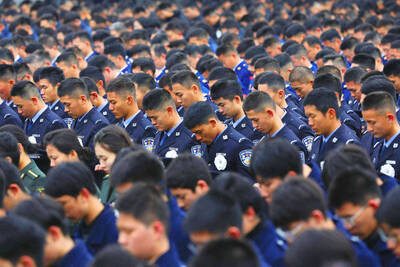
China yesterday held a low-key memorial ceremony for the 1937 Nanjing Massacre, with Chinese President Xi Jinping (習近平) not attending, despite a diplomatic crisis between Beijing and Tokyo over Taiwan. Beijing has raged at Tokyo since Japanese Prime Minister Sanae Takaichi last month said that a hypothetical Chinese attack on Taiwan could trigger a military response from Japan. China and Japan have long sparred over their painful history. China consistently reminds its people of the 1937 Nanjing Massacre, in which it says Japanese troops killed 300,000 people in what was then its capital. A post-World War II Allied tribunal put the death toll

A passerby could hear the cacophony from miles away in the Argentine capital, the unmistakable sound of 2,397 dogs barking — and breaking the unofficial world record for the largest-ever gathering of golden retrievers. Excitement pulsed through Bosques de Palermo, a sprawling park in Buenos Aires, as golden retriever-owners from all over Argentina transformed the park’s grassy expanse into a sea of bright yellow fur. Dog owners of all ages, their clothes covered in dog hair and stained with slobber, plopped down on picnic blankets with their beloved goldens to take in the surreal sight of so many other, exceptionally similar-looking ones.


 RSS
RSS