


Thai prosecutors dropped charges against the five-man crew of an aircraft accused of smuggling weapons from North Korea, saying yesterday that the men would be deported to preserve good relations with their home countries.
The Attorney-General’s Office said the decision was made after the governments of Belarus and Kazakhstan contacted the Thai Foreign Ministry and requested the crew’s release to face prosecution at home.
“To charge them in Thailand could effect the good relationship between the countries,” said Thanaphit Mollaphruek, a spokesman for the Attorney-General’s Office. “We have decided to drop all the charges and deport them to their home countries.”
“To charge them in this case would not be a benefit to Thailand,” the spokesman said.
The crew — four Kazakhs and a Belarusian — were expected to be released later in the day, their lawyer Somsak Saithong said.
Their Ilyushin Il-76 cargo plane was intercepted during a Dec. 12 refueling stop in Bangkok after loading 35 tonnes of weapons aboard in the North Korean capital, Pyongyang. Thai authorities said they acted on a tip from the US.
The UN imposed sanctions in June banning North Korea from exporting any arms after the communist regime conducted a nuclear test and test-fired missiles. North Korea is believed to earn hundreds of millions of dollars every year by selling missiles, missile parts and other weapons to countries such as Iran, Syria and Myanmar.
The crew has denied any knowledge of arms aboard the plane, which Thai authorities say included explosives, rocket-propelled grenades and components for surface-to-air missiles. The crew says they believed they were carrying oil-drilling equipment.
All five were charged with illegal arms possession, but Thai authorities had repeatedly said the charges were expected to be stiffened once an investigation wrapped up.
In recent weeks, however, the tone from Thai authorities changed.
Thai Foreign Minister Kasit Piromya indicated earlier this month the men would be released, telling reporters in Geneva the government had “suggested to the office of the attorney-general to release them because the UN resolution does not oblige Thailand to ... bring up charges on the pilots and the crew.”
Yesterday’s decision was likely to spark international criticism.
The weapons’ ultimate destination remains a mystery, though Thailand has said the plane’s final destination appears to have been Iran. Experts have also voiced concerns that authorities in the former Soviet republics have turned a blind eye to illicit activities of air freight companies that use Soviet-era planes to fly anything anywhere for a price.
A Thai government report to the UN Security Council, leaked to reporters late last month said the aircraft was bound for Tehran’s Mahrabad Airport.
However, Thai government spokesman Panitan Wattanayarkorn said subsequently that “to say that the weapons are going to Iran, that might be inexact.”
“The report only says where the plane was going to according to its flight plan, but it doesn’t say where the weapons were going to,” he said. “It’s still under investigation, and the suspects are under our legal system.”
Investigations by The Associated Press in several countries showed the flight was facilitated by a web of holding companies and fake addresses from New Zealand to Barcelona designed to disguise the movement of the weapons.

Australians were downloading virtual private networks (VPNs) in droves, while one of the world’s largest porn distributors said it was blocking users from its platforms as the country yesterday rolled out sweeping online age restriction. Australia in December became the first country to impose a nationwide ban on teenagers using social media. A separate law now requires artificial intelligence (AI)-powered chatbot services to keep certain content — including pornography, extreme violence and self-harm and eating disorder material — from minors or face fines of up to A$49.5 million (US$34.6 million). The country also joined Britain, France and dozens of US states requiring

Hungarian authorities temporarily detained seven Ukrainian citizens and seized two armored cars carrying tens of millions of euros in cash across Hungary on suspicion of money laundering, officials said on Friday. The Ukrainians were released on Friday, following their detention on Thursday, but Hungarian officials held onto the cash, prompting Ukraine to accuse Hungary’s Russia-friendly government of illegally seizing the money. “We will not tolerate this state banditism,” Ukrainian Minister of Foreign Affairs Andrii Sybiha said. The seven detained Ukrainians were employees of the Ukrainian state-owned Oschadbank, who were traveling in the two armored cars that were carrying the money between Austria and
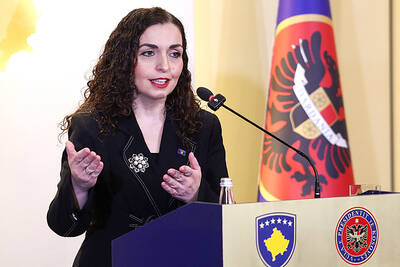
Kosovar President Vjosa Osmani on Friday after dissolving the Kosovar parliament said a snap election should be held as soon as possible to avoid another prolonged political crisis in the Balkan country at a time of global turmoil. Osmani said it is important for Kosovo to wrap up the upcoming election process and form functional institutions for political stability as the war rages in the Middle East. “Precisely because the geopolitical situation is that complex, it is important to finish this electoral process which is coming up,” she said. “It is very hard now to imagine what will happen next.” Kosovo, which declared

MORE BANS: Australia last year required sites to remove accounts held by under-16s, with a few countries pushing for similar action at an EU level and India considering its own ban Indonesia on Friday said it would ban social media access for children under 16, citing threats from online pornography, cyberbullying, online fraud and Internet addiction. “Accounts belonging to children under 16 on high-risk platforms will start to be deactivated, beginning with YouTube, TikTok, Facebook, Instagram, Threads, X, Bigo Live and Roblox,” Indonesian Minister of Communications and Digital Meutya Hafid said. “The government is stepping in so that parents no longer have to fight alone against the giants of the algorithm. Implementation will begin on March 28, 2026,” she said. The social media ban would be introduced in stages “until all platforms fulfill their


 RSS
RSS