


The Pakistani Taliban claimed responsibility for the devastating bombing of a religious procession in Karachi — a sign the militants may be escalating their war against the state with a rare attack in Pakistan’s commercial hub.
Monday’s bombing, which killed 44 people in the heart of the southern port city, underscored the group’s ability to strike far from its sanctuary in the northwest and its determination to hit back at a government that has launched a military campaign against it.
Attacking Karachi “means they’re trying to expand their frontiers of terrorism,” retired general and military analyst Talat Masood said.
Although the teeming city of about 15 million has often been the scene of sectarian, ethnic and political violence, the Pakistani Taliban have rarely claimed any attacks there. Many analysts believe the group has spared it in the past because its militants used the city as a haven to raise money and to rest.
On Wednesday, however, the group announced it was behind the bombing of minority Shiite Muslims marking the holy day of Ashoura as they marched through the heart of Karachi.
“We claim responsibility for the attack on the Shiite procession,” Asmatullah Shaheen, a Taliban spokesman, said in a telephone call from an undisclosed location.
He did not give a reason, but said one of the group’s men was sent to Karachi the day before the procession to carry out the bombing.
The bloodshed was intended as a message that the Taliban can strike “from Khyber [in the northwest] to Karachi,” Masood said.
“They’re trying to say that it’s possible; and it is possible for them because after all. It only takes a person, a few persons, to carry out this act, and they have plenty of those who are disposable and available to them,” he said.
Pakistani President Asif Ali Zardari has speculated the motive was to spark sectarian conflict that could complicate the government’s battle against the Pakistani Taliban.
Pakistan has a history of violence between extremist elements among its majority Sunni Muslim and minority Shiite communities.
Although the Taliban are not known for launching sectarian attacks, they have associations with Sunni militant groups that have targeted minority Shiites, who they regard as heretical.
It is unclear whether the Taliban carried out the bombing on its own or received help from other militant groups that officials say have a joint goal to destabilize Pakistan.
Authorities say sectarian groups have teamed up with Taliban and al-Qaeda militants waging war against the government in a joint effort to destabilize Pakistan. More than 500 people have been killed in attacks since mid-October when the army launched a major anti-Taliban offensive in the country’s lawless northwestern tribal area of South Waziristan, along the border with Afghanistan.
Karachi lawmaker Farooq Sattar speculated on Tuesday, before the claim of responsibility, that a Taliban strike against Karachi could be the latest retaliation for the military offensive.
“When they see they are losing in the northwest, why wouldn’t they turn to a new front?” Sattar said. “After all, they are fighting the battle for their survival.”
The bombing also sparked rioting that destroyed buildings and thousands of shops in central Karachi, causing millions of dollars in damage. Parts of Bolton Market, the country’s largest wholesale market, were still smoldering on Wednesday, more than 48 hours after the attack.
Mobs roamed the streets immediately after the blast, setting fire to nearby buildings, firing guns into the air and throwing stones at security forces who had been assigned to protect the procession.

‘CROSSING THE LINE’: China’s embassy in Seoul criticized US Forces Korea Commander General Xavier Brunson, asking if his ‘hostile’ remarks were authorized by Washington South Korea and the US are in talks over recent public remarks by the commander of US Forces Korea, Seoul’s presidential office said yesterday, after the comments drew sharp criticism from China. In a recent podcast interview, US Forces Korea Commander General Xavier Brunson described South Korea as “the dagger in the heart of Asia” from China’s east coast, prompting the Chinese embassy in Seoul to say that he had “truly crossed the line.” The interview came amid growing speculation that Washington might seek to expand the role of US Forces Korea in countering the growing regional influence of China, a key

Through the noise of rushing papers and whirring belts at a print factory in Kyoto, two creators watch their photo essay come to life in broadsheet form — part of an effort to win new audiences in the age of artificial intelligence (AI). Despite the decline of the publishing industry, self-publication and handmade “zine” magazines are growing in popularity in Japan, reflecting the nation’s enduring love of paper in the digital era. While speaking to Agence France-Presse at the plant, his hands black with ink, one of the creators, Kazuma Obara, said: “I think [paper] is a medium that engages all five

Australian researchers have trained lab-grown brain cells on a silicon computer chip to play the 1990s shooter game Doom and said they are just scratching the surface of what the neurons could be capable of doing. It is the science-fiction work of biotech boffins at Cortical Labs, who researched and developed the technology that harnesses the workings of the brain’s networking system. Each so-called “biological computer” contains about 200,000 living human brain cells, grown from stem cells that were harvested from blood donations. Having mastered the simple computer game Pong, where a paddle is moved up and down to send a ball
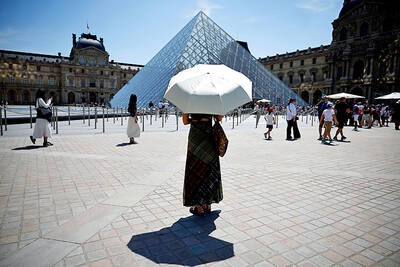
France experienced its hottest spring on record, the French weather service said on Tuesday, after an exceptional early heat wave that also broke highs for the season in England and Wales. Meteo-France said the average nationwide temperature over March to May was 13.8°C — about 1.7°C above the norm, and surpassing records set in 2011 and 2020. “The warmest spring since records began in 1900,” it said in a bulletin. All three months were warmer than average, but the onset of an “unprecedented heatwave” late last month pushed the mercury to highs typically seen at the height of the summer. “Our country had never


 RSS
RSS