


Thailand’s repatriation of thousands of ethnic Hmong asylum-seekers to Laos was imminent despite international objections that they could face persecution back home, a senior army officer said yesterday.
About 5,000 soldiers, policemen and civil servants were being assigned to carry out the repatriation of the Hmong at a refugee camp in Huay Nam Khao in Phetchabun Province, 300km north of Bangkok, Colonel Thana Charuvat said.
“We will start the operation as soon as we get the final instruction and when everything is ready. That includes mobilizing enough manpower to carry it out, otherwise it may encourage resistance,” Thana told reporters.
“A show of sufficient force on our part is essential to deter resistance, but we have no intention to use force. Our men are armed with shields and batons. They carry no guns or tear gas out of concern for the safety of women and children,” he said.
Most of the 4,400 Hmong facing repatriation have settled at Huay Nam Khao since 2004 to seek political asylum, saying they would be persecuted by Laos’s communist government if they return.
Over 1,000 of them are men over 15 who could put up resistance to the forced repatriation, said Colonel Thana, a senior officer charged with running the camp.
“We need to meet the obligation we have made with Laos, and hope that we don’t have to postpone it again. Laos has given repeated public guarantees of full safety for the returnees,” he said.
Known as the US’ “forgotten allies,” Hmong were recruited by the CIA to fight alongside US forces during the Vietnam War.
When the communists took power in 1975, the Hmong exodus began. Tens of thousands have since been resettled in the US.
Thai Prime Minister Abhisit Vejjajiva on Friday sought to allay fears about their forced repatriation, saying his government would ensure it took place in a transparent way “without chaos and in accordance with human rights principles.”
Thailand regards the group at Huay Nam Khao as illegal economic migrants and has come under fire for denying the UN refugee agency (UNHCR) access to the camp.
Colonel Thana said the media was denied access to the Hmong prior to the repatriation out of official concern they might resort to stunts to draw public attention to their status.
“This is to discourage the Hmong from resorting to possible self-inflicted physical abuses to attract public attention,” he said.
Officials at the camp said about 100 buses and trucks would be needed to move the Hmong from Huay Nam Khao to the Thai-Lao border at Nong Khai.
UNHCR, diplomats and rights groups believe some of the Hmong could qualify for refugee status if a screening process were allowed to take place.
Thailand fears that by facilitating their resettlement in a third country, it could create a “pull factor” that encourages more illegal migrants.
Colonel Thana questioned the sincerity expressed by third countries about accepting the refugees.
“If other countries really want to accept these refugees, they would have been resettled a long time ago,” he said.
The US State Department voiced concern on Thursday about reports of forced repatriation, saying that in the past, the Thai government had said many Hmong were in need of protection.
“Forced returns of persons entitled to protection is inconsistent with international practice and Thailand’s long history of protection of refugees,” acting spokesman Mark Toner said in a statement.
UNHCR said Thailand had an “international obligation” to ensure those in need of protection in their native countries were returned “only on a voluntary basis.”

PARLIAMENT CHAOS: Police forcibly removed Brazilian Deputy Glauber Braga after he called the legislation part of a ‘coup offensive’ and occupied the speaker’s chair Brazil’s lower house of Congress early yesterday approved a bill that could slash former Brazilian president Jair Bolsonaro’s prison sentence for plotting a coup, after efforts by a lawmaker to disrupt the proceedings sparked chaos in parliament. Bolsonaro has been serving a 27-year term since last month after his conviction for a scheme to stop Brazilian President Luiz Inacio Lula da Silva from taking office after the 2022 election. Lawmakers had been discussing a bill that would significantly reduce sentences for several crimes, including attempting a coup d’etat — opening up the prospect that Bolsonaro, 70, could have his sentence cut to

A powerful magnitude 7.6 earthquake shook Japan’s northeast region late on Monday, prompting tsunami warnings and orders for residents to evacuate. A tsunami as high as three metres (10 feet) could hit Japan’s northeastern coast after an earthquake with an estimated magnitude of 7.6 occurred offshore at 11:15 p.m. (1415 GMT), the Japan Meteorological Agency (JMA) said. Tsunami warnings were issued for the prefectures of Hokkaido, Aomori and Iwate, and a tsunami of 40cm had been observed at Aomori’s Mutsu Ogawara and Hokkaido’s Urakawa ports before midnight, JMA said. The epicentre of the quake was 80 km (50 miles) off the coast of
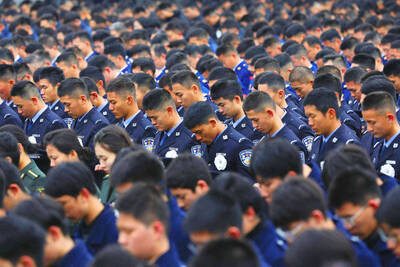
China yesterday held a low-key memorial ceremony for the 1937 Nanjing Massacre, with Chinese President Xi Jinping (習近平) not attending, despite a diplomatic crisis between Beijing and Tokyo over Taiwan. Beijing has raged at Tokyo since Japanese Prime Minister Sanae Takaichi last month said that a hypothetical Chinese attack on Taiwan could trigger a military response from Japan. China and Japan have long sparred over their painful history. China consistently reminds its people of the 1937 Nanjing Massacre, in which it says Japanese troops killed 300,000 people in what was then its capital. A post-World War II Allied tribunal put the death toll

A passerby could hear the cacophony from miles away in the Argentine capital, the unmistakable sound of 2,397 dogs barking — and breaking the unofficial world record for the largest-ever gathering of golden retrievers. Excitement pulsed through Bosques de Palermo, a sprawling park in Buenos Aires, as golden retriever-owners from all over Argentina transformed the park’s grassy expanse into a sea of bright yellow fur. Dog owners of all ages, their clothes covered in dog hair and stained with slobber, plopped down on picnic blankets with their beloved goldens to take in the surreal sight of so many other, exceptionally similar-looking ones.


 RSS
RSS