

Australian scientists have discovered an octopus in Indonesia that collects coconut shells for shelter — unusually sophisticated behavior that the researchers believe is the first evidence of tool use in an invertebrate animal.
The scientists filmed the veined octopus, Amphioctopus marginatus, selecting halved coconut shells from the sea floor, emptying them out, carrying them under their bodies up to 20m, and assembling two shells together to make a spherical hiding spot.
Julian Finn and Mark Norman of Museum Victoria in Melbourne observed the odd activity in four of the creatures during a series of dive trips to North Sulawesi and Bali in Indonesia between 1998 and last year. Their findings were published yesterday in the journal Current Biology.
“I was gobsmacked,” said Finn, a research biologist at the museum who specializes in cephalopods. “I mean, I’ve seen a lot of octopuses hiding in shells, but I’ve never seen one that grabs it up and jogs across the sea floor. I was trying hard not to laugh.”
Octopuses often use foreign objects as shelter. But the scientists found the veined octopus going a step further by preparing the shells, carrying them long distances and reassembling them as shelter elsewhere.
That’s an example of tool use, which has never been recorded in invertebrates before, Finn said.
“What makes it different from a hermit crab is this octopus collects shells for later use, so when it’s transporting it, it’s not getting any protection from it,” Finn said. “It’s that collecting it to use it later that is unusual.”
The researchers think the creatures probably once used shells in the same way. But once humans began cutting coconuts in half and discarding the shells into the ocean, the octopuses discovered an even better kind of shelter, Finn said.
The findings are significant, in that they reveal just how capable the creatures are of complex behavior, said Simon Robson, associate professor of tropical biology at James Cook University in Townsville.
“Octopuses have always stood out as appearing to be particularly intelligent invertebrates,” Robson said. “They have a fairly intelligent brain.”

A Chinese artificial intelligence (AI) cybersecurity tool called ARTEX was used in a spate of recent hacks of Japanese companies, the subsidiary of a major Tokyo-based Internet company yesterday. Dozens of Japanese companies, from restaurant chains to a car hire operator, have disclosed unauthorized access or data breaches in the past weeks — potentially impacting millions of customers. The information security arm of GMO Internet Group said it had “confirmed ARTEX was used” having investigated the attacks in collaboration with external organizations. “It also became clear ... the attacks were almost exclusively targeting Japan,” GMO cybersecurity center director Daiki Fukumori

On his terrace overlooking the forest in eastern Pennsylvania, Ed Negra lays out four letters. All are from a developer promising a US$10,000 check to each household once its data center is running. “I call it a bribe,” the US retiree said. The scene is picture-perfect. Autumn leaves are turning russet, and there is a stunning mountain view in this corner of Pennsylvania, a key state in the US’ upcoming midterm elections. “We thought it was a beautiful place to retire,” said the septuagenarian, who used to manage a large building-supply store in neighboring New Jersey. He and his wife settled in a sprawling
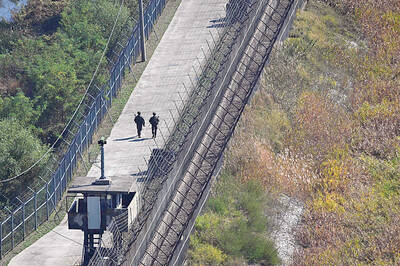
A STEP UP: The moving of small military positions forward should be taken seriously amid the North’s recent demonstrations of its firepower, an analyst said North Korea has moved new units into “firing positions,” the sister of leader Kim Jong-un said yesterday, days after Pyongyang warned it was considering deploying additional strike means to its border with South Korea. Tensions between Seoul and Pyongyang have soared since the South last month blamed an explosion inside the heavily fortified demilitarized zone (DMZ) separating the two countries on landmines laid by North Korea, an accusation it has rejected. “Our military leadership underlined the need to make those rogues aware that our new firepower units have taken their firing positions,” state media cited Kim Yo-jong as saying. Her statement came a

WARNING: Iran’s Islamic Revolutionary Guard Corps threatened to strike US bases across the Middle East if the US continues to escort ships through the Strait of Hormuz A late-night attack on Saudi Arabia’s Dammam airport killed two people and injured eight others, the civil aviation authority said on yesterday, a day after Washington ordered nonessential US embassy staff and their families to leave Saudi Arabia, as the kingdom comes under sustained deadly attacks by Yemen’s Houthis. A Saudi Arabian and an Indian man were killed in the attack on Wednesday, the Saudi Arabian General Authority of Civil Aviation said in a statement. Damage to the airport was being assessed, it added. In the past few weeks, Houthi attacks on Saudi oil and civilian infrastructure have reached an unprecedented scale, forcing


 RSS
RSS