


A British court issued an arrest warrant for Israel’s former foreign minister over war crimes allegedly committed in Gaza this year — only to withdraw it when it was discovered that she was not in the UK, it emerged on Monday.
Tzipi Livni, a member of the war Cabinet during Operation Cast Lead, had been due to address a meeting in London on Sunday but canceled her attendance in advance. Westminster Magistrates Court in central London issued the warrant at the request of lawyers acting for some of the Palestinian victims of the fighting, but it was later dropped.
The warrant marks the first time an Israeli minister or former minister has faced arrest in the UK and is evidence of a growing effort to pursue war crimes allegations under “universal jurisdiction.” Israel rejects these efforts as politically motivated, saying it acted in self-defense against Hamas rocket attacks from Gaza.
Livni, head of the opposition Kadima party, played a key role in decisions made before and during the three-week offensive. Palestinians claim 1,400 were killed, mostly civilians; Israel counted 1,166 dead, the majority of them combatants.
No one involved in the court episode was prepared to confirm, on the record, what had transpired in a chaotic series of highly sensitive legal moves. But a pro-Palestinian group welcomed news of the abortive move as “long overdue.”
The Foreign Office, clearly deeply embarrassed by the episode, said in a statement last night: “The UK is determined to do all it can to promote peace in the Middle East and to be a strategic partner of Israel. To do this, Israel’s leaders need to be able to come to the UK for talks with the British government. We are looking urgently at the implications of this case.”
Livni’s office said she had decided in advance not to come to the UK but lawyers seemed unaware of that when they approached the court last week. The judge refused to issue the warrant until it was clear Livni was in fact in the country, as he was erroneously informed on Sunday.
The former minister had been scheduled to speak at a Jewish National Fund conference.
“Scheduled meetings with government figures in London could not take place close to the conference and would have necessitated a longer-than-planned absence from Israel,” her office told the Ynet Web site.
It is the second time in less than three months that lawyers have gone to Westminster magistrates court asking for a warrant for the arrest of an Israeli politician. In September the court was asked to issue one for the arrest of Ehud Barak, Israel’s defense minister, under the 1988 Criminal Justice Act, which gives courts in England and Wales universal jurisdiction in war crimes cases.
However, a court ruled he enjoyed immunity under the State Immunity Act 1978.
Israeli sources said ministers who wish to visit the UK in a personal capacity have begun asking the Israeli embassy in London to arrange meetings with British officials. These offer legal protection against arrest.
Livni, crucially, cannot enjoy any such immunity as she is an ex-minister. Ehud Olmert, the former prime minister, is in the same position.

Australians were downloading virtual private networks (VPNs) in droves, while one of the world’s largest porn distributors said it was blocking users from its platforms as the country yesterday rolled out sweeping online age restriction. Australia in December became the first country to impose a nationwide ban on teenagers using social media. A separate law now requires artificial intelligence (AI)-powered chatbot services to keep certain content — including pornography, extreme violence and self-harm and eating disorder material — from minors or face fines of up to A$49.5 million (US$34.6 million). The country also joined Britain, France and dozens of US states requiring
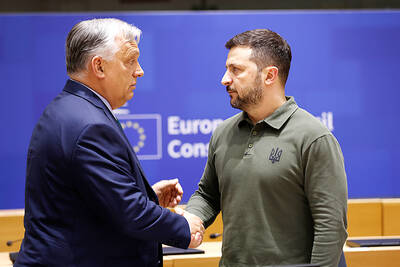
Hungarian authorities temporarily detained seven Ukrainian citizens and seized two armored cars carrying tens of millions of euros in cash across Hungary on suspicion of money laundering, officials said on Friday. The Ukrainians were released on Friday, following their detention on Thursday, but Hungarian officials held onto the cash, prompting Ukraine to accuse Hungary’s Russia-friendly government of illegally seizing the money. “We will not tolerate this state banditism,” Ukrainian Minister of Foreign Affairs Andrii Sybiha said. The seven detained Ukrainians were employees of the Ukrainian state-owned Oschadbank, who were traveling in the two armored cars that were carrying the money between Austria and
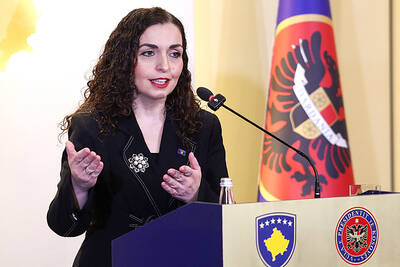
Kosovar President Vjosa Osmani on Friday after dissolving the Kosovar parliament said a snap election should be held as soon as possible to avoid another prolonged political crisis in the Balkan country at a time of global turmoil. Osmani said it is important for Kosovo to wrap up the upcoming election process and form functional institutions for political stability as the war rages in the Middle East. “Precisely because the geopolitical situation is that complex, it is important to finish this electoral process which is coming up,” she said. “It is very hard now to imagine what will happen next.” Kosovo, which declared

MORE BANS: Australia last year required sites to remove accounts held by under-16s, with a few countries pushing for similar action at an EU level and India considering its own ban Indonesia on Friday said it would ban social media access for children under 16, citing threats from online pornography, cyberbullying, online fraud and Internet addiction. “Accounts belonging to children under 16 on high-risk platforms will start to be deactivated, beginning with YouTube, TikTok, Facebook, Instagram, Threads, X, Bigo Live and Roblox,” Indonesian Minister of Communications and Digital Meutya Hafid said. “The government is stepping in so that parents no longer have to fight alone against the giants of the algorithm. Implementation will begin on March 28, 2026,” she said. The social media ban would be introduced in stages “until all platforms fulfill their


 RSS
RSS