


The Philippines said yesterday it had imposed martial law in a southern province to quell a rebellion by the region’s ruling clan accused of being behind the massacre of 57 people.
Philippine President Gloria Arroyo placed Maguindanao Province under military control late on Friday in an effort to contain heavily armed militias belonging to the provincial governor and other members of his Muslim clan, authorities said.
“There’s a rebellion in the area,” Justice Secretary Agnes Devanadera told a nationally televised news conference as she outlined the reasons for the imposition of martial law.
“It was practically an overthrow of government.”
Martial law was also implemented to make it easier to bring members of the powerful Ampatuan clan into custody, presidential spokesman Cerge Remonde told reporters.
“President Gloria Macapagal Arroyo has taken this bold step in answer to the cry for justice of the [relatives of the] victims of the now infamous Maguindanao massacre,” Remonde said.
It was the first time martial law had been declared anywhere in the Philippines since the reign of dictator Ferdinand Marcos. He had the whole of the country under martial law from 1972 to 1981.
Within hours of martial law being declared, special forces detained the province’s governor and patriarch of the clan, Andal Ampatuan Sr, who since 2001 had ruled Maguindanao with the backing of a private army.
More than 4,000 soldiers were deployed across Maguindanao, and a photographer on the outskirts of Shariff Aguak, the provincial capital, witnessed army checkpoints checking all vehicles traveling on the roads.
One of the clan chief’s sons, Zaldy Ampatuan, the governor of an autonomous Muslim area in the southern Philippines, was also taken into custody yesterday morning, along with two other relatives, the military said.
Andal Ampatuan Jr, another son of the clan patriarch, is already in a Manila detention center after being charged with 25 counts of murder for the Nov. 23 massacre that took place in a remote area of Maguindanao.
Police allege Ampatuan Jr and 100 of his gunmen shot dead the occupants of a convoy that included relatives of his rival for the post of Maguindanao governor in next year’s elections, as well as a group of journalists.
The rival, Esmael Mangudadatu, said the killings were carried out to stop him from running for office. The armed forces chief of staff, General Victor Ibrado, and other military chiefs said martial law was imposed because members of the Ampatuans’ private armies had threatened to attack civilians and government installations.
“By their sheer number they are really a threat to the peace and order in the province,” Ibrado said.
The military said one of the triggers for martial law was the discovery on Thursday of a huge cache of weapons buried just a few hundred meters from the Ampatuans’ family compound in Shariff Aguak.
The weapons inventory included three anti-tank recoilless rifles, mortars, machine guns, rifles and pistols, and thousands of rounds of ammunition — enough to arm two battalions or about 1,000 soldiers.
Presidential spokesman Remonde insisted that martial law would be lifted as soon as possible, with a maximum limit of 60 days.
But Arroyo critics immediately hit out at the move, warning it may be a prelude to her seizing similar control of other parts of the country or even a bid to remain in power after the Constitution requires her to step down.
“We believe there’s no basis for the implementation of martial law,” said opposition Senator Benigno Aquino, who is the front-runner to win next year’s presidential elections.
Muslim rebels fighting for an independent homeland have been waging a rebellion on Maguindanao and other parts of Mindanao island since the late 1970s. The conflict has claimed more than 150,000 lives, the military says.
Arroyo’s government has used Muslim clans such as the Ampatuans to rule these areas, and allowed them to build up their own armies as part of a containment strategy against the insurgents.
However critics have said the strategy has allowed these regional rulers to become warlords who believe they can act with impunity.

Through the noise of rushing papers and whirring belts at a print factory in Kyoto, two creators watch their photo essay come to life in broadsheet form — part of an effort to win new audiences in the age of artificial intelligence (AI). Despite the decline of the publishing industry, self-publication and handmade “zine” magazines are growing in popularity in Japan, reflecting the nation’s enduring love of paper in the digital era. While speaking to Agence France-Presse at the plant, his hands black with ink, one of the creators, Kazuma Obara, said: “I think [paper] is a medium that engages all five
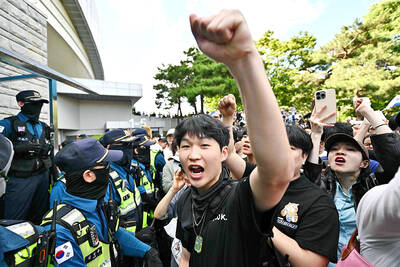
‘ABSURD MISTAKE’: The election commission said that there had been a failure to anticipate turnout after 14 polling stations ran short of ballot papers South Korean riot police yesterday cleared protesters from a Seoul polling station after a 35-hour blockade sparked by a shortage of ballot papers during local elections earlier this week. Wednesday’s election was the first nationwide vote since South Korean President Lee Jae-myung took office following the ouster of Yoon Suk-yeol over his short-lived martial law declaration. Lee’s ruling Democratic Party swept most races, but failed to flip the crucial Seoul mayoral seat. The South Korean National Election Commission apologized, blaming a failure to anticipate turnout after 14 polling stations in Seoul ran short of ballot papers. Some polling stations stayed open until 10pm to

Australian researchers have trained lab-grown brain cells on a silicon computer chip to play the 1990s shooter game Doom and said they are just scratching the surface of what the neurons could be capable of doing. It is the science-fiction work of biotech boffins at Cortical Labs, who researched and developed the technology that harnesses the workings of the brain’s networking system. Each so-called “biological computer” contains about 200,000 living human brain cells, grown from stem cells that were harvested from blood donations. Having mastered the simple computer game Pong, where a paddle is moved up and down to send a ball

France experienced its hottest spring on record, the French weather service said on Tuesday, after an exceptional early heat wave that also broke highs for the season in England and Wales. Meteo-France said the average nationwide temperature over March to May was 13.8°C — about 1.7°C above the norm, and surpassing records set in 2011 and 2020. “The warmest spring since records began in 1900,” it said in a bulletin. All three months were warmer than average, but the onset of an “unprecedented heatwave” late last month pushed the mercury to highs typically seen at the height of the summer. “Our country had never


 RSS
RSS