


Iranian President Mahmoud Ahmadinejad inaugurated an Iranian-funded hospital and two milk-processing plants on Tuesday in a goodwill visit in which his leftist host defended Iran’s “peaceful” nuclear aspirations.
Ahmadinejad and Bolivian President Evo Morales also signed an agreement in which Iran committed itself to help Bolivia investigate industrializing lithium, the lightweight metal used in electric car and other batteries. This poor Andean country possesses half the world’s known lithium reserves.
Morales and a military honor guard received Ahmadinejad at the airport, and a small band of Bolivian Muslims hailed the two as they arrived together at the presidential palace.
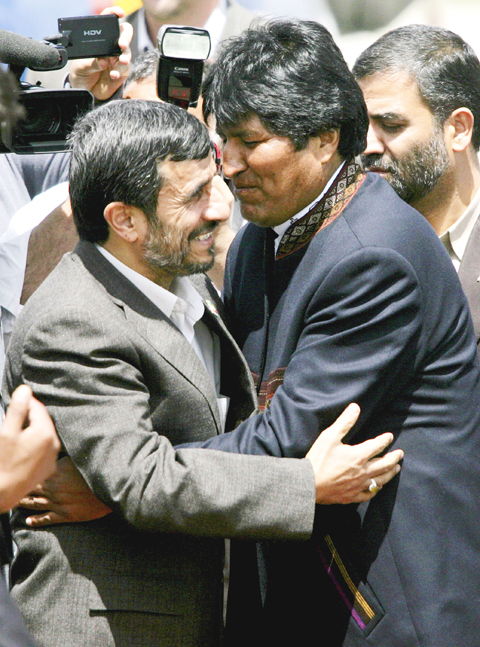
PHOTO : REUTERS
The Iranian president’s strained relations with Washington are shared by Bolivia’s first indigenous president, who expelled the US ambassador last year. Ahmadinejad called Morales “a friend and brother” on Tuesday and praised the two countries’ cooperation “despite the opposition of imperialism,” a reference to the US.
He previously visited in September 2007 as part of his effort to expand commercial and diplomatic ties in South America.
Iran then offered a US$1 billion mixture of aid and credit, much of which Morales hopes to use to expand Bolivia’s natural gas production, the country’s main revenue source.
One agreement they signed on Tuesday added Iran to a list of countries including France, South Korea and Japan that are vying for a role in helping Bolivia commercialize its lithium, which is concentrated in a remote southern salt flat.
Another commits Iran to build two dialysis centers.
Morales and Ahmadinejad also penned a joint declaration “recognizing the legitimate right of all countries to use and develop nuclear energy for peaceful ends, within the framework of international rights.”
After having lunch with Morales, Ahmadinejad inaugurated a hospital and two milk-processing plants in other parts of the country by video conference from the capital La Paz.
Tehran donated funding for the seven-story Red Crescent hospital and pasteurizing equipment for the plants.
Iran has also given equipment for a state-run TV station, sold Bolivia 700 tractors made in Venezuela and provided financing for a state-run cement plant.
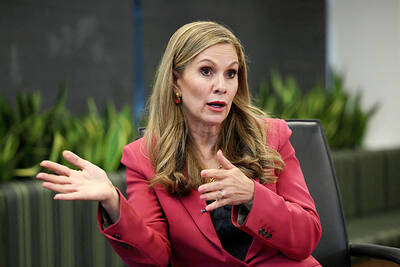
Australians were downloading virtual private networks (VPNs) in droves, while one of the world’s largest porn distributors said it was blocking users from its platforms as the country yesterday rolled out sweeping online age restriction. Australia in December became the first country to impose a nationwide ban on teenagers using social media. A separate law now requires artificial intelligence (AI)-powered chatbot services to keep certain content — including pornography, extreme violence and self-harm and eating disorder material — from minors or face fines of up to A$49.5 million (US$34.6 million). The country also joined Britain, France and dozens of US states requiring
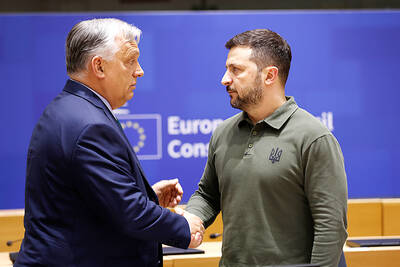
Hungarian authorities temporarily detained seven Ukrainian citizens and seized two armored cars carrying tens of millions of euros in cash across Hungary on suspicion of money laundering, officials said on Friday. The Ukrainians were released on Friday, following their detention on Thursday, but Hungarian officials held onto the cash, prompting Ukraine to accuse Hungary’s Russia-friendly government of illegally seizing the money. “We will not tolerate this state banditism,” Ukrainian Minister of Foreign Affairs Andrii Sybiha said. The seven detained Ukrainians were employees of the Ukrainian state-owned Oschadbank, who were traveling in the two armored cars that were carrying the money between Austria and
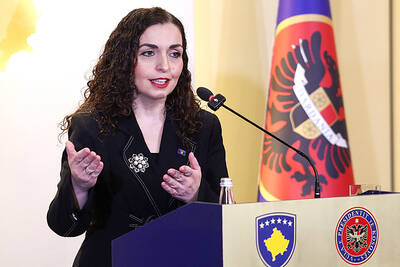
Kosovar President Vjosa Osmani on Friday after dissolving the Kosovar parliament said a snap election should be held as soon as possible to avoid another prolonged political crisis in the Balkan country at a time of global turmoil. Osmani said it is important for Kosovo to wrap up the upcoming election process and form functional institutions for political stability as the war rages in the Middle East. “Precisely because the geopolitical situation is that complex, it is important to finish this electoral process which is coming up,” she said. “It is very hard now to imagine what will happen next.” Kosovo, which declared

MORE BANS: Australia last year required sites to remove accounts held by under-16s, with a few countries pushing for similar action at an EU level and India considering its own ban Indonesia on Friday said it would ban social media access for children under 16, citing threats from online pornography, cyberbullying, online fraud and Internet addiction. “Accounts belonging to children under 16 on high-risk platforms will start to be deactivated, beginning with YouTube, TikTok, Facebook, Instagram, Threads, X, Bigo Live and Roblox,” Indonesian Minister of Communications and Digital Meutya Hafid said. “The government is stepping in so that parents no longer have to fight alone against the giants of the algorithm. Implementation will begin on March 28, 2026,” she said. The social media ban would be introduced in stages “until all platforms fulfill their


 RSS
RSS