


More than 1 million children regularly go to bed hungry in the US, said a government report that shows a startling increase in the number of families struggling to put food on the table.
US President Barack Obama, who pledged to eradicate childhood hunger, has described as “unsettling” the Agriculture Department survey, which says 50 million people in the US — one in six of the population — were unable to afford to buy sufficient food to stay healthy at some point last year, in large part because of escalating unemployment or poorly paid jobs.
That is a rise of more than one-third on the year before and the highest number since the survey began in 1995.
“These numbers are a wake-up call ... for us to get very serious about food security and hunger, about nutrition and food safety in this country,” US Secretary of Agriculture Tom Vilsack said.
Vilsack said he expected the numbers to worsen when the survey for this year is released next year.
The report said 6.7 million people were defined as having “very low food security” because they regularly did not have enough to eat. Among them, 96 percent reported that the food they bought did not last until they had money to buy more. Nearly all said they could not afford to eat balanced meals. Although few reported that this was a permanent situation throughout the year, 88 percent said it had occurred in three or more months.
Nearly half reported losing weight because they did not have enough money to buy food.
The number of children living in households where there were shortages of food at times rose by nearly one-third to 17 million. The report says that most parents who did not get enough to eat ensured their offspring received sufficient food, but that more than 1 million children still suffered outright hunger.
The worst affected states are in the south, with Mississippi having the largest proportion of its population enduring shortages of food, followed by Texas and Arkansas. More than half of those affected are minorities, principally blacks and Hispanics.
Millions more Americans do not go hungry only because they are so poor they receive government food stamps or rely on handouts from food banks such as Feeding America. In some states, such as West Virginia, one in six of the population is on food stamps.
Vicki Escarra, head of Feeding America, which runs 200 food banks across the country feeding 25 million people, described the report as “alarming” and said the situation was continuing to deteriorate.
“Although these new numbers are staggering, it should be noted that these numbers reflect the state of the nation one year ago, in 2008. Since then the economy has significantly weakened, and there are likely many more people struggling with hunger than this report states,” she said.
Feeding America said there had been a “dramatic increase” in requests for emergency food assistance from food banks across the US. It said that food banks in some parts of the country were requesting more than a 50 percent increase in assistance than over a year ago.
“Our network food banks are calling us every day, telling us that demand for emergency food is higher than it has ever been in our history,” Escarra said.
The principal cause is unemployment, which has risen past 10 percent, as well as increasing numbers of people who have had their hours cut back or been forced in to minimum wage jobs. Even before the recent economic collapse, many working people were struggling to meet rising living costs, such as those who drive long distances to their jobs in rural states who were hit by the rising cost of fuel.


STEPPING UP: Diminished US polar science presence mean opportunities for the UK and other countries, although China or Russia might also fill that gap, a researcher said The UK’s flagship polar research vessel is to head to Antarctica next week to help advance dozens of climate change-linked science projects, as Western nations spearhead studies there while the US withdraws. The RRS Sir David Attenborough, a state-of-the-art ship named after the renowned British naturalist, would aid research on everything from “hunting underwater tsunamis” to tracking glacier melt and whale populations. Operated by the British Antarctic Survey (BAS), the country’s polar research institute, the 15,000-tonne icebreaker — boasting a helipad, and various laboratories and gadgetry — is pivotal to the UK’s efforts to assess climate change’s impact there. “The saying goes

Police in China detained dozens of pastors of one of its largest underground churches over the weekend, a church spokesperson and relatives said, in the biggest crackdown on Christians since 2018. The detentions, which come amid renewed China-US tensions after Beijing dramatically expanded rare earth export controls last week, drew condemnation from US Secretary of State Marco Rubio, who on Sunday called for the immediate release of the pastors. Pastor Jin Mingri (金明日), founder of Zion Church, an unofficial “house church” not sanctioned by the Chinese government, was detained at his home in the southern city of Beihai on Friday evening, said
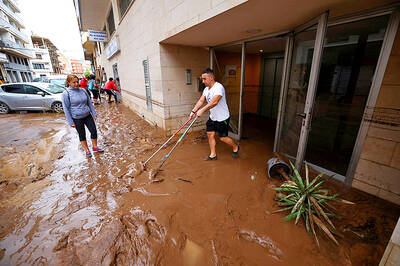
Floods on Sunday trapped people in vehicles and homes in Spain as torrential rain drenched the northeastern Catalonia region, a day after downpours unleashed travel chaos on the Mediterranean island of Ibiza. Local media shared videos of roaring torrents of brown water tearing through streets and submerging vehicles. National weather agency AEMET decreed the highest red alert in the province of Tarragona, warning of 180mm of rain in 12 hours in the Ebro River delta. Catalan fire service spokesman Oriol Corbella told reporters people had been caught by surprise, with people trapped “inside vehicles, in buildings, on ground floors.” Santa Barbara Mayor Josep Lluis

The Venezuelan government on Monday said that it would close its embassies in Norway and Australia, and open new ones in Burkina Faso and Zimbabwe in a restructuring of its foreign service, after weeks of growing tensions with the US. The closures are part of the “strategic reassignation of resources,” Venezueland President Nicolas Maduro’s government said in a statement, adding that consular services to Venezuelans in Norway and Australia would be provided by diplomatic missions, with details to be shared in the coming days. The Norwegian Ministry of Foreign Affairs said that it had received notice of the embassy closure, but no


 RSS
RSS