


A judge made Michael Jackson’s longtime attorney and a music executive the executors of his estate on Tuesday, giving them broad powers to run the late pop star’s affairs despite objections from his father.
The judge’s ruling came after an attorney for the singer’s mother, Katherine Jackson, said she had no objection to John Branca and John McClain running the estate.
The Jackson estate is expected to see a boost of at least US$200 million by the end of the year on the strength of the movie This Is It, which relies on rehearsal footage of him, as well as music sales and other business deals engineered by Branca and McClain.
Michael Jackson died, age 50, on June 25 from an overdose of powerful medications, leaving behind an estate that includes part ownership in a music catalog with songs from numerous bands including the Beatles. According to Jackson’s 2002 will, the estate funnels money to a trust that benefits Katherine Jackson, the singer’s three kids and children’s charities.
Until now, attorney Branca and music executive McClain have handled the estate as administrators, but legal experts said being named executors gives them broader powers and makes it harder for anyone to challenge their position.
“I think that the decision today means there won’t be any further challenge,” said attorney Beth Kaufman, a partner at the Washington-based law firm Caplin & Drysdale and an expert on estates.
In court filings, Joe Jackson challenged the appointment of Branca and McClain, but Los Angeles Superior Court Judge Mitchell Beckloff dismissed his objections.
Beckloff said Joe Jackson, who had a contentious relationship with his son, was excluded from the estate’s assets under the singer’s will and family trust and had no standing to challenge Branca or McClain.
“That was a decision his son made,” Beckloff said in court. “I don’t see how [Joe Jackson’s] affected by the appointment of Branca or McClain as executors.”
In recent months, Katherine Jackson also had objected to the way Branca and McClain ran the estate, and she demanded greater say. But last month, she replaced her legal team and on Tuesday her new attorney, Adam Streisand, said Katherine approved of Branca and McClain.
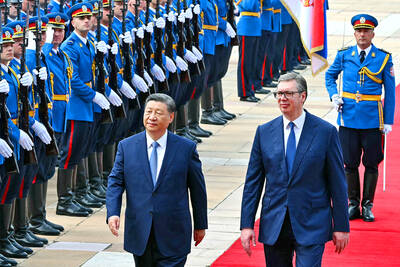
MONEY MATTERS: Xi was to highlight projects such as a new high-speed railway between Belgrade and Budapest, as Serbia is entirely open to Chinese trade and investment Serbian President Aleksandar Vucic yesterday said that “Taiwan is China” as he made a speech welcoming Chinese President Xi Jinping (習近平) to Belgrade, state broadcaster Radio Television of Serbia (RTS) said. “We have a clear and simple position regarding Chinese territorial integrity,” he told a crowd outside the government offices while Xi applauded him. “Yes, Taiwan is China.” Xi landed in Belgrade on Tuesday night on the second leg of his European tour, and was greeted by Vucic and most government ministers. Xi had just completed a two-day trip to France, where he held talks with French President Emmanuel Macron as the

With the midday sun blazing, an experimental orange and white F-16 fighter jet launched with a familiar roar that is a hallmark of US airpower, but the aerial combat that followed was unlike any other: This F-16 was controlled by artificial intelligence (AI), not a human pilot, and riding in the front seat was US Secretary of the Air Force Frank Kendall. AI marks one of the biggest advances in military aviation since the introduction of stealth in the early 1990s, and the US Air Force has aggressively leaned in. Even though the technology is not fully developed, the service is planning
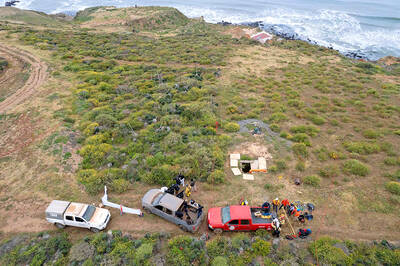
INTERNATIONAL PROBE: Australian and US authorities were helping coordinate the investigation of the case, which follows the 2015 murder of Australian surfers in Mexico Three bodies were found in Mexico’s Baja California state, the FBI said on Friday, days after two Australians and an American went missing during a surfing trip in an area hit by cartel violence. Authorities used a pulley system to hoist what appeared to be lifeless bodies covered in mud from a shaft on a cliff high above the Pacific. “We confirm there were three individuals found deceased in Santo Tomas, Baja California,” a statement from the FBI’s office in San Diego, California, said without providing the identities of the victims. Australian brothers Jake and Callum Robinson and their American friend Jack Carter
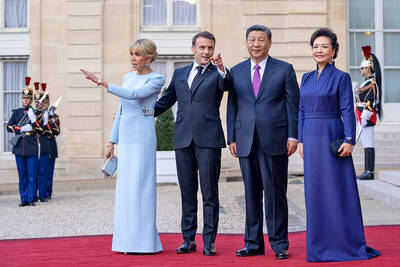
CUSTOMS DUTIES: France’s cognac industry was closely watching the talks, fearing that an anti-dumping investigation opened by China is retaliation for trade tensions French President Emmanuel Macron yesterday hosted Chinese President Xi Jinping (習近平) at one of his beloved childhood haunts in the Pyrenees, seeking to press a message to Beijing not to support Russia’s war against Ukraine and to accept fairer trade. The first day of Xi’s state visit to France, his first to Europe since 2019, saw respectful, but sometimes robust exchanges between the two men during a succession of talks on Monday. Macron, joined initially by EU Commission President Ursula von der Leyen, urged Xi not to allow the export of any technology that could be used by Russia in its invasion


 RSS
RSS