


A quick exchange of guns and a pledge to undertake a vasectomy is customary for India’s Maoist “comrades” when they wed in their isolated forest hideouts.
Some 10,000 to 20,000 heavily armed rebels are believed to be hiding out in India’s forests as followers of a revolutionary communist ideology that paints the state and landowners as the enemies of the people.
“This is how I got married,” says 36-year-old Ramesh Podiyani, a surrendered Maoist commander who fought for more than two decades in Chhattisgarh, a central state at the heart of India’s “Red Corridor.” The vasectomy, he explained, was because children could weaken a fighter emotionally, distracting him from the cause of waging class war and destroying capitalism.

PHOTO: AFP
“Comrades” undergo the surgery in private clinics or with sympathetic doctors, avoiding government hospitals where they might be detected.
Podiyani, who now works for a private company, grew up in a Maoist training camp from the age seven where, instead of going to school, he was trained with bows and arrows, then with guns and landmines.
“I killed several people, but I’m not sorry. It was my duty to kill as a comrade,” he said, sitting inside a police conference room in the town of Jagdalpur, 400km from Chhattisgarh state capital Raipur.
Podiyani and his wife served two years in prison after they surrendered to police and are now waiting for a promised government job and a house.
Most of the recruits who end up as Maoist fighters are from India’s marginalized tribal groups. Some are forcibly enlisted, others join by choice, attracted by the fight for the poor and justice.
“I was excited when I joined the Maoists. They gifted me a uniform and leather boots,” Podiyani says, adding that he was enlisted after his parents fled the village when the recruitment drive began.
Ratha Werna, a former Maoist soldier now training in a special police camp in Jagdalpur, is also prepared to speak openly about life in an organization that is challenging the authority of the government in 20 of India’s 29 states.
The strength of the decades-long insurgency has finally prompted the government to launch a major offensive, with thousands of police and paramilitary forces set to surge into the rebel strongholds.
“We thought the Maoists were the government and they were good because they were working for us,” says Werna, who was expelled by the Maoists after he failed to rob a bank in Raipur and is now a police de-miner.
Robbing banks, killing landlords, attacking police stations and holding up trains are regular activities for the guerrillas, who work in a highly structured organization topped by former teacher Mupalla Laxman Rao, better known as Ganapathi.
Inside the Maoist camps, there are strict rules forbidding corruption, lies and adultery and leaders keep a close eye on the conduct of every cadre, four former rebels said in a series of interviews. All disputes between the camp members are decided within 24 hours by the camp leader, with punishments ranging from demotion, detention to physical labor. Religion and superstition is also forbidden.
“I was not allowed to worship the trees and the birds in the camp,” said 32-year-old Dhuna, a former rebel and tribal villager from a Maoist-dominated area of the densely forested, impoverished state. “From humble forest dwellers we were forced to become brutal soldiers.”
Women generally cook, collect wood and act as soldiers. Some have been known to abandon their children on state highways in order to better serve the cause, said Kathihar Ras, a worker in a local orphanage.
Men’s tasks include patrolling, organizing propaganda exercises and collecting protection money from wealthy business leaders to guarantee their safety.
The Maoist propaganda machine — an essential part of the movement that the government is countering with its own communications efforts — uses printing presses, hired translators and professional writers.
“India is nothing but a semi-colonial and semi-feudal state under neo-colonial form of indirect rule, exploitation and control,” is one idea in a strategy manual.
Podiyani remembers some of the songs used during the regular workshops in which fellow fighters were taught about strategy and tactics for a revolution to topple the democratic government by 2060.
This target date is mentioned in training manuals seized by the police over the last seven years.
One song, he recalls, went as follows:
“These villages and land are ours. Why are the rich here? Let us all kill them, stab them and burn them.”

Le Tuan Binh keeps his Moroccan soldier father’s tombstone at his village home north of Hanoi, a treasured reminder of a man whose community in Vietnam has been largely forgotten. Mzid Ben Ali, or “Mohammed” as Binh calls him, was one of tens of thousands of North Africans who served in the French army as it battled to maintain its colonial rule of Indochina. He fought for France against the Viet Minh independence movement in the 1950s, before leaving the military — as either a defector or a captive — and making a life for himself in Vietnam. “It’s very emotional for me,”

The Chinese Communist Party’s (CCP) Central Committee is to gather in July for a key meeting known as a plenum, the third since the body of elite decisionmakers was elected in 2022, focusing on reforms amid “challenges” at home and complexities broad. Plenums are important events on China’s political calendar that require the attendance of all of the Central Committee, comprising 205 members and 171 alternate members with Chinese President Xi Jinping (習近平) at the helm. The Central Committee typically holds seven plenums between party congresses, which are held once every five years. The current central committee members were elected at the
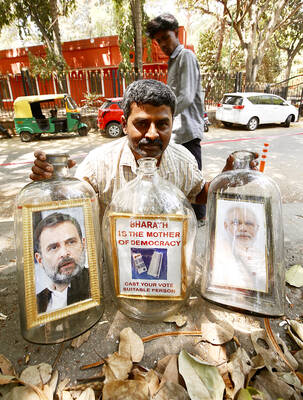
Indian Prime Minister Narendra Modi reaffirmed his pledge to replace India’s religion-based marriage and inheritance laws with a uniform civil code if he returns to office for a third term, a move that some minority groups have opposed. In an interview with the Times of India listing his agenda, Modi said his government would push for making the code a reality. “It is clear that separate laws for communities are detrimental to the health of society,” he said in the interview published yesterday. “We cannot be a nation where one community is progressing with the support of the Constitution while the other

CODIFYING DISCRIMINATION: Transgender people would be sentenced to three years in prison, while same-sex relations could land a person in jail for more than a decade Iraq’s parliament on Saturday passed a bill criminalizing same-sex relations, which would receive a sentence of up to 15 years in prison, in a move rights groups condemned as an “attack on human rights.” Transgender people would be sentenced to three years’ jail under the amendments to a 1988 anti-prostitution law, which were adopted during a session attended by 170 of 329 lawmakers. A previous draft had proposed capital punishment for same-sex relations, in what campaigners had called a “dangerous” escalation. The new amendments enable courts to sentence people engaging in same-sex relations to 10 to 15 years in prison, according to the


 RSS
RSS