


Japan pledged ¥500 billion (US$5.6 billion) in fresh aid to the Mekong region after concluding a summit yesterday aimed at catching up with China in strengthening its partnership with the Southeast Asian region.
Japanese Prime Minister Yukio Hatoyama said the meeting was partly in response to “changing international situations,” including China’s growing influence as well as the greater interest the US has expressed in the region. It was the first of its kind hosted by Japan.
“It is fantastic that Japan can build a relationship of trust in this new way,” Hatoyama said.
He told a press conference the Mekong region was a “priority area” for Japan’s official development assistance (ODA) as it seeks to boost development in the resource-rich area.
“We strongly recognized the need for further strengthening of the Mekong-Japan relationship and cooperation to maximize the potential of the Mekong region,” the statement said.
The leaders issued a “Tokyo declaration” that committed Japan’s ODA help for 63 projects in the region, including developing ports, airports and power lines, encouraging private sector investment and inviting 30,000 people, including youngsters, to visit Japan to promote exchange and understanding over the next three years.
Eighty percent of the package would be in low-interest yen loans, a government official said.
Japan and China have for years poured aid and investment into the region, home to more than 220 million people, and are seen increasingly as competitors for influence.
Hatoyama said it was “not fair to say China’s increasing involvement in the Mekong region is a disadvantage for Japan,” noting Tokyo and Beijing had begun to coordinate policies towards the region.
“It is very important to create mutual benefits by cooperating each other” for “win-win-win relations” among Japan, China and the Mekong nations, he said.
Much of the region along the lower reaches of the 4,800km-long Mekong River has historically been isolated by war and political turmoil and remains poorer than other parts of Southeast Asia.
Hatoyama, who has pushed the concept of an EU-style Asian community, has set his sights on boosting economic development and has vowed to expand aid, particularly to Cambodia, Laos and Vietnam.
The leaders agreed on an action plan to promote development, protect the environment and fight climate change under the slogan “A decade towards the Green Mekong.”
They also demanded that Myanmar take steps towards democracy, calling for transparent elections next year.
They said they “expect that the government of Myanmar would take more positive steps in its democratization process.”

BOMBARDMENT: Moscow sent more than 440 drones and 32 missiles, Volodymyr Zelenskiy said, in ‘one of the most terrifying strikes’ on the capital in recent months A nighttime Russian missile and drone bombardment of Ukraine killed at least 15 people and injured 116 while they slept in their homes, local officials said yesterday, with the main barrage centering on the capital, Kyiv. Kyiv City Military Administration head Tymur Tkachenko said 14 people were killed and 99 were injured as explosions echoed across the city for hours during the night. The bombardment demolished a nine-story residential building, destroying dozens of apartments. Emergency workers were at the scene to rescue people from under the rubble. Russia flung more than 440 drones and 32 missiles at Ukraine, Ukrainian President Volodymyr Zelenskiy

‘SHORTSIGHTED’: Using aid as leverage is punitive, would not be regarded well among Pacific Island nations and would further open the door for China, an academic said New Zealand has suspended millions of dollars in budget funding to the Cook Islands, it said yesterday, as the relationship between the two constitutionally linked countries continues to deteriorate amid the island group’s deepening ties with China. A spokesperson for New Zealand Minister of Foreign Affairs Winston Peters said in a statement that New Zealand early this month decided to suspend payment of NZ$18.2 million (US$11 million) in core sector support funding for this year and next year as it “relies on a high trust bilateral relationship.” New Zealand and Australia have become increasingly cautious about China’s growing presence in the Pacific
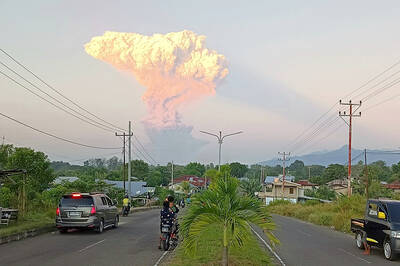
Indonesia’s Mount Lewotobi Laki-Laki yesterday erupted again with giant ash and smoke plumes after forcing evacuations of villages and flight cancelations, including to and from the resort island of Bali. Several eruptions sent ash up to 5km into the sky on Tuesday evening to yesterday afternoon. An eruption on Tuesday afternoon sent thick, gray clouds 10km into the sky that expanded into a mushroom-shaped ash cloud visible as much as 150km kilometers away. The eruption alert was raised on Tuesday to the highest level and the danger zone where people are recommended to leave was expanded to 8km from the crater. Officers also
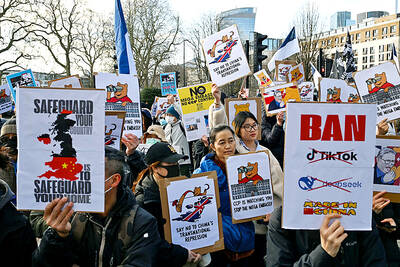
ESPIONAGE: The British government’s decision on the proposed embassy hinges on the security of underground data cables, a former diplomat has said A US intervention over China’s proposed new embassy in London has thrown a potential resolution “up in the air,” campaigners have said, amid concerns over the site’s proximity to a sensitive hub of critical communication cables. The furor over a new “super-embassy” on the edge of London’s financial district was reignited last week when the White House said it was “deeply concerned” over potential Chinese access to “the sensitive communications of one of our closest allies.” The Dutch parliament has also raised concerns about Beijing’s ideal location of Royal Mint Court, on the edge of the City of London, which has so


 RSS
RSS