


Sri Lanka has begun allowing tens of thousands of war-displaced Tamils to return home after months of being held in government-run camps, the head of the UN office responsible for emergencies said.
Almost 300,000 civilians were forced from their homes and moved into the cramped camps in the north of the Indian Ocean island during the final months of Sri Lanka’s 25-year-old civil war against separatist Tamil rebels that ended in May.
Zola Dowell, head of UN Office for the Coordination of Humanitarian Affairs (OCHA), said that from August to the end of last month, around 90,000 people moved back to their areas of origin, with 30,000 returning just in the last 10 days.
“We welcome the speeding-up of the return process,” Dowell said in a telephone interview late on Wednesday from Colombo. “Over the last week, between 2,500 and 4,000 people a day are being transported back.”
The international community has for months been pressing authorities to accelerate the process of resettlement, saying that keeping people there too long could breed resentment and that the poor conditions demanded they be moved faster. But the government, which has pledged to resettle around 80 percent of the displaced by the end of the year, said it first needed to weed out former Liberation Tigers of Tamil Eelam (LTTE) cadres and remove tens of thousands of land mines.
Most civilians are being moved back to their home areas in Jaffna in the extreme north of the island, while others are going back to Mannar in the northeast, Vavuniya in the north and parts of the east.
“People are being moved back to their districts of origin, but due to the ongoing mine risks, many were not able to immediately go back to their actual homes,” Dowell said.
She said initially, most returnees are being moved to schools and churches and other buildings, and that people did have relative freedom of movement. Nonetheless, aid workers are not allowed to have a full-time presence there.
“As people go back to their villages, we would like to be there with them so that we can ensure that things like food distribution points are there and water and sanitation provisions are adequate,” Dowell said.
The government and the aid community have a strained relationship, owing to Sri Lanka’s wariness that LTTE cadres could infiltrate the organizations as they did in wartime. Sri Lanka insists it can handle the humanitarian tasks itself, and has limited aid agency access to refugee camps on the grounds that it does not want to threaten the security the country fought hard to win.
“There are concerns whether the capacity of the public services can cope with so many people as civil structures need to be re-established and further developed and we would like to support the authorities in doing this,” Dowell said.
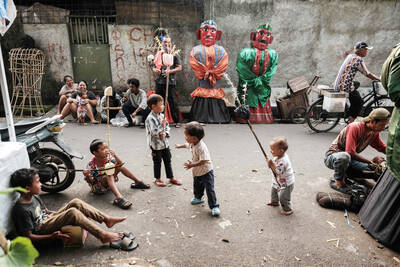
In the sweltering streets of Jakarta, buskers carry towering, hollow puppets and pass around a bucket for donations. Now, they fear becoming outlaws. City authorities said they would crack down on use of the sacred ondel-ondel puppets, which can stand as tall as a truck, and they are drafting legislation to remove what they view as a street nuisance. Performances featuring the puppets — originally used by Jakarta’s Betawi people to ward off evil spirits — would be allowed only at set events. The ban could leave many ondel-ondel buskers in Jakarta jobless. “I am confused and anxious. I fear getting raided or even

Eleven people, including a former minister, were arrested in Serbia on Friday over a train station disaster in which 16 people died. The concrete canopy of the newly renovated station in the northern city of Novi Sad collapsed on Nov. 1, 2024 in a disaster widely blamed on corruption and poor oversight. It sparked a wave of student-led protests and led to the resignation of then-Serbian prime minister Milos Vucevic and the fall of his government. The public prosecutor’s office in Novi Sad opened an investigation into the accident and deaths. In February, the public prosecutor’s office for organized crime opened another probe into

RISING RACISM: A Japanese group called on China to assure safety in the country, while the Chinese embassy in Tokyo urged action against a ‘surge in xenophobia’ A Japanese woman living in China was attacked and injured by a man in a subway station in Suzhou, China, Japanese media said, hours after two Chinese men were seriously injured in violence in Tokyo. The attacks on Thursday raised concern about xenophobic sentiment in China and Japan that have been blamed for assaults in both countries. It was the third attack involving Japanese living in China since last year. In the two previous cases in China, Chinese authorities have insisted they were isolated incidents. Japanese broadcaster NHK did not identify the woman injured in Suzhou by name, but, citing the Japanese

RESTRUCTURE: Myanmar’s military has ended emergency rule and announced plans for elections in December, but critics said the move aims to entrench junta control Myanmar’s military government announced on Thursday that it was ending the state of emergency declared after it seized power in 2021 and would restructure administrative bodies to prepare for the new election at the end of the year. However, the polls planned for an unspecified date in December face serious obstacles, including a civil war raging over most of the country and pledges by opponents of the military rule to derail the election because they believe it can be neither free nor fair. Under the restructuring, Myanmar’s junta chief Min Aung Hlaing is giving up two posts, but would stay at the


 RSS
RSS