


Signs of progress have emerged from two days of talks and Honduras’ rival factions plan to resume after a weekend break trying to resolve the bitter divide over the ouster of former Honduran president Manuel Zelaya.
The factions did not claim to have resolved the crisis sparked by the June 28 coup, although representatives of both negotiating teams said on Friday that the first face-to-face talks in months had achieved results.
Both Mayra Mejia, part of the three-member team that represents Zelaya, and Vilma Morales, who represents the government of interim Honduran President Roberto Micheletti, said talks yielded agreement on 60 percent of the issues under an international plan to resolve the crisis.
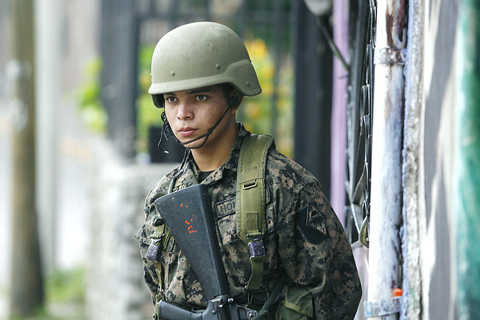
PHOTO: REUTERS
“I feel full of optimism,” Morales, a former head of the Supreme Court, told reporters crowded into the lobby of the hotel hosting the private talks. “We’ve made progress on many points and on many very important points.”
Mejia concurred, saying that “we’ve made substantial progress” in meetings that she described as “very cordial.”
Both reiterated earlier statements that the negotiators had agreed not to discuss specific details until the talks are completed. They planned to discuss the issues within their own factions over a three-day recess and resume negotiations on Tuesday.
Zelaya negotiator Juan Barahona, however, challenged the upbeat assessment. He said no agreement had been reached on the fundamental issue: whether the ousted leader could return to serve out the remaining months of his term.
“Yes, there are advances ... but they aren’t on the important issues,” said Barahona, an organizer of the protests that have roiled Honduras since the coup. “I’m still pessimistic, very pessimistic.”
Mejia, the labor minister under Zelaya, declined to comment on Barahona’s appraisal.
“All subjects are on the table and that’s all we want to say right now,” she said. “But we have made important advances.”
Negotiations revolve around the San Jose Accord, which would restore Zelaya as head of a unity government until his term ends in January and offer amnesty to both coup leaders and the deposed president, who faces abuse of power and other charges in Honduras.
Micheletti’s government previously rejected the plan.
The international community has been pressuring the interim government to allow Zelaya’s return before the Nov. 29 presidential election that was scheduled before the coup.
Before negotiations broke for the day, police fired tear gas and a water cannon at about 200 pro-Zelaya protesters who demonstrated outside the hotel. There were no arrests and apparently no major injuries, though many people rubbed their eyes or had tears streaming from their eyes because of the acrid smoke.
Zelaya remained holed up with dozens of supporters in the Brazilian embassy, which has been his refuge since sneaking back into Honduras late last month.
Honduras has experienced near daily protests since the military-backed coup, which came after Zelaya pressed ahead with plans for a referendum on changing the constitution despite a Supreme Court order ruling the vote illegal.
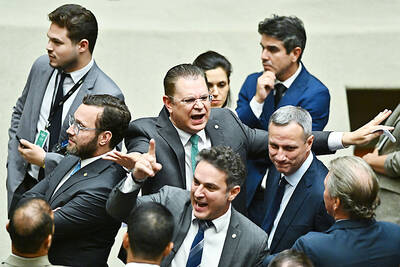
PARLIAMENT CHAOS: Police forcibly removed Brazilian Deputy Glauber Braga after he called the legislation part of a ‘coup offensive’ and occupied the speaker’s chair Brazil’s lower house of Congress early yesterday approved a bill that could slash former Brazilian president Jair Bolsonaro’s prison sentence for plotting a coup, after efforts by a lawmaker to disrupt the proceedings sparked chaos in parliament. Bolsonaro has been serving a 27-year term since last month after his conviction for a scheme to stop Brazilian President Luiz Inacio Lula da Silva from taking office after the 2022 election. Lawmakers had been discussing a bill that would significantly reduce sentences for several crimes, including attempting a coup d’etat — opening up the prospect that Bolsonaro, 70, could have his sentence cut to

A powerful magnitude 7.6 earthquake shook Japan’s northeast region late on Monday, prompting tsunami warnings and orders for residents to evacuate. A tsunami as high as three metres (10 feet) could hit Japan’s northeastern coast after an earthquake with an estimated magnitude of 7.6 occurred offshore at 11:15 p.m. (1415 GMT), the Japan Meteorological Agency (JMA) said. Tsunami warnings were issued for the prefectures of Hokkaido, Aomori and Iwate, and a tsunami of 40cm had been observed at Aomori’s Mutsu Ogawara and Hokkaido’s Urakawa ports before midnight, JMA said. The epicentre of the quake was 80 km (50 miles) off the coast of
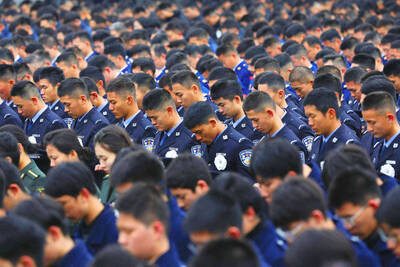
China yesterday held a low-key memorial ceremony for the 1937 Nanjing Massacre, with Chinese President Xi Jinping (習近平) not attending, despite a diplomatic crisis between Beijing and Tokyo over Taiwan. Beijing has raged at Tokyo since Japanese Prime Minister Sanae Takaichi last month said that a hypothetical Chinese attack on Taiwan could trigger a military response from Japan. China and Japan have long sparred over their painful history. China consistently reminds its people of the 1937 Nanjing Massacre, in which it says Japanese troops killed 300,000 people in what was then its capital. A post-World War II Allied tribunal put the death toll

A passerby could hear the cacophony from miles away in the Argentine capital, the unmistakable sound of 2,397 dogs barking — and breaking the unofficial world record for the largest-ever gathering of golden retrievers. Excitement pulsed through Bosques de Palermo, a sprawling park in Buenos Aires, as golden retriever-owners from all over Argentina transformed the park’s grassy expanse into a sea of bright yellow fur. Dog owners of all ages, their clothes covered in dog hair and stained with slobber, plopped down on picnic blankets with their beloved goldens to take in the surreal sight of so many other, exceptionally similar-looking ones.


 RSS
RSS