


Israel received an uncomfortable reminder of international anger over the Gaza war on Tuesday when lawyers representing 16 Palestinians asked a London court to issue an arrest warrant for Israeli Defense Minister Ehud Barak, who is visiting Britain.
After a day of delays and legal wrangling the bid failed on the grounds that Barak enjoyed diplomatic immunity from prosecution. But the episode triggered a brief storm that is likely to give Israeli officials second thoughts about the risk of prosecution in foreign courts.
Barak was addressing a fringe meeting at the Labour party conference in Brighton on Tuesday night and was due to meet British Prime Minister Gordon Brown and Foreign Secretary David Miliband.
Furious Israeli officials insisted all day that he was protected by diplomatic immunity and could not be legally detained.
The action related to alleged war crimes and breaches of the Geneva conventions during the Gaza offensive, launched by Israel last December in response to Palestinian rocket attacks and widely criticized. The death toll is disputed, but the Israeli human rights group B’Tselem says 1,387 Palestinians died, including 773 people not taking part in hostilities.
Lawyers asked a district judge at the City of Westminster magistrates court, London, to issue a warrant for Barak’s arrest under the 1988 Criminal Justice Act, which gives courts in England and Wales universal jurisdiction in war crimes cases.
The hearing was postponed while the court asked the Foreign Office to clarify Barak’s status in the UK. The lawyers making the application said they believed a warrant could be issued even if he was in Britain in an official capacity.
Intensive contacts were understood to have taken place throughout the day between London and Jerusalem. Barak is also deputy prime minister of Israel and leader of the country’s Labour party.
Lawyers from Irvine Thanvi Natas and Imran Khan & Partners said they believed the warrant that the international criminal court issued in May last year for the arrest of Sudanese President Omar al-Bashir offered a precedent. Bashir is accused of committing war crimes in Darfur.
The issue is politically explosive. Israeli Ambassador to Britain Ron Prosor lambasted the move as the “continuation of the process of demonization and the delegitimization of Israel,” and called the action “spiteful.”
Deputy district judge Daphne Wickham said allegations of war crimes had been well documented, but added: “I am satisfied that under customary international law Mr Barak has immunity from prosecution as he would not be able to perform his functions efficiently if he were the subject of criminal proceedings in this jurisdiction.”

Australians were downloading virtual private networks (VPNs) in droves, while one of the world’s largest porn distributors said it was blocking users from its platforms as the country yesterday rolled out sweeping online age restriction. Australia in December became the first country to impose a nationwide ban on teenagers using social media. A separate law now requires artificial intelligence (AI)-powered chatbot services to keep certain content — including pornography, extreme violence and self-harm and eating disorder material — from minors or face fines of up to A$49.5 million (US$34.6 million). The country also joined Britain, France and dozens of US states requiring
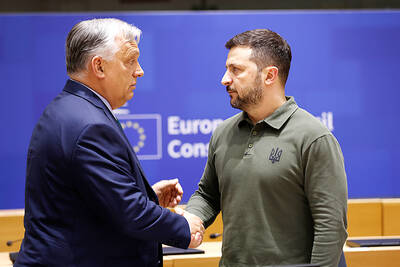
Hungarian authorities temporarily detained seven Ukrainian citizens and seized two armored cars carrying tens of millions of euros in cash across Hungary on suspicion of money laundering, officials said on Friday. The Ukrainians were released on Friday, following their detention on Thursday, but Hungarian officials held onto the cash, prompting Ukraine to accuse Hungary’s Russia-friendly government of illegally seizing the money. “We will not tolerate this state banditism,” Ukrainian Minister of Foreign Affairs Andrii Sybiha said. The seven detained Ukrainians were employees of the Ukrainian state-owned Oschadbank, who were traveling in the two armored cars that were carrying the money between Austria and
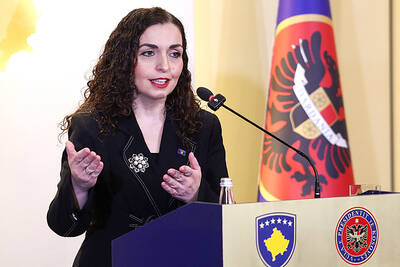
Kosovar President Vjosa Osmani on Friday after dissolving the Kosovar parliament said a snap election should be held as soon as possible to avoid another prolonged political crisis in the Balkan country at a time of global turmoil. Osmani said it is important for Kosovo to wrap up the upcoming election process and form functional institutions for political stability as the war rages in the Middle East. “Precisely because the geopolitical situation is that complex, it is important to finish this electoral process which is coming up,” she said. “It is very hard now to imagine what will happen next.” Kosovo, which declared

MORE BANS: Australia last year required sites to remove accounts held by under-16s, with a few countries pushing for similar action at an EU level and India considering its own ban Indonesia on Friday said it would ban social media access for children under 16, citing threats from online pornography, cyberbullying, online fraud and Internet addiction. “Accounts belonging to children under 16 on high-risk platforms will start to be deactivated, beginning with YouTube, TikTok, Facebook, Instagram, Threads, X, Bigo Live and Roblox,” Indonesian Minister of Communications and Digital Meutya Hafid said. “The government is stepping in so that parents no longer have to fight alone against the giants of the algorithm. Implementation will begin on March 28, 2026,” she said. The social media ban would be introduced in stages “until all platforms fulfill their


 RSS
RSS