


Intelligence activities across the US government and military cost a total of US$75 billion a year, the nation’s top intelligence official disclosed on Tuesday, revealing publicly for the first time an overall number long shrouded in secrecy.
The disclosure by Dennis Blair, US President Barack Obama’s director of national intelligence, put a spotlight on the sharp growth in intelligence spending as well as on the huge and long obscured role of military intelligence programs, which, based on previous disclosures, would account for roughly US$25 billion to US$30 billion of the US$75 billion total.
In comparison, when total intelligence spending was accidentally published in a congressional document in 1994, it totaled about US$26 billion, including US$10 billion for military intelligence programs, said Steven Aftergood, an expert on intelligence spending with the Federation of American Scientists’ Project on Government Secrecy.
Blair cited the US$75 billion figure in releasing a four-year strategic blueprint for the sprawling, 200,000-person intelligence community.
In a conference call with reporters, Blair brushed aside as “no longer relevant” what he called the “traditional fault line” separating military programs from overall intelligence spending.
In an unclassified version of Blair’s blueprint, intelligence agencies singled out as threats Iran’s nuclear program, North Korea’s “erratic behavior,” and insurgencies fueled by militant groups including al-Qaeda.
Blair said the “accumulation of knowledge” about al-Qaeda has made the US intelligence community more effective at preventing attacks.
The intelligence assessment also pointed to growing challenges from China’s military modernization and natural resource-driven diplomacy.
Blair cited Beijing’s “aggressive” push into areas that could threaten US cyber-security.
The US$75 billion figure incorporated spending by the nation’s 16 intelligence agencies, referred to collectively as the national intelligence program, as well as amounts spent by the Pentagon on so-called military intelligence program activities in support of troops in the field in Iraq, Afghanistan and elsewhere, officials said.
Under pressure from Congress and advocacy groups, the US government has taken steps in recent years to open its books on some intelligence spending.
The Bush administration, for example, disclosed the amount spent by the 16 intelligence agencies under the NIP — US$47.5 billion last year alone — but those figures did not incorporate the military intelligence program, officials said.
Aftergood said there was no reason to keep information about those military programs secret.
“Its disclosure does not reveal any sensitive sources, methods or operations,” he said, adding that Blair’s disclosure “suggests that a more rational approach to intelligence secrecy may be around the corner. And it’s about time.”
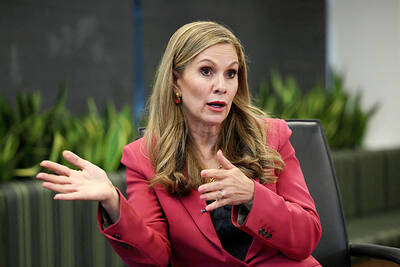
Australians were downloading virtual private networks (VPNs) in droves, while one of the world’s largest porn distributors said it was blocking users from its platforms as the country yesterday rolled out sweeping online age restriction. Australia in December became the first country to impose a nationwide ban on teenagers using social media. A separate law now requires artificial intelligence (AI)-powered chatbot services to keep certain content — including pornography, extreme violence and self-harm and eating disorder material — from minors or face fines of up to A$49.5 million (US$34.6 million). The country also joined Britain, France and dozens of US states requiring
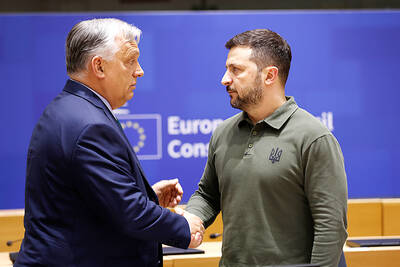
Hungarian authorities temporarily detained seven Ukrainian citizens and seized two armored cars carrying tens of millions of euros in cash across Hungary on suspicion of money laundering, officials said on Friday. The Ukrainians were released on Friday, following their detention on Thursday, but Hungarian officials held onto the cash, prompting Ukraine to accuse Hungary’s Russia-friendly government of illegally seizing the money. “We will not tolerate this state banditism,” Ukrainian Minister of Foreign Affairs Andrii Sybiha said. The seven detained Ukrainians were employees of the Ukrainian state-owned Oschadbank, who were traveling in the two armored cars that were carrying the money between Austria and
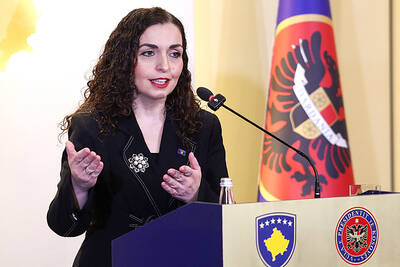
Kosovar President Vjosa Osmani on Friday after dissolving the Kosovar parliament said a snap election should be held as soon as possible to avoid another prolonged political crisis in the Balkan country at a time of global turmoil. Osmani said it is important for Kosovo to wrap up the upcoming election process and form functional institutions for political stability as the war rages in the Middle East. “Precisely because the geopolitical situation is that complex, it is important to finish this electoral process which is coming up,” she said. “It is very hard now to imagine what will happen next.” Kosovo, which declared

MORE BANS: Australia last year required sites to remove accounts held by under-16s, with a few countries pushing for similar action at an EU level and India considering its own ban Indonesia on Friday said it would ban social media access for children under 16, citing threats from online pornography, cyberbullying, online fraud and Internet addiction. “Accounts belonging to children under 16 on high-risk platforms will start to be deactivated, beginning with YouTube, TikTok, Facebook, Instagram, Threads, X, Bigo Live and Roblox,” Indonesian Minister of Communications and Digital Meutya Hafid said. “The government is stepping in so that parents no longer have to fight alone against the giants of the algorithm. Implementation will begin on March 28, 2026,” she said. The social media ban would be introduced in stages “until all platforms fulfill their


 RSS
RSS