


A prominent Iranian conservative respected by supporters of the country’s Islamic regime issued a blistering condemnation of the ruling establishment and its supreme leader on Monday, adding an unexpected voice to a growing chorus of criticism over the bloody aftermath of Iran’s disputed election.
The apparent change of heart on the part of Mohammad Nourizad, a filmmaker and activist praised until recently by hardliners, was a surprising sign that the lethal force used by the government against pro-reform protesters has infuriated even some of the government’s supporters and turned them into critics.
His letter, published on several Web sites, was exceptional for its harsh language and for taking the risky step of explicitly targeting Supreme Leader Ayatollah Ali Khamenei.
“As commander in chief of the armed forces, you didn’t treat people well after the election. Your agents opened fire, killed the people, beat them and destroyed and burnt their property. Your role in this can’t be ignored,” the letter reads. “Your apology can cool down the wrath of the people.”
If once he saw Khamenei as a political savior, Nourizad wrote, he now sees that Iran lags behind its neighbors and shows no sign of allowing freedom of speech.
“As the country’s most powerful figure, not a single time have you admitted a fault,” he writes.
Nourizad called on Khamenei to apologize for ordering the crackdown against protesters who took to the streets in June after an election returned President Mahmoud Ahmadinejad to power. The pro-reform camp says the government faked the election and denied victory to the rightful winner, pro-reform candidate Mir Hossein Mousavi.
The opposition says at least 72 protesters were killed in the violence that followed the election, while government officials maintain that only 36 died in the unrest. Thousands were arrested.
On Monday, reformer Mahdi Karroubi, who also ran in the presidential election, refused to retract charges that protesters were tortured and raped, even though a government panel exonerated the regime and recommended that Karroubi himself be charged for making the allegations.
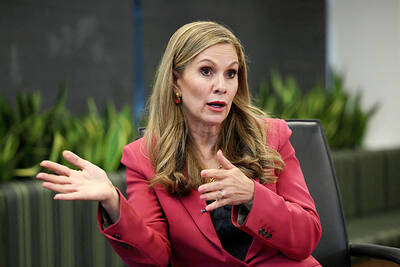
Australians were downloading virtual private networks (VPNs) in droves, while one of the world’s largest porn distributors said it was blocking users from its platforms as the country yesterday rolled out sweeping online age restriction. Australia in December became the first country to impose a nationwide ban on teenagers using social media. A separate law now requires artificial intelligence (AI)-powered chatbot services to keep certain content — including pornography, extreme violence and self-harm and eating disorder material — from minors or face fines of up to A$49.5 million (US$34.6 million). The country also joined Britain, France and dozens of US states requiring
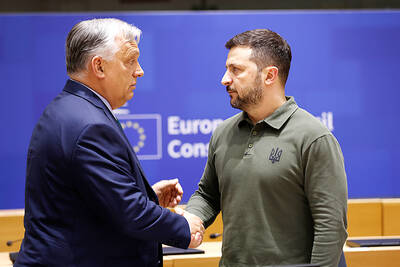
Hungarian authorities temporarily detained seven Ukrainian citizens and seized two armored cars carrying tens of millions of euros in cash across Hungary on suspicion of money laundering, officials said on Friday. The Ukrainians were released on Friday, following their detention on Thursday, but Hungarian officials held onto the cash, prompting Ukraine to accuse Hungary’s Russia-friendly government of illegally seizing the money. “We will not tolerate this state banditism,” Ukrainian Minister of Foreign Affairs Andrii Sybiha said. The seven detained Ukrainians were employees of the Ukrainian state-owned Oschadbank, who were traveling in the two armored cars that were carrying the money between Austria and
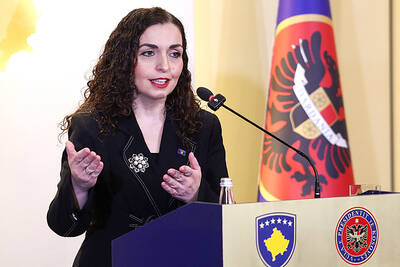
Kosovar President Vjosa Osmani on Friday after dissolving the Kosovar parliament said a snap election should be held as soon as possible to avoid another prolonged political crisis in the Balkan country at a time of global turmoil. Osmani said it is important for Kosovo to wrap up the upcoming election process and form functional institutions for political stability as the war rages in the Middle East. “Precisely because the geopolitical situation is that complex, it is important to finish this electoral process which is coming up,” she said. “It is very hard now to imagine what will happen next.” Kosovo, which declared

MORE BANS: Australia last year required sites to remove accounts held by under-16s, with a few countries pushing for similar action at an EU level and India considering its own ban Indonesia on Friday said it would ban social media access for children under 16, citing threats from online pornography, cyberbullying, online fraud and Internet addiction. “Accounts belonging to children under 16 on high-risk platforms will start to be deactivated, beginning with YouTube, TikTok, Facebook, Instagram, Threads, X, Bigo Live and Roblox,” Indonesian Minister of Communications and Digital Meutya Hafid said. “The government is stepping in so that parents no longer have to fight alone against the giants of the algorithm. Implementation will begin on March 28, 2026,” she said. The social media ban would be introduced in stages “until all platforms fulfill their


 RSS
RSS